
尼日利亚西南部临床感染和无症状携带者中金黄色葡萄球菌分离株的分子特征及药敏性
Molecular Characterization and Antimicrobial Susceptibility of Staphylococcus aureus Isolates from Clinical Infection and Asymptomatic Carriers in Southwest Nigeria.
作者信息
Ayepola Olayemi O, Olasupo Nurudeen A, Egwari Louis O, Becker Karsten, Schaumburg Frieder
机构信息
Department of Biological Sciences, Covenant University, Ota, Ogun State, Nigeria.
Department of Microbiology, Lagos State University, Ojo, Lagos State, Nigeria.
出版信息
PLoS One. 2015 Sep 8;10(9):e0137531. doi: 10.1371/journal.pone.0137531. eCollection 2015.
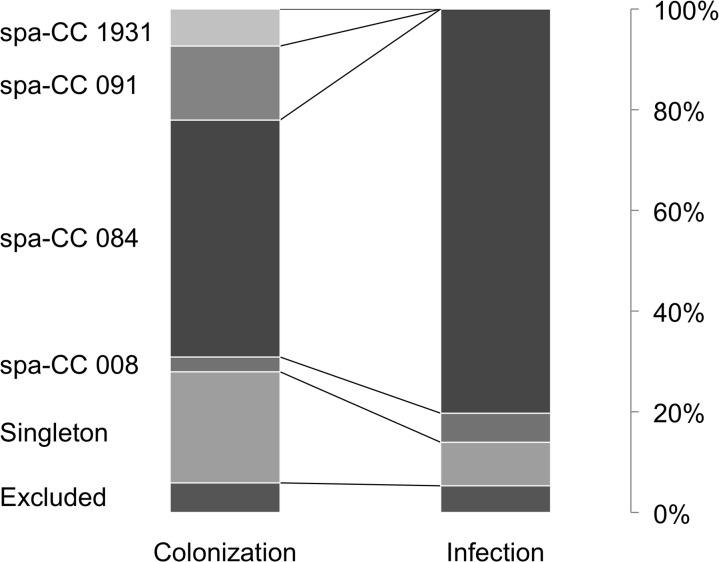
Few reports from Africa suggest that resistance pattern, virulence factors and genotypes differ between Staphylococcus aureus from nasal carriage and clinical infection. We therefore compared antimicrobial resistance, selected virulence factors and genotypes of S. aureus from nasal carriage and clinical infection in Southwest Nigeria. Non-duplicate S. aureus isolates were obtained from infection (n = 217) and asymptomatic carriers (n = 73) during a cross sectional study in Lagos and Ogun States, Nigeria from 2010-2011. Susceptibility testing was performed using Vitek automated systems. Selected virulence factors were detected by PCR. The population structure was assessed using spa typing. The spa clonal complexes (spa-CC) were deduced using the Based Upon Repeat Pattern algorithm (BURP). Resistance was higher for aminoglycosides in clinical isolates while resistances to quinolones and tetracycline were more prevalent in carrier isolates. The Panton-Valentine leukocidin (PVL) was more frequently detected in isolates from infection compared to carriage (80.2 vs 53.4%; p<0.001, chi2-test). Seven methicillin resistant S. aureus isolates were associated with spa types t002, t008, t064, t194, t8439, t8440 and t8441. The predominant spa types among the methicillin-susceptible S. aureus isolates were t084 (65.5%), t2304 (4.4%) and t8435 (4.1%). spa-CC 084 was predominant among isolates from infection (80.3%, n = 167) and was significantly associated with PVL (OR = 7.1, 95%CI: 3.9-13.2, p<0.001, chi2-test). In conclusion, PVL positive isolates were more frequently detected among isolates from infection compared to carriage and are associated with spa-CC 084.
非洲的少数报告表明,鼻腔携带的金黄色葡萄球菌与临床感染菌株在耐药模式、毒力因子和基因型方面存在差异。因此,我们比较了尼日利亚西南部鼻腔携带和临床感染的金黄色葡萄球菌的抗菌药物耐药性、选定的毒力因子和基因型。在2010 - 2011年于尼日利亚拉各斯州和奥贡州进行的一项横断面研究中,从感染患者(n = 217)和无症状携带者(n = 73)中获取了非重复的金黄色葡萄球菌分离株。使用Vitek自动化系统进行药敏试验。通过PCR检测选定的毒力因子。使用spa分型评估群体结构。使用基于重复模式算法(BURP)推导spa克隆复合体(spa-CC)。临床分离株中氨基糖苷类药物的耐药性较高,而喹诺酮类和四环素类药物的耐药性在携带者分离株中更为普遍。与携带菌株相比,感染菌株中更频繁地检测到杀白细胞素(PVL)(80.2% 对53.4%;p<0.001,卡方检验)。七株耐甲氧西林金黄色葡萄球菌分离株与spa型t002、t008、t064、t194、t8439、t8440和t8441相关。甲氧西林敏感金黄色葡萄球菌分离株中主要的spa型为t084(65.5%)、t2304(4.4%)和t8435(4.1%)。spa-CC 084在感染分离株中占主导地位(80.3%,n = 167),并且与PVL显著相关(OR = 7.1,95%CI:3.9 - 13.2,p<0.001,卡方检验)。总之,与携带菌株相比,感染菌株中更频繁地检测到PVL阳性分离株,并且它们与spa-CC 084相关。
 Zotero 插件