
在7T场强下,通过具有对称频率扫描的双反转恢复进行脂质抑制,以实现稳健的二维GRAPPA加速脑磁共振波谱成像。
Lipid suppression via double inversion recovery with symmetric frequency sweep for robust 2D-GRAPPA-accelerated MRSI of the brain at 7 T.
作者信息
Hangel Gilbert, Strasser Bernhard, Považan Michal, Gruber Stephan, Chmelík Marek, Gajdošík Martin, Trattnig Siegfried, Bogner Wolfgang
机构信息
MR Centre of Excellence (MRCE), Department of Biomedical Imaging and Image-guided Therapy, Medical University of Vienna, Vienna, Austria.
Christian Doppler Laboratory for Clinical Molecular MR Imaging, Medical University of Vienna, Vienna, Austria.
出版信息
NMR Biomed. 2015 Nov;28(11):1413-25. doi: 10.1002/nbm.3386. Epub 2015 Sep 15.
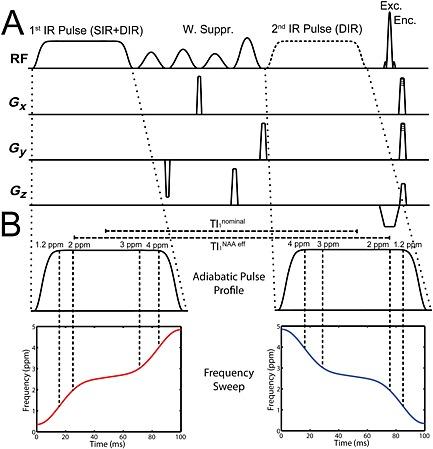
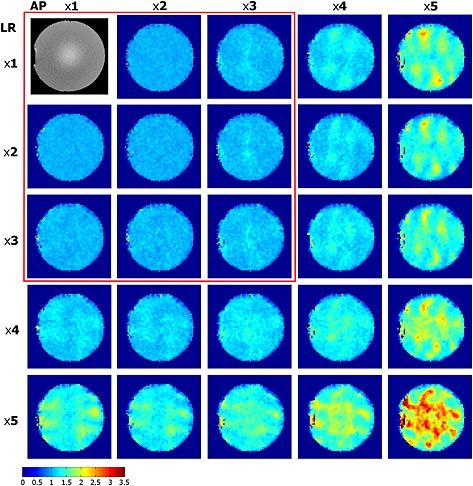
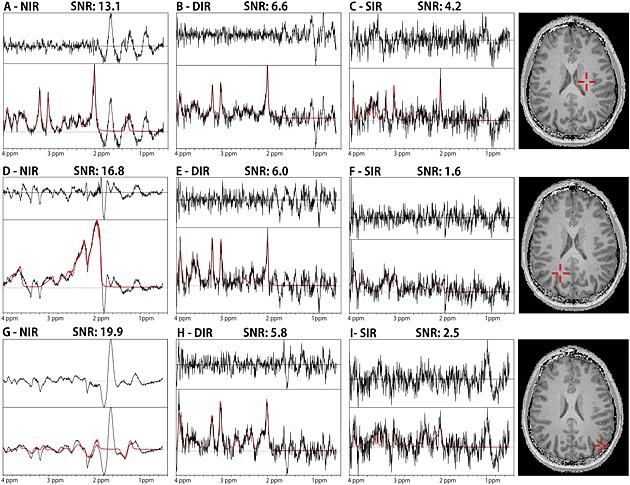
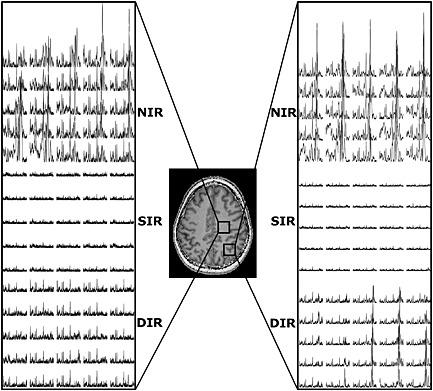
This work presents a new approach for high-resolution MRSI of the brain at 7 T in clinically feasible measurement times. Two major problems of MRSI are the long scan times for large matrix sizes and the possible spectral contamination by the transcranial lipid signal. We propose a combination of free induction decay (FID)-MRSI with a short acquisition delay and acceleration via in-plane two-dimensional generalised autocalibrating partially parallel acquisition (2D-GRAPPA) with adiabatic double inversion recovery (IR)-based lipid suppression to allow robust high-resolution MRSI. We performed Bloch simulations to evaluate the magnetisation pathways of lipids and metabolites, and compared the results with phantom measurements. Acceleration factors in the range 2-25 were tested in a phantom. Five volunteers were scanned to verify the value of our MRSI method in vivo. GRAPPA artefacts that cause fold-in of transcranial lipids were suppressed via double IR, with a non-selective symmetric frequency sweep. The use of long, low-power inversion pulses (100 ms) reduced specific absorption rate requirements. The symmetric frequency sweep over both pulses provided good lipid suppression (>90%), in addition to a reduced loss in metabolite signal-to-noise ratio (SNR), compared with conventional IR suppression (52-70%). The metabolic mapping over the whole brain slice was not limited to a rectangular region of interest. 2D-GRAPPA provided acceleration up to a factor of nine for in vivo FID-MRSI without a substantial increase in g-factors (<1.1). A 64 × 64 matrix can be acquired with a common repetition time of ~1.3 s in only 8 min without lipid artefacts caused by acceleration. Overall, we present a fast and robust MRSI method, using combined double IR fat suppression and 2D-GRAPPA acceleration, which may be used in (pre)clinical studies of the brain at 7 T.
这项工作提出了一种在临床可行的测量时间内,于7T磁场下对大脑进行高分辨率磁共振波谱成像(MRSI)的新方法。MRSI的两个主要问题是大矩阵尺寸扫描时间长以及经颅脂质信号可能造成的频谱污染。我们提出将自由感应衰减(FID)-MRSI与短采集延迟相结合,并通过平面内二维广义自校准部分并行采集(2D-GRAPPA)以及基于绝热双反转恢复(IR)的脂质抑制进行加速,以实现可靠的高分辨率MRSI。我们进行了布洛赫模拟,以评估脂质和代谢物的磁化路径,并将结果与模型测量进行比较。在模型中测试了2至25范围内的加速因子。对五名志愿者进行了扫描,以验证我们的MRSI方法在体内的价值。通过双IR和非选择性对称频率扫描抑制了导致经颅脂质折叠的GRAPPA伪影。使用长的低功率反转脉冲(100毫秒)降低了比吸收率要求。与传统的IR抑制(52-70%)相比,两个脉冲上的对称频率扫描除了降低代谢物信噪比(SNR)损失外,还提供了良好的脂质抑制(>90%)。整个脑切片的代谢图谱不限于矩形感兴趣区域。2D-GRAPPA为体内FID-MRSI提供了高达9倍的加速,而g因子没有大幅增加(<1.1)。在仅8分钟内,以约1.3秒的常见重复时间即可采集64×64矩阵,且不会因加速产生脂质伪影。总体而言,我们提出了一种快速且可靠的MRSI方法,使用双IR脂肪抑制和2D-GRAPPA加速相结合,可用于7T磁场下大脑的(预)临床研究。



 Zotero 插件