
1990 - 2013年英格兰地区的健康变化,按英格兰地区和贫困程度分析:《2013年全球疾病负担研究》的系统分析
Changes in health in England, with analysis by English regions and areas of deprivation, 1990-2013: a systematic analysis for the Global Burden of Disease Study 2013.
作者信息
Newton John N, Briggs Adam D M, Murray Christopher J L, Dicker Daniel, Foreman Kyle J, Wang Haidong, Naghavi Mohsen, Forouzanfar Mohammad H, Ohno Summer Lockett, Barber Ryan M, Vos Theo, Stanaway Jeffrey D, Schmidt Jürgen C, Hughes Andrew J, Fay Derek F J, Ecob Russell, Gresser Charis, McKee Martin, Rutter Harry, Abubakar Ibrahim, Ali Raghib, Anderson H Ross, Banerjee Amitava, Bennett Derrick A, Bernabé Eduardo, Bhui Kamaldeep S, Biryukov Stanley M, Bourne Rupert R, Brayne Carol E G, Bruce Nigel G, Brugha Traolach S, Burch Michael, Capewell Simon, Casey Daniel, Chowdhury Rajiv, Coates Matthew M, Cooper Cyrus, Critchley Julia A, Dargan Paul I, Dherani Mukesh K, Elliott Paul, Ezzati Majid, Fenton Kevin A, Fraser Maya S, Fürst Thomas, Greaves Felix, Green Mark A, Gunnell David J, Hannigan Bernadette M, Hay Roderick J, Hay Simon I, Hemingway Harry, Larson Heidi J, Looker Katharine J, Lunevicius Raimundas, Lyons Ronan A, Marcenes Wagner, Mason-Jones Amanda J, Matthews Fiona E, Moller Henrik, Murdoch Michele E, Newton Charles R, Pearce Neil, Piel Frédéric B, Pope Daniel, Rahimi Kazem, Rodriguez Alina, Scarborough Peter, Schumacher Austin E, Shiue Ivy, Smeeth Liam, Tedstone Alison, Valabhji Jonathan, Williams Hywel C, Wolfe Charles D A, Woolf Anthony D, Davis Adrian C J
机构信息
Public Health England, London, UK; University of Manchester, Manchester, UK.
University of Oxford, Oxford, UK.
出版信息
Lancet. 2015 Dec 5;386(10010):2257-74. doi: 10.1016/S0140-6736(15)00195-6. Epub 2015 Sep 14.
BACKGROUND
In the Global Burden of Disease Study 2013 (GBD 2013), knowledge about health and its determinants has been integrated into a comparable framework to inform health policy. Outputs of this analysis are relevant to current policy questions in England and elsewhere, particularly on health inequalities. We use GBD 2013 data on mortality and causes of death, and disease and injury incidence and prevalence to analyse the burden of disease and injury in England as a whole, in English regions, and within each English region by deprivation quintile. We also assess disease and injury burden in England attributable to potentially preventable risk factors. England and the English regions are compared with the remaining constituent countries of the UK and with comparable countries in the European Union (EU) and beyond.
METHODS
We extracted data from the GBD 2013 to compare mortality, causes of death, years of life lost (YLLs), years lived with a disability (YLDs), and disability-adjusted life-years (DALYs) in England, the UK, and 18 other countries (the first 15 EU members [apart from the UK] and Australia, Canada, Norway, and the USA [EU15+]). We extended elements of the analysis to English regions, and subregional areas defined by deprivation quintile (deprivation areas). We used data split by the nine English regions (corresponding to the European boundaries of the Nomenclature for Territorial Statistics level 1 [NUTS 1] regions), and by quintile groups within each English region according to deprivation, thereby making 45 regional deprivation areas. Deprivation quintiles were defined by area of residence ranked at national level by Index of Multiple Deprivation score, 2010. Burden due to various risk factors is described for England using new GBD methodology to estimate independent and overlapping attributable risk for five tiers of behavioural, metabolic, and environmental risk factors. We present results for 306 causes and 2337 sequelae, and 79 risks or risk clusters.
FINDINGS
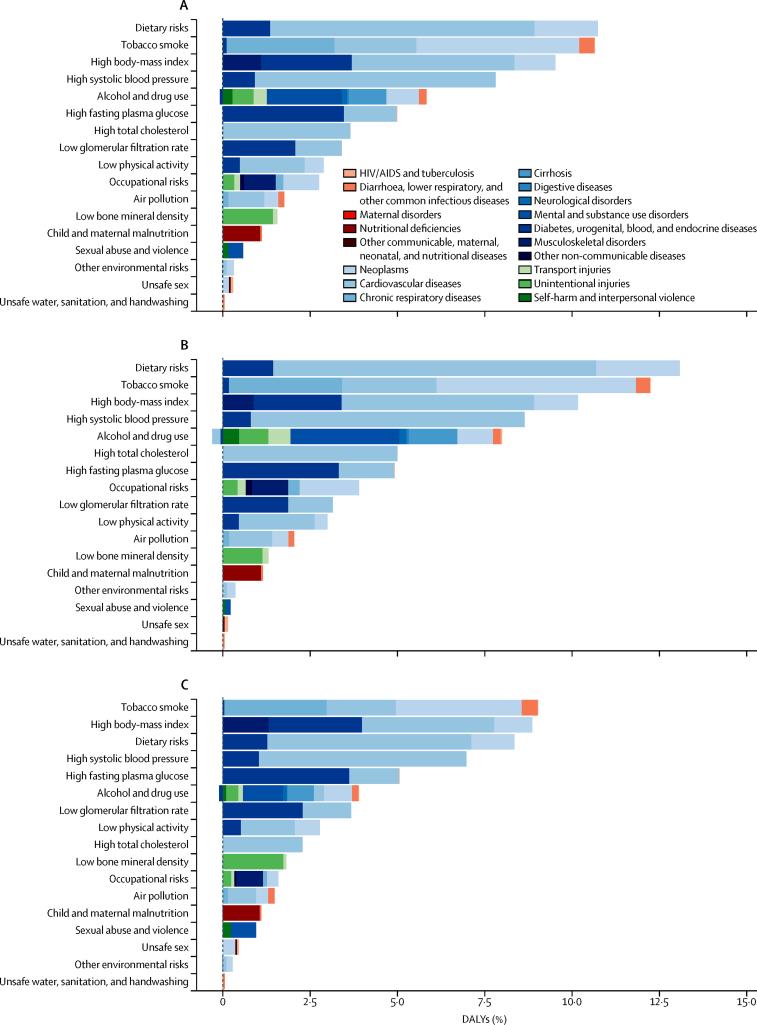
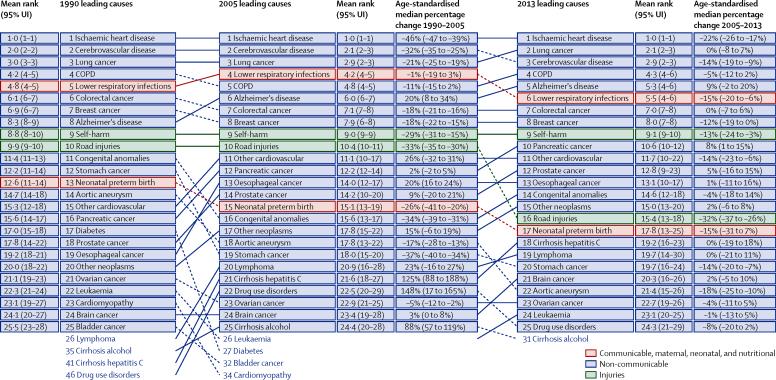
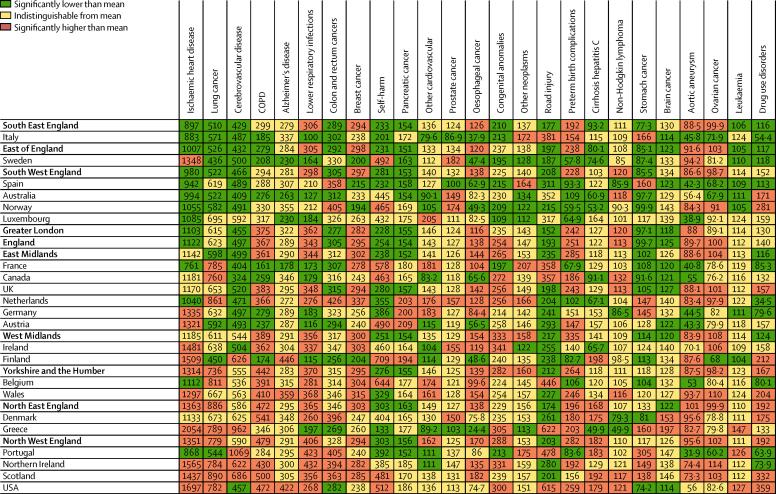
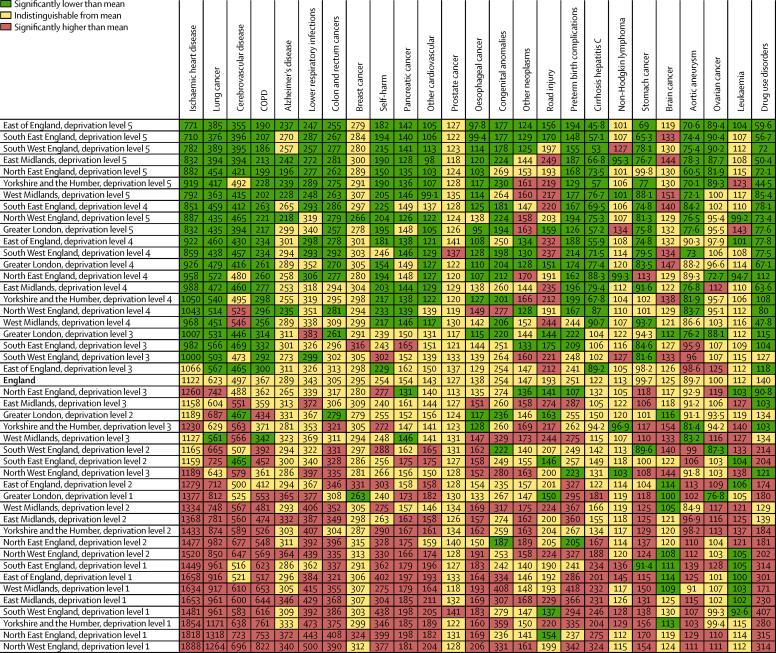
Between 1990 and 2013, life expectancy from birth in England increased by 5·4 years (95% uncertainty interval 5·0-5·8) from 75·9 years (75·9-76·0) to 81·3 years (80·9-81·7); gains were greater for men than for women. Rates of age-standardised YLLs reduced by 41·1% (38·3-43·6), whereas DALYs were reduced by 23·8% (20·9-27·1), and YLDs by 1·4% (0·1-2·8). For these measures, England ranked better than the UK and the EU15+ means. Between 1990 and 2013, the range in life expectancy among 45 regional deprivation areas remained 8·2 years for men and decreased from 7·2 years in 1990 to 6·9 years in 2013 for women. In 2013, the leading cause of YLLs was ischaemic heart disease, and the leading cause of DALYs was low back and neck pain. Known risk factors accounted for 39·6% (37·7-41·7) of DALYs; leading behavioural risk factors were suboptimal diet (10·8% [9·1-12·7]) and tobacco (10·7% [9·4-12·0]).
INTERPRETATION
Health in England is improving although substantial opportunities exist for further reductions in the burden of preventable disease. The gap in mortality rates between men and women has reduced, but marked health inequalities between the least deprived and most deprived areas remain. Declines in mortality have not been matched by similar declines in morbidity, resulting in people living longer with diseases. Health policies must therefore address the causes of ill health as well as those of premature mortality. Systematic action locally and nationally is needed to reduce risk exposures, support healthy behaviours, alleviate the severity of chronic disabling disorders, and mitigate the effects of socioeconomic deprivation.
FUNDING
Bill & Melinda Gates Foundation and Public Health England.
背景
在《2013年全球疾病负担研究》(GBD 2013)中,关于健康及其决定因素的知识已被整合到一个可比较的框架中,以为卫生政策提供信息。该分析的结果与英国及其他地区当前的政策问题相关,特别是关于健康不平等的问题。我们使用GBD 2013中关于死亡率和死亡原因以及疾病和损伤发病率及患病率的数据,来分析整个英格兰、英格兰各地区以及英格兰每个地区内按贫困五分位数划分的疾病和损伤负担。我们还评估了英格兰可归因于潜在可预防风险因素的疾病和损伤负担。将英格兰和英格兰各地区与英国的其他组成国家以及欧盟(EU)及其他地区的可比国家进行比较。
方法
我们从GBD 2013中提取数据,以比较英格兰、英国和其他18个国家(欧盟最初的15个成员国[不包括英国]以及澳大利亚、加拿大、挪威和美国[EU15 +])的死亡率、死亡原因、寿命损失年数(YLLs)、带病生存年数(YLDs)和伤残调整生命年(DALYs)。我们将分析范围扩展到英格兰各地区以及按贫困五分位数定义的次区域(贫困地区)。我们使用按九个英格兰地区(对应于《地域统计命名法》第1级[NUTS 1]地区的欧洲边界)以及每个英格兰地区内按贫困程度划分的五分位数组划分的数据,从而形成45个区域贫困地区。贫困五分位数由根据2010年多重贫困指数得分在国家层面排名的居住地区定义。使用新的GBD方法描述英格兰因各种风险因素导致的负担,以估计行为、代谢和环境风险因素五个层级的独立和重叠归因风险。我们展示了306种病因和2337种后遗症以及79种风险或风险集群的结果。
结果
1990年至2013年间,英格兰出生时的预期寿命从75.9岁(75.9 - 76.0)增加了5.4岁(95%不确定区间5.0 - 5.8),达到81.3岁(80.9 - 81.7);男性的增幅大于女性。年龄标准化的YLLs率下降了41.1%(38.3 - 43.6),而DALYs下降了23.8%(20.9 - 27.1),YLDs下降了1.4%(0.1 - 2.8)。在这些指标方面,英格兰的排名优于英国和EU15 +的平均水平。1990年至2013年间,45个区域贫困地区男性的预期寿命差距保持在8.2岁,女性的预期寿命差距从1990年的7.2岁降至2013年的6.9岁。2013年,YLLs的主要原因是缺血性心脏病,DALYs的主要原因是腰背痛。已知风险因素占DALYs的39.6%(37.7 - 41.7);主要行为风险因素是饮食不合理(10.8%[9.1 - 12.7])和烟草(10.7%[9.4 - 12.0])。
解读
英格兰的健康状况正在改善,尽管在进一步减轻可预防疾病负担方面仍有很大空间。男性和女性之间的死亡率差距已经缩小,但最贫困和最不贫困地区之间仍存在明显的健康不平等。死亡率的下降并未伴随着发病率的类似下降,导致人们带病生存的时间更长。因此,卫生政策必须同时解决健康不佳的原因以及过早死亡的原因。需要在地方和国家层面采取系统性行动,以减少风险暴露、支持健康行为、减轻慢性致残性疾病的严重程度,并减轻社会经济剥夺的影响。
资金来源
比尔及梅琳达·盖茨基金会和英国公共卫生部。


 Zotero 插件