
1990-2016 年英国和 150 个英格兰地方行政区的健康变化:2016 年全球疾病负担研究的系统分析。
Changes in health in the countries of the UK and 150 English Local Authority areas 1990-2016: a systematic analysis for the Global Burden of Disease Study 2016.
机构信息
University of East Anglia, Norwich, UK.
University of East Anglia, Norwich, UK.
出版信息
Lancet. 2018 Nov 3;392(10158):1647-1661. doi: 10.1016/S0140-6736(18)32207-4. Epub 2018 Oct 24.
BACKGROUND
Previous studies have reported national and regional Global Burden of Disease (GBD) estimates for the UK. Because of substantial variation in health within the UK, action to improve it requires comparable estimates of disease burden and risks at country and local levels. The slowdown in the rate of improvement in life expectancy requires further investigation. We use GBD 2016 data on mortality, causes of death, and disability to analyse the burden of disease in the countries of the UK and within local authorities in England by deprivation quintile.
METHODS
We extracted data from the GBD 2016 to estimate years of life lost (YLLs), years lived with disability (YLDs), disability-adjusted life-years (DALYs), and attributable risks from 1990 to 2016 for England, Scotland, Wales, Northern Ireland, the UK, and 150 English Upper-Tier Local Authorities. We estimated the burden of disease by cause of death, condition, year, and sex. We analysed the association between burden of disease and socioeconomic deprivation using the Index of Multiple Deprivation. We present results for all 264 GBD causes of death combined and the leading 20 specific causes, and all 84 GBD risks or risk clusters combined and 17 specific risks or risk clusters.
FINDINGS
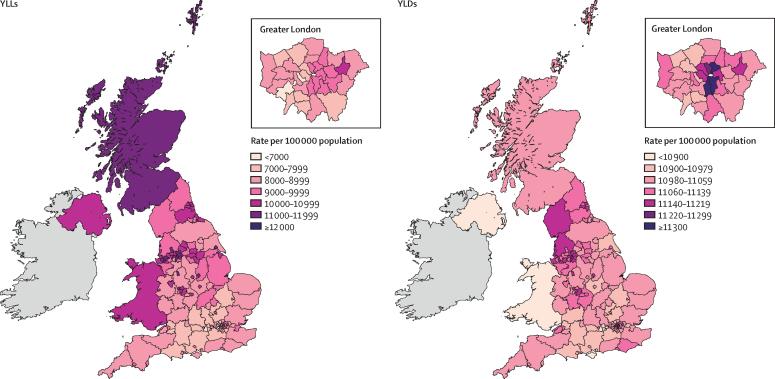
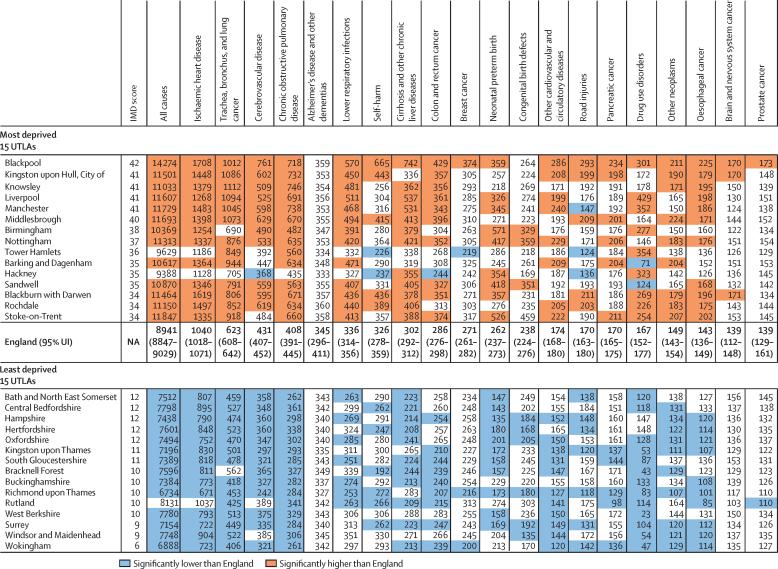
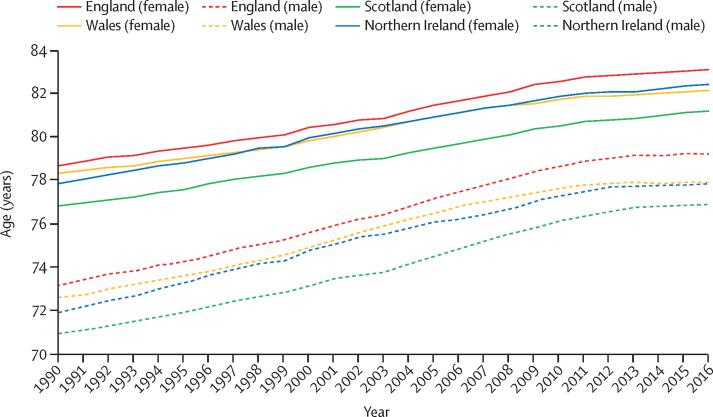
The leading causes of age-adjusted YLLs in all UK countries in 2016 were ischaemic heart disease, lung cancers, cerebrovascular disease, and chronic obstructive pulmonary disease. Age-standardised rates of YLLs for all causes varied by two times between local areas in England according to levels of socioeconomic deprivation (from 14 274 per 100 000 population [95% uncertainty interval 12 791-15 875] in Blackpool to 6888 [6145-7739] in Wokingham). Some Upper-Tier Local Authorities, particularly those in London, did better than expected for their level of deprivation. Allowing for differences in age structure, more deprived Upper-Tier Local Authorities had higher attributable YLLs for most major risk factors in the GBD. The population attributable fractions for all-cause YLLs for individual major risk factors varied across Upper-Tier Local Authorities. Life expectancy and YLLs have improved more slowly since 2010 in all UK countries compared with 1990-2010. In nine of 150 Upper-Tier Local Authorities, YLLs increased after 2010. For attributable YLLs, the rate of improvement slowed most substantially for cardiovascular disease and breast, colorectal, and lung cancers, and showed little change for Alzheimer's disease and other dementias. Morbidity makes an increasing contribution to overall burden in the UK compared with mortality. The age-standardised UK DALY rate for low back and neck pain (1795 [1258-2356]) was higher than for ischaemic heart disease (1200 [1155-1246]) or lung cancer (660 [642-679]). The leading causes of ill health (measured through YLDs) in the UK in 2016 were low back and neck pain, skin and subcutaneous diseases, migraine, depressive disorders, and sense organ disease. Age-standardised YLD rates varied much less than equivalent YLL rates across the UK, which reflects the relative scarcity of local data on causes of ill health.
INTERPRETATION
These estimates at local, regional, and national level will allow policy makers to match resources and priorities to levels of burden and risk factors. Improvement in YLLs and life expectancy slowed notably after 2010, particularly in cardiovascular disease and cancer, and targeted actions are needed if the rate of improvement is to recover. A targeted policy response is also required to address the increasing proportion of burden due to morbidity, such as musculoskeletal problems and depression. Improving the quality and completeness of available data on these causes is an essential component of this response.
FUNDING
Bill & Melinda Gates Foundation and Public Health England.
背景
先前的研究已经报告了英国的全球疾病负担(GBD)国家和地区估计值。由于英国内部健康状况存在显著差异,因此需要在国家和地方层面上对疾病负担和风险进行可比的估计,以采取行动加以改善。而目前,生命预期延长的速度已经明显放缓,这需要进一步调查。我们使用 GBD 2016 年关于死亡率、死因和残疾的数据,通过英国各地区的贫困五分位数,分析英国各地区和英格兰地方当局的疾病负担。
方法
我们从 GBD 2016 年的数据中提取数据,以估计英格兰、苏格兰、威尔士、北爱尔兰、英国和 150 个英国上层地方当局 1990 年至 2016 年期间的生命损失年(YLLs)、残疾生活年(YLDs)、残疾调整生命年(DALYs)和归因风险。我们按死因、病种、年份和性别估计疾病负担。我们使用多因素剥夺指数分析疾病负担与社会经济剥夺之间的关系。我们报告了所有 264 个 GBD 死因和前 20 个特定死因的综合结果,以及所有 84 个 GBD 风险或风险群集和 17 个特定风险或风险群集的综合结果。
结果
2016 年,英国所有国家的年龄调整 YLL 主要原因是缺血性心脏病、肺癌、脑血管病和慢性阻塞性肺疾病。根据社会经济剥夺程度,英格兰各地区的全因 YLL 标准化率相差两倍(从布莱克浦的 14274 人/10 万人(95%不确定区间为 12791-15875)到沃金厄姆的 6888 人/10 万人(6145-7739))。一些上层地方当局,特别是伦敦的地方当局,在其所处的贫困水平下表现优于预期。考虑到年龄结构的差异,在 GBD 中,较贫困的上层地方当局的归因 YLL 对于大多数主要风险因素更高。各主要风险因素的全因 YLL 人群归因分数因上层地方当局而异。自 2010 年以来,与 1990-2010 年相比,英国所有国家的生命预期和 YLL 延长速度明显放缓。在 150 个上层地方当局中,有 9 个地区的 YLL 在 2010 年后增加。对于归因 YLL 来说,心血管疾病和乳腺癌、结直肠癌和肺癌的改善速度明显放缓,而阿尔茨海默病和其他痴呆症的变化很小。与死亡率相比,英国的疾病负担中,发病率的贡献越来越大。英国的低腰痛和颈痛(1795 [1258-2356])年龄标准化 DALY 率高于缺血性心脏病(1200 [1155-1246])或肺癌(660 [642-679])。2016 年,英国健康不良的主要原因(通过 YLD 衡量)是腰痛和颈痛、皮肤和皮下疾病、偏头痛、抑郁障碍和感觉器官疾病。英国各地区的 YLD 标准化率变化比等效 YLL 率小得多,这反映了当地关于健康不良原因的相对缺乏数据。
解释
这些在地方、地区和国家层面的估计值将使决策者能够根据负担和风险因素的水平匹配资源和优先事项。2010 年后,YLL 和生命预期的改善明显放缓,尤其是在心血管疾病和癌症方面,如果要恢复改善速度,就需要采取有针对性的行动。还需要采取有针对性的政策应对措施来解决因肌肉骨骼问题和抑郁等疾病导致的负担比例不断增加的问题。改善这些原因的现有数据的质量和完整性是这一应对措施的重要组成部分。
资助
比尔及梅琳达·盖茨基金会和英国公共卫生署。




 Zotero 插件