
WNK4独特的氯离子感知特性使远端肾单位能够调节钾稳态。
Unique chloride-sensing properties of WNK4 permit the distal nephron to modulate potassium homeostasis.
作者信息
Terker Andrew S, Zhang Chong, Erspamer Kayla J, Gamba Gerardo, Yang Chao-Ling, Ellison David H
机构信息
Division of Nephrology & Hypertension, Department of Medicine, Oregon Health & Science University, Portland, Oregon, USA.
Department of Nephrology, Xinhua Hospital, School of Medicine, Shanghai Jiao Tong University, Shanghai, China.
出版信息
Kidney Int. 2016 Jan;89(1):127-34. doi: 10.1038/ki.2015.289. Epub 2016 Jan 4.
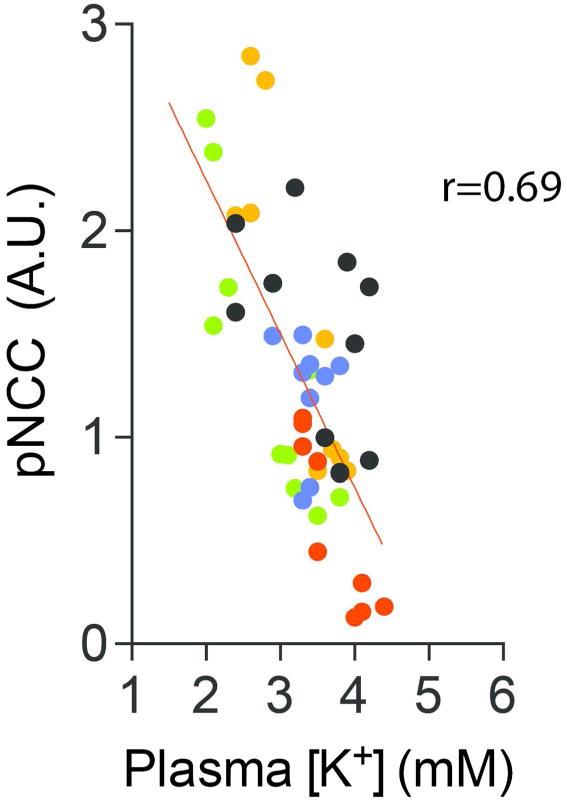
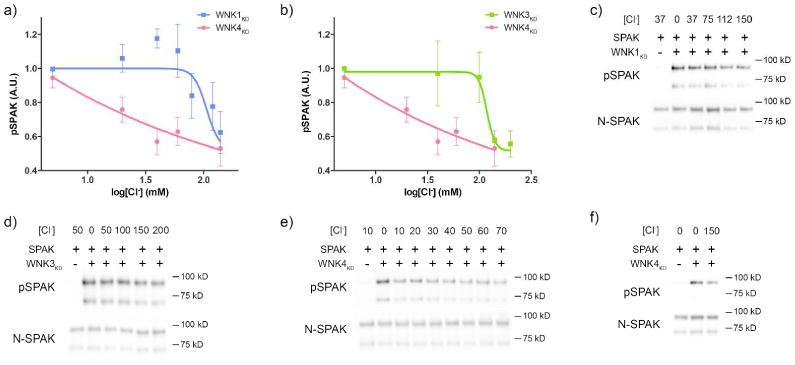
Dietary potassium deficiency activates thiazide-sensitive sodium chloride cotransport along the distal nephron. This may explain, in part, the hypertension and cardiovascular mortality observed in individuals who consume a low-potassium diet. Recent data suggest that plasma potassium affects the distal nephron directly by influencing intracellular chloride, an inhibitor of the with-no-lysine kinase (WNK)-Ste20p-related proline- and alanine-rich kinase (SPAK) pathway. As previous studies used extreme dietary manipulations, we sought to determine whether the relationship between potassium and NaCl cotransporter (NCC) is physiologically relevant and clarify the mechanisms involved. We report that modest changes in both dietary and plasma potassium affect NCC in vivo. Kinase assay studies showed that chloride inhibits WNK4 kinase activity at lower concentrations than it inhibits activity of WNK1 or WNK3. Also, chloride inhibited WNK4 within the range of distal cell chloride concentration. Mutation of a previously identified WNK chloride-binding motif converted WNK4 effects on SPAK from inhibitory to stimulatory in mammalian cells. Disruption of this motif in WNKs 1, 3, and 4 had different effects on NCC, consistent with the three WNKs having different chloride sensitivities. Thus, potassium effects on NCC are graded within the physiological range, which explains how unique chloride-sensing properties of WNK4 enable it to mediate effects of potassium on NCC in vivo.
饮食中钾缺乏会激活远曲小管上对噻嗪类敏感的氯化钠协同转运体。这可能部分解释了在低钾饮食个体中观察到的高血压和心血管疾病死亡率。最近的数据表明,血浆钾通过影响细胞内氯离子直接作用于远曲小管,细胞内氯离子是无赖氨酸激酶(WNK)-Ste20p相关富含脯氨酸和丙氨酸激酶(SPAK)途径的抑制剂。由于先前的研究采用了极端的饮食干预措施,我们试图确定钾与氯化钠协同转运体(NCC)之间的关系在生理上是否相关,并阐明其中涉及的机制。我们报告,饮食和血浆钾的适度变化在体内会影响NCC。激酶分析研究表明,氯离子在比抑制WNK1或WNK3活性更低的浓度下就能抑制WNK4激酶活性。此外,在远曲小管细胞氯离子浓度范围内,氯离子能抑制WNK4。在哺乳动物细胞中,一个先前确定的WNK氯离子结合基序发生突变后,WNK4对SPAK的作用从抑制变为刺激。WNK1、WNK3和WNK4中该基序的破坏对NCC有不同影响,这与这三种WNK具有不同的氯离子敏感性一致。因此,在生理范围内,钾对NCC的影响是分级的,这解释了WNK4独特的氯离子感知特性如何使其在体内介导钾对NCC的作用。


 Zotero 插件