
除MYC易位外的伯基特淋巴瘤:N-MYC与DNA甲基转移酶失调
Burkitt lymphoma beyond MYC translocation: N-MYC and DNA methyltransferases dysregulation.
作者信息
De Falco Giulia, Ambrosio Maria Raffaella, Fuligni Fabio, Onnis Anna, Bellan Cristiana, Rocca Bruno Jim, Navari Mohsen, Etebari Maryam, Mundo Lucia, Gazaneo Sara, Facchetti Fabio, Pileri Stefano A, Leoncini Lorenzo, Piccaluga Pier Paolo
机构信息
Department of Medical Biotechnologies, University of Siena, Italy - Via delle Scotte, 6 - 53100, Siena, Italy.
School of Biological and Chemical Sciences, Queen Mary University of London, London, UK.
出版信息
BMC Cancer. 2015 Oct 9;15:668. doi: 10.1186/s12885-015-1661-7.
BACKGROUND
The oncogenic transcription factor MYC is pathologically activated in many human malignancies. A paradigm for MYC dysregulation is offered by Burkitt lymphoma, where chromosomal translocations leading to Immunoglobulin gene-MYC fusion are the crucial initiating oncogenic events. However, Burkitt lymphoma cases with no detectable MYC rearrangement but maintaining MYC expression have been identified and alternative mechanisms can be involved in MYC dysregulation in these cases.
METHODS
We studied the microRNA profile of MYC translocation-positive and MYC translocation-negative Burkitt lymphoma cases in order to uncover possible differences at the molecular level. Data was validated at the mRNA and protein level by quantitative Real-Time polymerase chain reaction and immunohistochemistry, respectively.
RESULTS
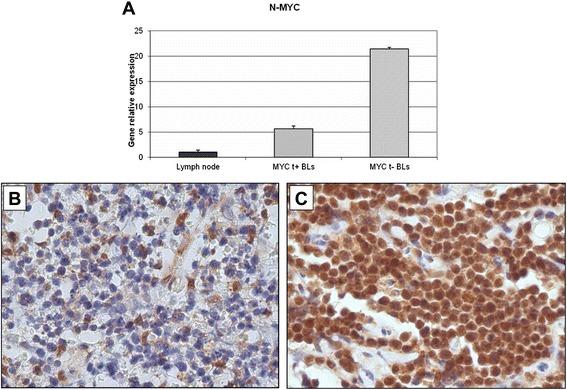
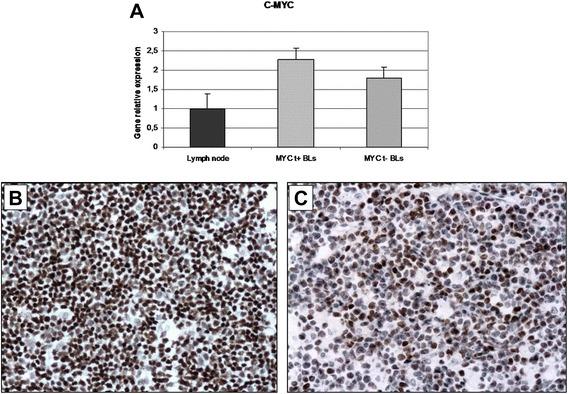
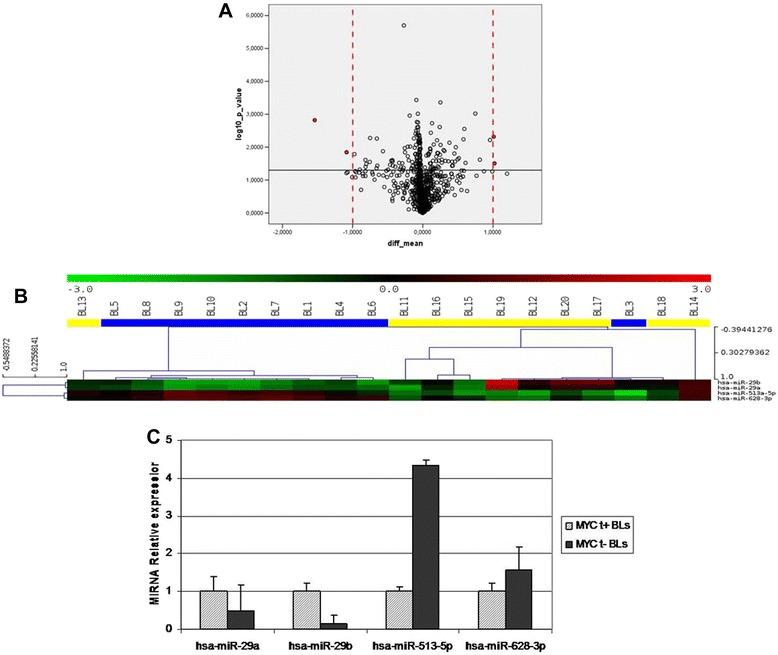
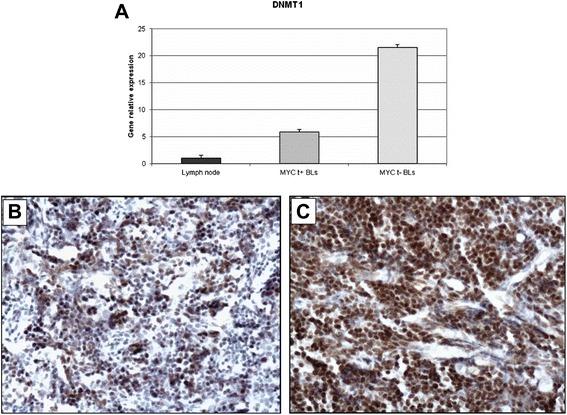
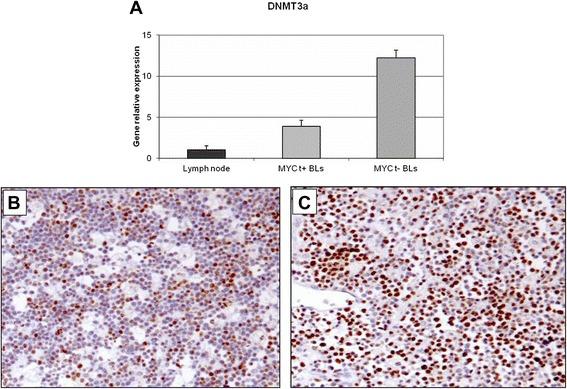
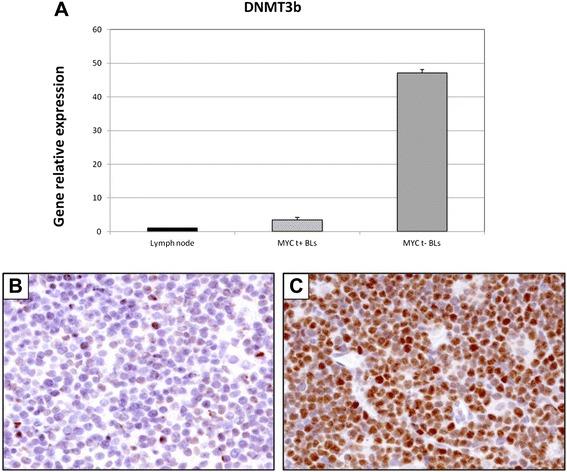
We identified four microRNAs differentially expressed between the two groups. The impact of these microRNAs on the expression of selected genes was then investigated. Interestingly, in MYC translocation-negative cases we found over-expression of DNA-methyl transferase family members, consistent to hypo-expression of the hsa-miR-29 family. This finding suggests an alternative way for the activation of lymphomagenesis in these cases, based on global changes in methylation landscape, aberrant DNA hypermethylation, lack of epigenetic control on transcription of targeted genes, and increase of genomic instability. In addition, we observed an over-expression of another MYC family gene member, MYCN that may therefore represent a cooperating mechanism of MYC in driving the malignant transformation in those cases lacking an identifiable MYC translocation but expressing the gene at the mRNA and protein levels.
CONCLUSIONS
Collectively, our results showed that MYC translocation-positive and MYC translocation-negative Burkitt lymphoma cases are slightly different in terms of microRNA and gene expression. MYC translocation-negative Burkitt lymphoma, similarly to other aggressive B-cell non Hodgkin's lymphomas, may represent a model to understand the intricate molecular pathway responsible for MYC dysregulation in cancer.
背景
致癌转录因子MYC在许多人类恶性肿瘤中发生病理激活。伯基特淋巴瘤提供了一个MYC失调的范例,其中导致免疫球蛋白基因-MYC融合的染色体易位是关键的起始致癌事件。然而,已经鉴定出没有可检测到的MYC重排但维持MYC表达的伯基特淋巴瘤病例,并且这些病例中MYC失调可能涉及其他机制。
方法
我们研究了MYC易位阳性和MYC易位阴性伯基特淋巴瘤病例的微小RNA谱,以揭示分子水平上可能存在的差异。分别通过定量实时聚合酶链反应和免疫组织化学在mRNA和蛋白质水平对数据进行验证。
结果
我们鉴定出两组之间差异表达的四种微小RNA。然后研究了这些微小RNA对选定基因表达的影响。有趣的是,在MYC易位阴性病例中,我们发现DNA甲基转移酶家族成员过表达,这与hsa-miR-29家族的低表达一致。这一发现表明,在这些病例中,基于甲基化格局的全局变化、异常的DNA高甲基化、对靶向基因转录缺乏表观遗传控制以及基因组不稳定性增加,存在另一种淋巴瘤发生激活途径。此外,我们观察到另一个MYC家族基因成员MYCN过表达,因此在那些缺乏可识别的MYC易位但在mRNA和蛋白质水平表达该基因的病例中,MYCN可能代表MYC驱动恶性转化的协同机制。
结论
总体而言,我们的结果表明,MYC易位阳性和MYC易位阴性伯基特淋巴瘤病例在微小RNA和基因表达方面略有不同。与其他侵袭性B细胞非霍奇金淋巴瘤类似,MYC易位阴性伯基特淋巴瘤可能代表一种模型,用于理解癌症中负责MYC失调的复杂分子途径。


 Zotero 插件