
不平等是全球婴儿和孕产妇死亡率的有力预测指标。
Inequality as a Powerful Predictor of Infant and Maternal Mortality around the World.
作者信息
Ruiz Juan Ignacio, Nuhu Kaamel, McDaniel Justin Tyler, Popoff Federico, Izcovich Ariel, Criniti Juan Martin
机构信息
Department of Health Education and Recreation, College of Education and Human Services, Southern Illinois University Carbondale, Carbondale, Illinois, United States of America.
Servicio de Clínica Médica, Hospital Aleman, Ciudad Autónoma de Buenos Aires, Argentina.
出版信息
PLoS One. 2015 Oct 21;10(10):e0140796. doi: 10.1371/journal.pone.0140796. eCollection 2015.
BACKGROUND
Maternal and infant mortality are highly devastating, yet, in many cases, preventable events for a community. The human development of a country is a strong predictor of maternal and infant mortality, reflecting the importance of socioeconomic factors in determinants of health. Previous research has shown that the Human Development Index (HDI) predicts infant mortality rate (IMR) and the maternal mortality ratio (MMR). Inequality has also been shown to be associated with worse health in certain populations. The main purpose of the present study was to determine the correlation and predictive power of the Inequality Adjusted Human Development Index (IHDI) as a measure of inequality with the Infant Mortality Rate (IMR), Maternal Mortality Rate (MMR), Early Neonatal Mortality Rate (ENMR), Late Neonatal Mortality Rate (LNMR), and the Post Neonatal Mortality Rate (PNMR).
METHODS AND FINDINGS
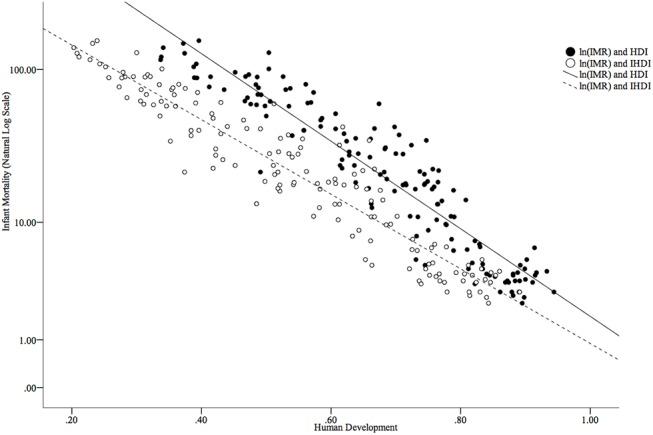
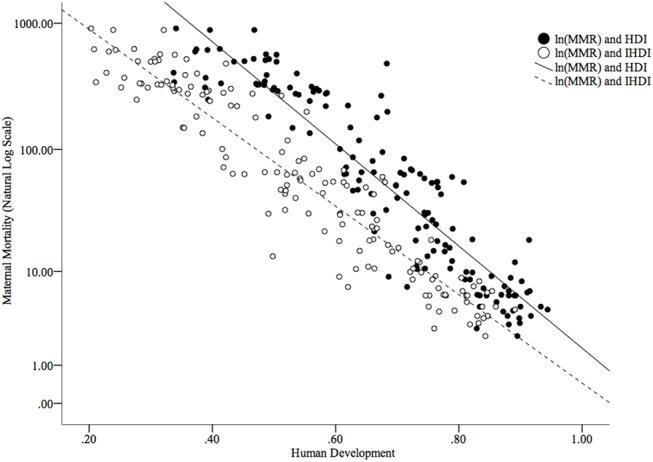
Data for the present study were downloaded from two sources: infant and maternal mortality data were downloaded from the Global Burden of Disease 2013 Cause of Death Database and the Human Development Index (HDI) and Inequality-Adjusted Human Development Index (IHDI) data were downloaded from the United Nations Development Program (UNDP). Pearson correlation coefficients were estimated, following logarithmic transformations to the data, to examine the relationship between HDI and IHDI with MMR, IMR, ENMR, LNMR, and PNMR. Steiger's Z test for the equality of two dependent correlations was utilized in order to determine whether the HDI or IHDI was more strongly associated with the outcome variables. Lastly, we constructed OLS regression models in order to determine the predictive power of the HDI and IHDI in terms of the MMR, IMR, ENMR, LNMR, and PNMR. Maternal and infant mortality were both strongly and negatively correlated with both HDI and IHDI; however, Steiger's Z test for the equality of two dependent correlations revealed that IHDI was more strongly correlated than HDI with MMR (Z = 4.897, p < 0.001), IMR (Z = 2.524, p = 0.012), ENMR (Z = 2.936, p = 0.003), LNMR (Z = 2.272, p = 0.023), and PNMR (Z = 2.277, p = 0.023). Furthermore, side-by-side OLS regression models revealed that, when IHDI was used as the predictor variable instead of HDI, the R2 value was 0.053 higher for MMR, 0.025 higher for IMR, 0.038 higher for ENMR, 0.029 higher for LNMR, and 0.026 higher for PNMR.
CONCLUSIONS
Even when both the HDI and the IHDI correlate with the infant and maternal mortality rates, the IHDI is a better predictor for these two health indicators. Therefore, these results add more evidence that inequality is playing an important role in determining the health status of various populations in the world and more efforts should be put into programs to fight inequality.
背景
母婴死亡率具有极大的破坏性,但在许多情况下,对于一个社区而言是可预防的事件。一个国家的人类发展是母婴死亡率的有力预测指标,反映了社会经济因素在健康决定因素中的重要性。先前的研究表明,人类发展指数(HDI)可预测婴儿死亡率(IMR)和孕产妇死亡率(MMR)。不平等也已被证明与某些人群的健康状况较差有关。本研究的主要目的是确定作为不平等衡量指标的不平等调整后的人类发展指数(IHDI)与婴儿死亡率(IMR)、孕产妇死亡率(MMR)、早期新生儿死亡率(ENMR)、晚期新生儿死亡率(LNMR)和新生儿后期死亡率(PNMR)之间的相关性和预测能力。
方法与结果
本研究的数据从两个来源下载:婴儿和孕产妇死亡率数据从《2013年全球疾病负担死因数据库》下载,人类发展指数(HDI)和不平等调整后的人类发展指数(IHDI)数据从联合国开发计划署(UNDP)下载。在对数据进行对数转换后,估计皮尔逊相关系数,以检验HDI和IHDI与MMR、IMR、ENMR、LNMR和PNMR之间的关系。使用斯泰格Z检验来检验两个相关系数是否相等,以确定HDI还是IHDI与结果变量的相关性更强。最后,我们构建了普通最小二乘法(OLS)回归模型,以确定HDI和IHDI对MMR、IMR、ENMR、LNMR和PNMR的预测能力。母婴死亡率与HDI和IHDI均呈强负相关;然而,斯泰格Z检验两个相关系数是否相等的结果显示,IHDI与MMR(Z = 4.897,p < 0.001)、IMR(Z = 2.524,p = 0.012)、ENMR(Z = 2.936,p = 0.003)、LNMR(Z = 2.272,p = 0.023)和PNMR(Z = 2.277,p = 0.023)之间的相关性比HDI更强。此外,并列的OLS回归模型显示,当使用IHDI而非HDI作为预测变量时,MMR的R²值高0.053,IMR高0.025,ENMR高0.038,LNMR高0.029,PNMR高0.026。
结论
即使HDI和IHDI都与婴儿和孕产妇死亡率相关,但IHDI是这两个健康指标的更好预测指标。因此,这些结果进一步证明不平等在决定世界各人群的健康状况方面发挥着重要作用,应加大力度开展消除不平等的项目。


 Zotero 插件