
与詹姆斯·林德联盟合作开展的痴呆症研究优先级设定:利用患者和公众参与以及证据基础为研究议程提供信息。
Dementia priority setting partnership with the James Lind Alliance: using patient and public involvement and the evidence base to inform the research agenda.
作者信息
Kelly Sarah, Lafortune Louise, Hart Nicola, Cowan Katherine, Fenton Mark, Brayne Carol
机构信息
Institute of Public Health, University of Cambridge, Cambridge CB2 0SR, UK School of Clinical Medicine, University of Cambridge, Cambridge CB2 0SR, UK.
Alzheimer's Society, London, UK.
出版信息
Age Ageing. 2015 Nov;44(6):985-93. doi: 10.1093/ageing/afv143.
BACKGROUND
The James Lind Alliance (JLA) created an approach to elicit the views of those under-represented in research priority exercises. Building on this, the JLA Dementia Priority Setting Partnership was set up as an independent and evidence-based project to identify and prioritise unanswered questions ('uncertainties') about prevention, diagnosis, treatment and care relating to dementia.
METHODS
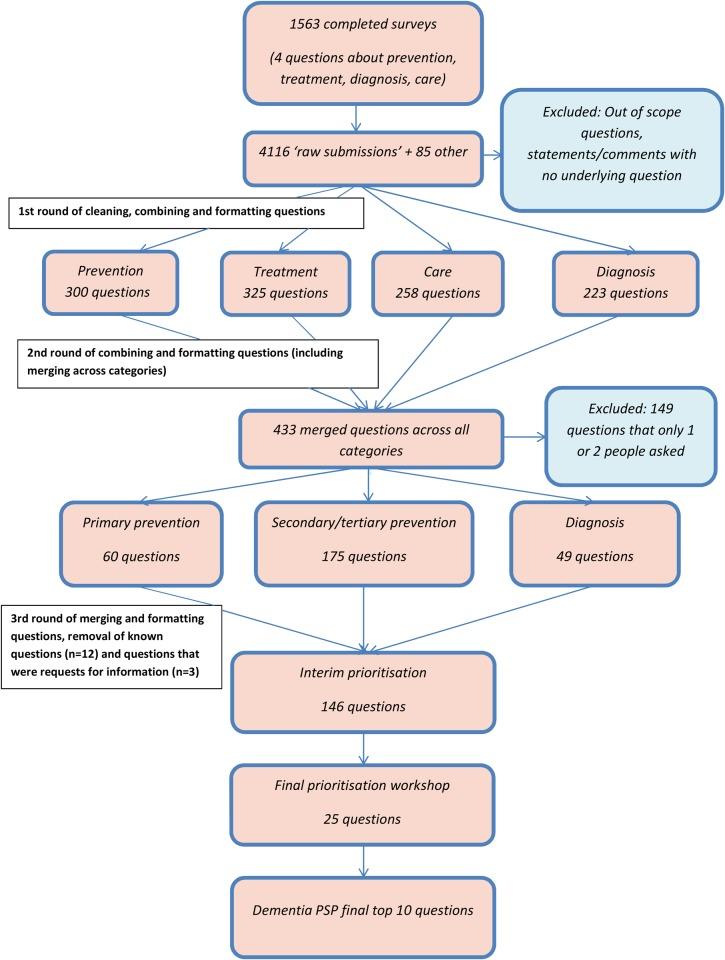
A survey was widely disseminated to stakeholders with an interest in the needs of the older population. Thematic analysis was used to identify themes from the large amount of questions collected from which research questions were developed using PICO framework (Population, Intervention, Comparator, Outcome). Each question was checked against an extensive evidence base of high-quality systematic reviews to verify whether they were true uncertainties.
FINDINGS
One thousand five hundred and sixty-three questionnaires were received, from people with dementia, carers/relatives, and health and care professionals; 85 uncertainties were identified from other sources. Questions were refined and formatted iteratively into 146 unique uncertainties. An interim prioritisation process involving diverse organisations identified the top 25 ranked questions. At a final face-to-face prioritisation workshop, 18 people representing the above constituencies arrived by consensus at the top 10 priority questions. The impact of patient and public involvement on the priorities is discussed.
INTERPRETATION
The long (146 questions) and top 10 lists of dementia research priorities provide a focus for researchers, funders and commissioners. They highlight a need for more research into care for people with dementia and carers, and a need for high-quality effectiveness trials in all aspects of dementia research.
背景
詹姆斯·林德联盟(JLA)创建了一种方法,以获取在研究优先级确定活动中代表性不足的人群的观点。在此基础上,JLA痴呆症优先级确定合作项目作为一个独立且基于证据的项目得以设立,旨在识别并确定有关痴呆症预防、诊断、治疗和护理方面未解决的问题(“不确定性”)的优先级。
方法
一项调查广泛分发给了对老年人群需求感兴趣的利益相关者。采用主题分析法从收集到的大量问题中识别主题,并使用PICO框架(人群、干预措施、对照、结局)制定研究问题。每个问题都对照大量高质量系统评价的证据库进行核查,以验证它们是否为真正的不确定性问题。
结果
共收到1563份问卷,来自痴呆症患者、护理人员/亲属以及健康和护理专业人员;从其他来源识别出85个不确定性问题。问题经过反复提炼和格式化,形成了146个独特的不确定性问题。一个涉及不同组织的中期优先级确定过程确定了排名前25的问题。在最终的面对面优先级确定研讨会上,代表上述群体的18人通过协商一致确定了前10个优先问题。讨论了患者和公众参与对优先级的影响。
解读
痴呆症研究优先级的长清单(146个问题)和前10个清单为研究人员、资助者和委托方提供了重点。它们突出了对痴呆症患者及其护理人员护理进行更多研究的必要性,以及在痴呆症研究各个方面进行高质量有效性试验的必要性。
 Zotero 插件