
具有微卫星不稳定性的结直肠癌的突变谱分析
Mutational profiling of colorectal cancers with microsatellite instability.
作者信息
Lin Elaine I, Tseng Li-Hui, Gocke Christopher D, Reil Stacy, Le Dung T, Azad Nilofer S, Eshleman James R
机构信息
Department of Pathology and The Sidney Kimmel Comprehensive Cancer Center, Johns Hopkins University School of Medicine, Baltimore, Maryland, USA.
Department of Medical Genetics, National Taiwan University Hospital, Taipei, Taiwan.
出版信息
Oncotarget. 2015 Dec 8;6(39):42334-44. doi: 10.18632/oncotarget.5997.
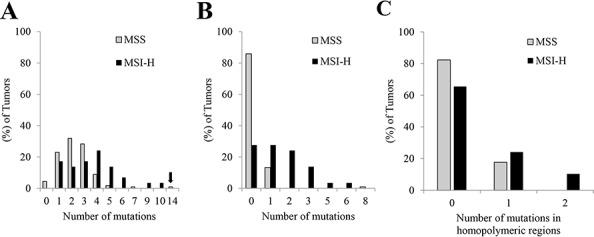
Microsatellite instability (MSI) is caused by defective mismatch repair in 15-20% of colorectal cancers (CRCs). Higher mutation loads in tumors with mismatch repair deficiency can predict response to pembrolizumab, an anti-programmed death 1 (PD-1) immune checkpoint inhibitor. We analyzed the mutations in 113 CRCs without MSI (MSS) and 29 CRCs with MSI-High (MSI-H) using the 50-gene AmpliSeq cancer panel. Overall, MSI-H CRCs showed significantly higher mutations than MSS CRCs, including insertion/deletion mutations at repeat regions. MSI-H CRCs showed higher incidences of mutations in the BRAF, PIK3CA, and PTEN genes as well as mutations in the receptor tyrosine kinase families. While the increased mutations in BRAF and PTEN in MSI-H CRCs are well accepted, we also support findings of mutations in the mTOR pathway and receptor tyrosine kinase family genes. MSS CRCs showed higher incidences of mutations in the APC, KRAS and TP53 genes, confirming previous findings. NGS assays may be designed to detect driver mutations for targeted therapeutics and to identify tumors with high mutation loads for potential treatment with immune checkpoint blockade therapies. Further studies may be warranted to elucidate potential targeted therapeutics against mutations in the mTOR pathway and the receptor tyrosine kinase family in MSI-H CRCs as well as the benefit of anti-PD-1 immunotherapy in hypermutated MSS CRCs or other cancers.
微卫星不稳定性(MSI)由15%-20%的结直肠癌(CRC)中错配修复缺陷引起。错配修复缺陷的肿瘤中较高的突变负荷可预测对派姆单抗(一种抗程序性死亡1(PD-1)免疫检查点抑制剂)的反应。我们使用50基因AmpliSeq癌症检测板分析了113例无MSI(MSS)的CRC和29例高微卫星不稳定性(MSI-H)的CRC中的突变情况。总体而言,MSI-H CRCs的突变明显高于MSS CRCs,包括重复区域的插入/缺失突变。MSI-H CRCs在BRAF、PIK3CA和PTEN基因以及受体酪氨酸激酶家族中的突变发生率更高。虽然MSI-H CRCs中BRAF和PTEN突变增加已被广泛接受,但我们也支持mTOR通路和受体酪氨酸激酶家族基因中存在突变的发现。MSS CRCs在APC、KRAS和TP53基因中的突变发生率更高,证实了先前的研究结果。可设计二代测序(NGS)检测来检测驱动突变以进行靶向治疗,并识别具有高突变负荷的肿瘤以进行免疫检查点阻断治疗的潜在治疗。可能需要进一步研究来阐明针对MSI-H CRCs中mTOR通路和受体酪氨酸激酶家族突变的潜在靶向治疗方法,以及抗PD-1免疫疗法在高突变MSS CRCs或其他癌症中的益处。
 Zotero 插件