
环境温度与肥胖患病率:韩国一项基于全国人口的研究
Ambient Temperature and Prevalence of Obesity: A Nationwide Population-Based Study in Korea.
作者信息
Yang Hae Kyung, Han Kyungdo, Cho Jae-Hyoung, Yoon Kun-Ho, Cha Bong-Yun, Lee Seung-Hwan
机构信息
Division of Endocrinology and Metabolism, Department of Internal Medicine, Seoul St. Mary's Hospital, College of Medicine, The Catholic University of Korea, Seoul, Korea.
Department of Medical Statistics, College of Medicine, The Catholic University of Korea, Seoul, Korea.
出版信息
PLoS One. 2015 Nov 2;10(11):e0141724. doi: 10.1371/journal.pone.0141724. eCollection 2015.
BACKGROUND
Recent studies have suggested a possible association between outdoor or indoor temperature and obesity. We aimed to examine whether ambient temperature is associated with the prevalence of obesity or abdominal obesity in the Korean population.
METHODS
Data on anthropometric, socio-demographic, laboratory and lifestyle factors were retrieved from National Health Insurance System data obtained in 2009-2010. Thirty years (1981 to 2010) of meteorological parameters for 71 observation areas were acquired from the Korea Meteorological Administration. Included in this analysis were 124,354 individuals. A body mass index (BMI) ≥ 25 kg/m2 and a waist circumference (WC) ≥ 90 cm (men) or 85 cm (women) were considered to represent obesity and abdominal obesity, respectively.
RESULTS
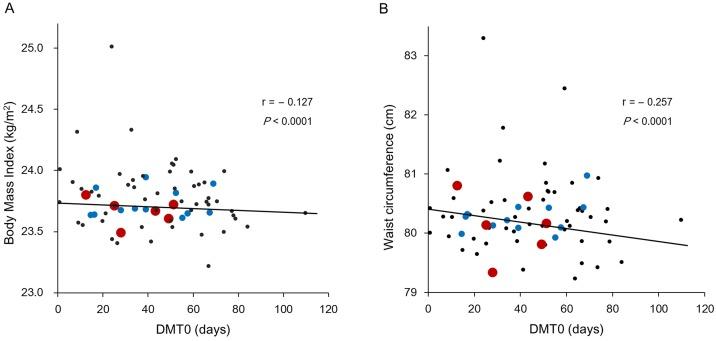
The mean annual temperature (MAT) ranged from 6.6°C to 16.6°C, and BMI was positively correlated with MAT (r = 0.0078, P = 0.0065). WC was positively correlated with MAT (r = 0.0165, P < 0.0001) and negatively correlated with the number of days with mean temperature < 0°C (DMT0; r = -0.0129, P = 0.0002). After adjusting for age, sex, smoking status, alcohol consumption, exercise, income, residential area and altitude, the odds ratios (95% CI) for obesity and abdominal obesity in the highest quintile MAT group were 1.045 (1.010, 1.081) and 1.082 (1.042, 1.124), respectively, compared with the lower four quintiles of the MAT group. Similarly, subjects in the area of the lowest quintile of DMT0 had significantly higher odds of abdominal obesity compared with the higher four quintile groups of DMT0.
CONCLUSION
This study finds an association between ambient temperature and prevalence of obesity in the Korean population when controlling for several confounding factors. Adaptive thermogenesis might be a possible explanation for this phenomenon.
背景
近期研究表明,室外或室内温度与肥胖之间可能存在关联。我们旨在研究环境温度是否与韩国人群中的肥胖患病率或腹型肥胖有关。
方法
从2009 - 2010年获得的国民健康保险系统数据中检索人体测量学、社会人口统计学、实验室和生活方式因素的数据。从韩国气象厅获取了71个观测区域30年(1981年至2010年)的气象参数。本分析纳入了124,354人。体重指数(BMI)≥25 kg/m²和腰围(WC)≥90 cm(男性)或85 cm(女性)分别被视为代表肥胖和腹型肥胖。
结果
年平均温度(MAT)范围为6.6°C至16.6°C,BMI与MAT呈正相关(r = 0.0078,P = 0.0065)。WC与MAT呈正相关(r = 0.0165,P < 0.0001),与平均温度<0°C的天数(DMT0)呈负相关(r = -0.0129,P = 0.0002)。在调整年龄、性别、吸烟状况、饮酒、运动、收入、居住地区和海拔后,与MAT组的较低四分位数相比,MAT最高五分位数组中肥胖和腹型肥胖的优势比(95% CI)分别为1.(1.010,1.081)和1.082(1.042,1.124)。同样,与DMT0较高四分位数组相比,DMT0最低五分位数区域的受试者腹型肥胖的几率显著更高。
结论
本研究发现,在控制了几个混杂因素后,韩国人群中环境温度与肥胖患病率之间存在关联。适应性产热可能是这一现象的一种可能解释。


 Zotero 插件