
幽门螺杆菌根除可预防胃发育异常内镜切除术后的异时性胃肿瘤。
Helicobacter pylori Eradication Prevents Metachronous Gastric Neoplasms after Endoscopic Resection of Gastric Dysplasia.
作者信息
Shin Seung Hwan, Jung Da Hyun, Kim Jie-Hyun, Chung Hyun Soo, Park Jun Chul, Shin Sung Kwan, Lee Sang Kil, Lee Yong Chan
机构信息
Department of Internal Medicine, Yonsei University College of Medicine, Seoul, Korea.
Department of Internal Medicine, Gangnam Severance Hospital, Yonsei University College of Medicine, Seoul, Korea.
出版信息
PLoS One. 2015 Nov 18;10(11):e0143257. doi: 10.1371/journal.pone.0143257. eCollection 2015.
PURPOSE
There is insufficient data about the role of eradication of H. pylori after endoscopic resection (ER) for gastric dysplasia. The aim was to investigate the benefit of H. pylori eradication after ER in patients with gastric dysplasia to prevent metachronous gastric neoplasms.
MATERIALS AND METHODS
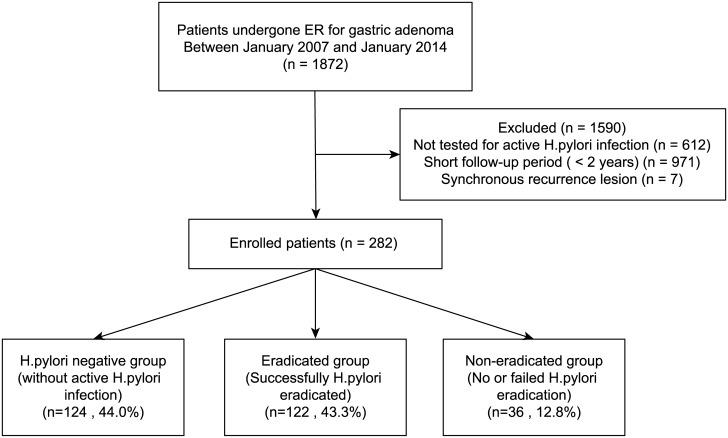
We retrospectively reviewed 1872 patients who underwent ER of gastric dysplasia. We excluded patients with a follow-up period of <2 years or who had not undergone tests for active H. pylori infection. A total of 282 patients were enrolled. The patients were categorized into those without active H. pylori infection (H. pylori-negative group, n = 124), those who successfully underwent H. pylori eradication (eradicated group, n = 122), and those who failed or did not undergo H. pylori eradication (persistent group, n = 36).
RESULTS
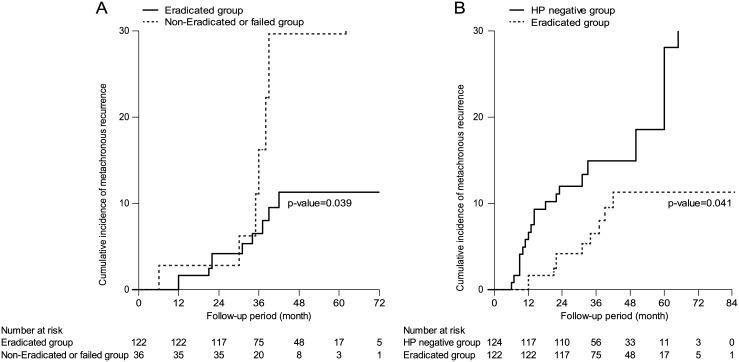
Metachronous recurrence was diagnosed in 36 patients, including 19 in the H. pylori-negative group, 10 in the eradicated group, and 7 in the persistent group. The cumulative incidence of metachronous recurrence was significantly lower in the H. pylori-eradicated group in comparison with either of the H. pylori-persistent (non-eradicated or failed) groups (p = 0.039). Similarly, the incidence of metachronous recurrence was significantly lower in the H. pylori-eradicated group compared with the H. pylori-negative group (p = 0.041).
CONCLUSION
Successful H. pylori eradication may reduce the development of metachronous gastric neoplasms after ER in patients with gastric dysplasia.
目的
关于内镜切除(ER)治疗胃发育异常后根除幽门螺杆菌(H. pylori)的作用,现有数据不足。本研究旨在探讨胃发育异常患者ER后根除H. pylori预防异时性胃肿瘤的益处。
材料与方法
我们回顾性分析了1872例行胃发育异常ER的患者。我们排除了随访期<2年或未进行活动性H. pylori感染检测的患者。共纳入282例患者。患者分为无活动性H. pylori感染组(H. pylori阴性组,n = 124)、成功根除H. pylori组(根除组,n = 122)和根除失败或未进行H. pylori根除组(持续感染组,n = 36)。
结果
36例患者被诊断为异时性复发,其中H. pylori阴性组19例,根除组10例,持续感染组7例。与H. pylori持续感染(未根除或根除失败)组相比,H. pylori根除组异时性复发的累积发生率显著更低(p = 0.039)。同样,与H. pylori阴性组相比,H. pylori根除组异时性复发的发生率显著更低(p = 0.041)。
结论
成功根除H. pylori可能会降低胃发育异常患者ER后异时性胃肿瘤的发生。
 Zotero 插件