
艾滋病毒/艾滋病健康结果的州际差异:社会服务和公共卫生支出的影响。
State variation in HIV/AIDS health outcomes: the effect of spending on social services and public health.
作者信息
Talbert-Slagle Kristina M, Canavan Maureen E, Rogan Erika M, Curry Leslie A, Bradley Elizabeth H
机构信息
Department of Health Policy and Management, Yale School of Public Health, New Haven, Connecticut, USA.
出版信息
AIDS. 2016 Feb 20;30(4):657-63. doi: 10.1097/QAD.0000000000000978.
OBJECTIVE
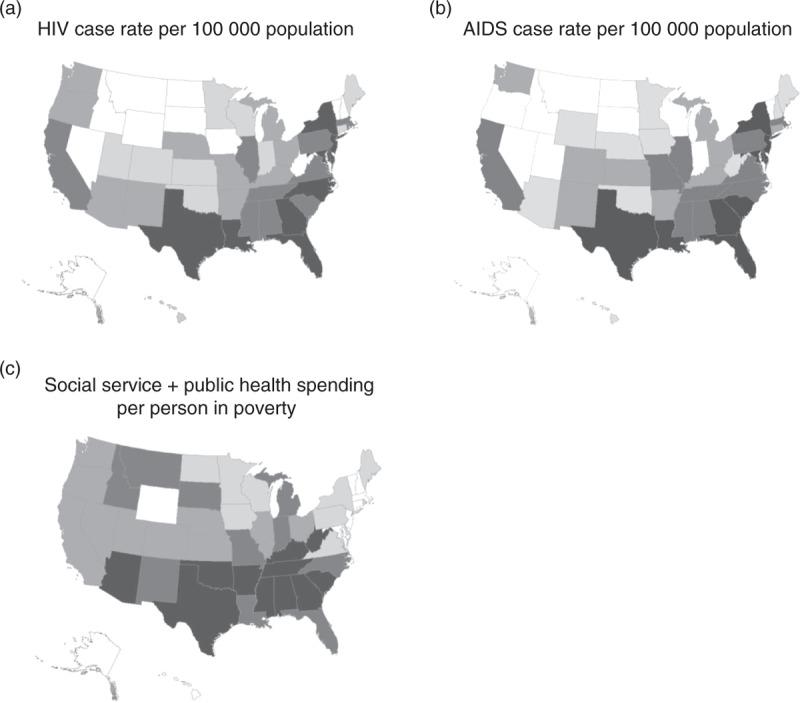
Despite considerable advances in the prevention and treatment of HIV/AIDS, the burden of new infections of HIV and AIDS varies substantially across the country. Previous studies have demonstrated associations between increased healthcare spending and better HIV/AIDS outcomes; however, less is known about the association between spending on social services and public health spending and HIV/AIDS outcomes. We sought to examine the association between state-level spending on social services and public health and HIV/AIDS case rates and AIDS deaths across the United States.
DESIGN
We conducted a retrospective, longitudinal study of the 50 U.S. states over 2000-2009 using a dataset of HIV/AIDS case rates and AIDS deaths per 100 000 people matched with a unique dataset of state-level spending on social services and public health per person in poverty.
METHODS
We estimated multivariable regression models for each HIV/AIDS outcome as a function of the social service and public health spending 1 and 5 years earlier in the state, adjusted for the log of state GDP per capita, regional and time fixed effects, Medicaid spending as % of GDP, and socio-demographic, economic, and health resource factors.
RESULTS
States with higher spending on social services and public health per person in poverty had significantly lower HIV and AIDS case rates and fewer AIDS deaths, both 1 and 5 years post expenditure (P ≤ 0.05).
CONCLUSION
Our findings suggest that spending on social services and public health may provide a leverage point for state policymakers to reduce HIV/AIDS case rates and AIDS deaths in their state.
目的
尽管在艾滋病毒/艾滋病的预防和治疗方面取得了长足进展,但该国艾滋病毒和艾滋病新感染负担在全国范围内差异很大。先前的研究表明,医疗保健支出增加与更好的艾滋病毒/艾滋病治疗效果之间存在关联;然而,关于社会服务支出和公共卫生支出与艾滋病毒/艾滋病治疗效果之间的关联,人们了解较少。我们试图研究美国各州社会服务和公共卫生支出与艾滋病毒/艾滋病病例率及艾滋病死亡人数之间的关联。
设计
我们对2000年至2009年期间美国50个州进行了一项回顾性纵向研究,使用了每10万人中的艾滋病毒/艾滋病病例率和艾滋病死亡人数数据集,并将其与贫困人群人均州社会服务和公共卫生支出的独特数据集相匹配。
方法
我们针对每个艾滋病毒/艾滋病结果估计多变量回归模型,该模型是该州1年和5年前社会服务和公共卫生支出的函数,并根据人均州国内生产总值的对数、区域和时间固定效应、医疗补助支出占国内生产总值的百分比以及社会人口、经济和卫生资源因素进行了调整。
结果
贫困人群人均社会服务和公共卫生支出较高的州,在支出后1年和5年的艾滋病毒和艾滋病病例率显著较低,艾滋病死亡人数也较少(P≤0.05)。
结论
我们的研究结果表明,社会服务和公共卫生支出可能为州政策制定者提供一个杠杆点,以降低本州的艾滋病毒/艾滋病病例率和艾滋病死亡人数。
 Zotero 插件