
美国终末期肾病患者终末期肾病前的肾脏病护理及预后
Nephrology care prior to end-stage renal disease and outcomes among new ESRD patients in the USA.
作者信息
Gillespie Brenda W, Morgenstern Hal, Hedgeman Elizabeth, Tilea Anca, Scholz Natalie, Shearon Tempie, Burrows Nilka Rios, Shahinian Vahakn B, Yee Jerry, Plantinga Laura, Powe Neil R, McClellan William, Robinson Bruce, Williams Desmond E, Saran Rajiv
机构信息
Kidney Epidemiology and Cost Center , University of Michigan , Ann Arbor, MI , USA ; Department of Biostatistics , University of Michigan , Ann Arbor, MI , USA ; Center for Statistical Consultation and Research, University of Michigan , Ann Arbor, MI , USA.
Department of Epidemiology , University of Michigan School of Public Health , Ann Arbor, MI , USA ; Department of Environmental Health Sciences , University of Michigan School of Public Health , Ann Arbor, MI , USA ; Department of Urology , University of Michigan Medical School , Ann Arbor, MI , USA.
出版信息
Clin Kidney J. 2015 Dec;8(6):772-80. doi: 10.1093/ckj/sfv103. Epub 2015 Nov 3.
BACKGROUND
Longer nephrology care before end-stage renal disease (ESRD) has been linked with better outcomes.
METHODS
We investigated whether longer pre-end-stage renal disease (ESRD) nephrology care was associated with lower mortality at both the patient and state levels among 443 761 incident ESRD patients identified in the USA between 2006 and 2010.
RESULTS
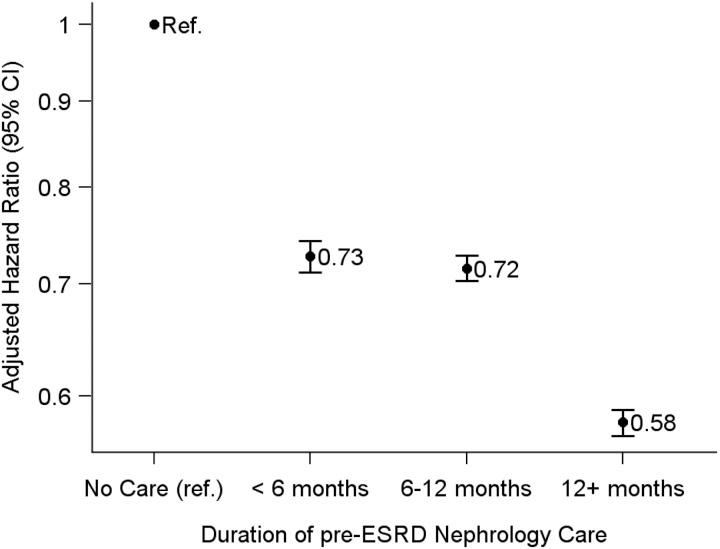
Overall, 33% of new ESRD patients had received no prior nephrology care, while 28% had received care for >12 months. At the patient level, predictors of >12 months of nephrology care included having health insurance, white race, younger age, diabetes, hypertension and US region. Longer pre-ESRD nephrology care was associated with lower first-year mortality (adjusted hazard ratio = 0.58 for >12 months versus no care; 95% confidence interval 0.57-0.59), higher albumin and hemoglobin, choice of peritoneal dialysis and native fistula and discussion of transplantation options. Living in a state with a 10% higher proportion of patients receiving >12 months of pre-ESRD care was associated with a 9.3% lower relative mortality rate, standardized for case mix (R (2) = 0.47; P < 0.001).
CONCLUSIONS
This study represents the largest cohort of incident ESRD patients to date. Although we did not follow patients before ESRD onset, our findings, both at the individual patient and state levels, reflect the importance of early nephrology care among those with chronic kidney disease.
背景
终末期肾病(ESRD)发生前接受更长时间的肾病护理与更好的预后相关。
方法
我们调查了2006年至2010年间在美国确诊的443761例新发终末期肾病(ESRD)患者中,终末期肾病(ESRD)发生前更长时间的肾病护理在患者和州层面是否与较低的死亡率相关。
结果
总体而言,33%的新发ESRD患者此前未接受过肾病护理,而28%的患者接受过超过12个月的护理。在患者层面,接受超过12个月肾病护理的预测因素包括拥有医疗保险、白人种族、年龄较小、糖尿病、高血压和美国地区。终末期肾病(ESRD)发生前更长时间的肾病护理与较低的第一年死亡率相关(超过12个月护理与未接受护理相比,调整后的风险比=0.58;95%置信区间0.57-0.59),更高的白蛋白和血红蛋白水平、腹膜透析和自体动静脉内瘘的选择以及移植选择的讨论。生活在终末期肾病(ESRD)发生前接受超过12个月护理的患者比例高出10%的州,经病例组合标准化后,相对死亡率降低9.3%(R(2)=0.47;P<0.001)。
结论
本研究是迄今为止最大的新发终末期肾病(ESRD)患者队列。尽管我们没有在终末期肾病(ESRD)发病前对患者进行随访,但我们在个体患者和州层面的研究结果都反映了慢性肾病患者早期肾病护理的重要性。


 Zotero 插件