
临床前期1型糖尿病早期β细胞功能减退
Reduced β-cell function in early preclinical type 1 diabetes.
作者信息
Koskinen Maarit K, Helminen Olli, Matomäki Jaakko, Aspholm Susanna, Mykkänen Juha, Mäkinen Marjaana, Simell Ville, Vähä-Mäkilä Mari, Simell Tuula, Ilonen Jorma, Knip Mikael, Veijola Riitta, Toppari Jorma, Simell Olli
机构信息
Department of PaediatricsUniversity of Turku and Turku University Hospital, Turku, FinlandMediCity LaboratoriesDepartment of Clinical Medicine, University of Turku, Lemminkäisenkatu 3, 20520 Turku, FinlandPEDEGO Research UnitDepartment of Paediatrics, Medical Research Centre Oulu, University of Oulu, Oulu, FinlandDepartment of Children and AdolescentsOulu University Hospital, Oulu, FinlandClinical Research CentreTurku University Hospital, Turku, FinlandDepartment of PaediatricsTampere University Hospital, Tampere, FinlandNovo Nordisk Farma OyCMR Department, Espoo, FinlandDiabetes Outpatient ClinicTampere, FinlandDepartment of PaediatricsTurku University Hospital, Turku, FinlandResearch Centre of Applied and Preventive Cardiovascular MedicineUniversity of Turku, Turku, FinlandImmunogenetics LaboratoryUniversity of Turku, Turku, FinlandDepartment of Clinical MicrobiologyUniversity of Eastern Finland, Kuopio, FinlandChildren's HospitalUniversity of Helsinki and Helsinki University Hospital, Helsinki, FinlandResearch Programs UnitDiabetes and Obesity, University of Helsinki, Helsinki, FinlandFolkhälsan Research CentreUniversity of Helsinki, Helsinki, FinlandDepartment of PhysiologyInstitute of Biomedicine, University of Turku, Turku, Finland Department of PaediatricsUniversity of Turku and Turku University Hospital, Turku, FinlandMediCity LaboratoriesDepartment of Clinical Medicine, University of Turku, Lemminkäisenkatu 3, 20520 Turku, FinlandPEDEGO Research UnitDepartment of Paediatrics, Medical Research Centre Oulu, University of Oulu, Oulu, FinlandDepartment of Children and AdolescentsOulu University Hospital, Oulu, FinlandClinical Research CentreTurku University Hospital, Turku, FinlandDepartment of PaediatricsTampere University Hospital, Tampere, FinlandNovo Nordisk Farma OyCMR Department, Espoo, FinlandDiabetes Outpatient ClinicTampere, FinlandDepartment of PaediatricsTurku University Hospital, Turku, FinlandResearch Centre of Applied and Preventive Cardiovascu
Department of PaediatricsUniversity of Turku and Turku University Hospital, Turku, FinlandMediCity LaboratoriesDepartment of Clinical Medicine, University of Turku, Lemminkäisenkatu 3, 20520 Turku, FinlandPEDEGO Research UnitDepartment of Paediatrics, Medical Research Centre Oulu, University of Oulu, Oulu, FinlandDepartment of Children and AdolescentsOulu University Hospital, Oulu, FinlandClinical Research CentreTurku University Hospital, Turku, FinlandDepartment of PaediatricsTampere University Hospital, Tampere, FinlandNovo Nordisk Farma OyCMR Department, Espoo, FinlandDiabetes Outpatient ClinicTampere, FinlandDepartment of PaediatricsTurku University Hospital, Turku, FinlandResearch Centre of Applied and Preventive Cardiovascular MedicineUniversity of Turku, Turku, FinlandImmunogenetics LaboratoryUniversity of Turku, Turku, FinlandDepartment of Clinical MicrobiologyUniversity of Eastern Finland, Kuopio, FinlandChildren's HospitalUniversity of Helsinki and Helsinki University Hospital, Helsinki, FinlandResearch Programs UnitDiabetes and Obesity, University of Helsinki, Helsinki, FinlandFolkhälsan Research CentreUniversity of Helsinki, Helsinki, FinlandDepartment of PhysiologyInstitute of Biomedicine, University of Turku, Turku, Finland.
出版信息
Eur J Endocrinol. 2016 Mar;174(3):251-9. doi: 10.1530/EJE-15-0674. Epub 2015 Nov 30.
OBJECTIVE
We aimed to characterize insulin responses to i.v. glucose during the preclinical period of type 1 diabetes starting from the emergence of islet autoimmunity.
DESIGN AND METHODS
A large population-based cohort of children with HLA-conferred susceptibility to type 1 diabetes was observed from birth. During regular follow-up visits islet autoantibodies were analysed. We compared markers of glucose metabolism in sequential intravenous glucose tolerance tests between 210 children who were positive for multiple (≥2) islet autoantibodies and progressed to type 1 diabetes (progressors) and 192 children testing positive for classical islet-cell antibodies only and remained healthy (non-progressors).
RESULTS
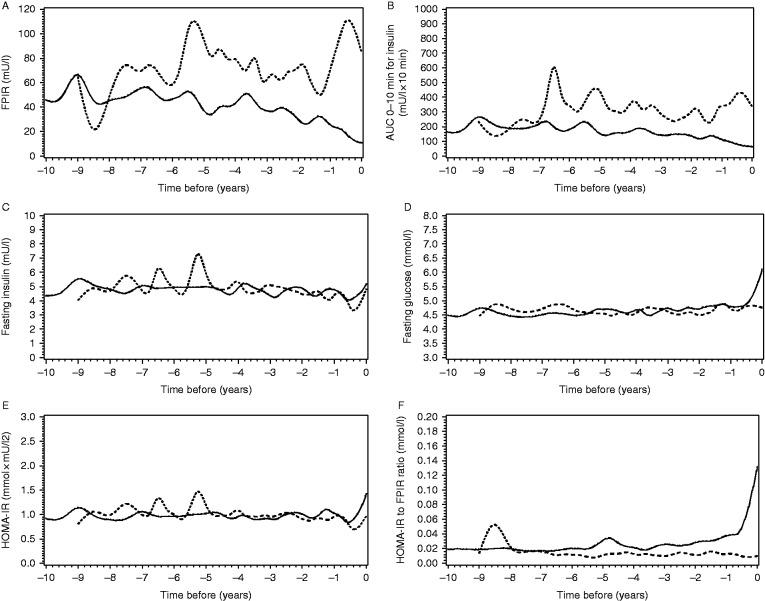
In the progressors, the first phase insulin response (FPIR) was decreased as early as 4-6 years before the diagnosis when compared to the non-progressors (P=0.001). The difference in FPIR between the progressors and non-progressors was significant (P<0.001) in all age groups, increasing with age (at 2 years: difference 50% (95% CI 28-75%) and at 10 years: difference 172% (95% CI 128-224%)). The area under the 10-min insulin curve showed a similar difference between the groups (P<0.001; at 2 years: difference 36% (95% CI 17-58%) and at 10 years: difference 186% (95% CI 143-237%)). Insulin sensitivity did not differ between the groups.
CONCLUSIONS
FPIR is decreased several years before the diagnosis of type 1 diabetes, implying an intrinsic defect in β-cell mass and/or function.
目的
我们旨在从胰岛自身免疫出现开始,描述1型糖尿病临床前期静脉注射葡萄糖后的胰岛素反应特征。
设计与方法
对一大群具有1型糖尿病HLA易感性的儿童进行从出生起的观察。在定期随访期间分析胰岛自身抗体。我们比较了210名多种(≥2种)胰岛自身抗体呈阳性并进展为1型糖尿病的儿童(进展者)和192名仅经典胰岛细胞抗体检测呈阳性且保持健康的儿童(非进展者)在连续静脉葡萄糖耐量试验中的葡萄糖代谢指标。
结果
与非进展者相比,进展者在诊断前4 - 6年时,第一阶段胰岛素反应(FPIR)就已降低(P = 0.001)。进展者与非进展者之间的FPIR差异在所有年龄组中均显著(P < 0.001),且随年龄增加(2岁时:差异50%(95%置信区间28 - 75%);10岁时:差异172%(95%置信区间128 - 224%))。10分钟胰岛素曲线下面积在两组间也显示出类似差异(P < 0.001;2岁时:差异36%(95%置信区间17 - 58%);10岁时:差异186%(95%置信区间143 - 237%))。两组间胰岛素敏感性无差异。
结论
1型糖尿病诊断前数年FPIR降低,这意味着β细胞量和/或功能存在内在缺陷。


 Zotero 插件