
肥大细胞介导的伤害感受机制。
Mast Cell-Mediated Mechanisms of Nociception.
作者信息
Aich Anupam, Afrin Lawrence B, Gupta Kalpna
机构信息
Vascular Biology Center, Division of Hematology, Oncology and Transplantation, Department of Medicine, University of Minnesota, Minneapolis, MN 55455, USA.
出版信息
Int J Mol Sci. 2015 Dec 4;16(12):29069-92. doi: 10.3390/ijms161226151.
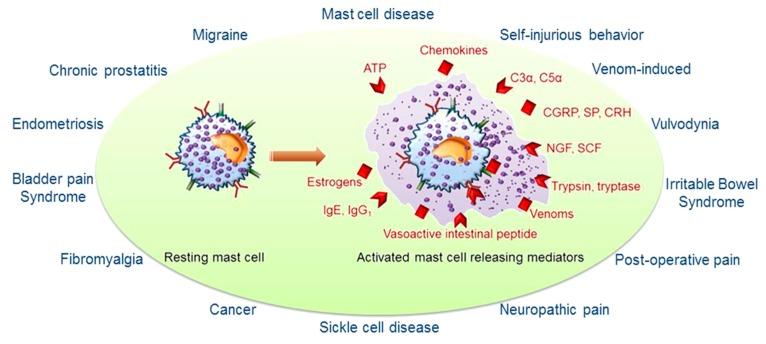
Mast cells are tissue-resident immune cells that release immuno-modulators, chemo-attractants, vasoactive compounds, neuropeptides and growth factors in response to allergens and pathogens constituting a first line of host defense. The neuroimmune interface of immune cells modulating synaptic responses has been of increasing interest, and mast cells have been proposed as key players in orchestrating inflammation-associated pain pathobiology due to their proximity to both vasculature and nerve fibers. Molecular underpinnings of mast cell-mediated pain can be disease-specific. Understanding such mechanisms is critical for developing disease-specific targeted therapeutics to improve analgesic outcomes. We review molecular mechanisms that may contribute to nociception in a disease-specific manner.
肥大细胞是驻留在组织中的免疫细胞,可响应过敏原和病原体释放免疫调节剂、趋化因子、血管活性化合物、神经肽和生长因子,构成宿主防御的第一道防线。免疫细胞调节突触反应的神经免疫界面越来越受到关注,肥大细胞因其靠近血管和神经纤维,被认为是协调炎症相关疼痛病理生物学的关键因素。肥大细胞介导疼痛的分子基础可能因疾病而异。了解这些机制对于开发针对特定疾病的靶向治疗以改善镇痛效果至关重要。我们综述了可能以疾病特异性方式导致伤害感受的分子机制。
 Zotero 插件