
体内人毛囊周期研究指南
A Guide to Studying Human Hair Follicle Cycling In Vivo.
作者信息
Oh Ji Won, Kloepper Jennifer, Langan Ewan A, Kim Yongsoo, Yeo Joongyeub, Kim Min Ji, Hsi Tsai-Ching, Rose Christian, Yoon Ghil Suk, Lee Seok-Jong, Seykora John, Kim Jung Chul, Sung Young Kwan, Kim Moonkyu, Paus Ralf, Plikus Maksim V
机构信息
Hair Transplantation Center, Kyungpook National University Hospital, Daegu, Korea; Department of Immunology, Kyungpook National University School of Medicine, Daegu, Korea; Department of Developmental and Cell Biology, University of California, Irvine, Irvine, California, USA; Sue and Bill Gross Stem Cell Research Center, University of California, Irvine, Irvine, California, USA; Center for Complex Biological Systems, University of California, Irvine, Irvine, California, USA.
Department of Dermatology, University of Lübeck, Lübeck, Germany.
出版信息
J Invest Dermatol. 2016 Jan;136(1):34-44. doi: 10.1038/JID.2015.354.
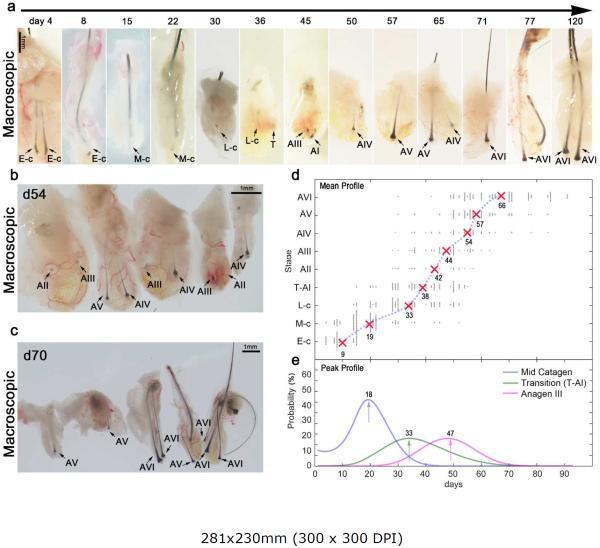
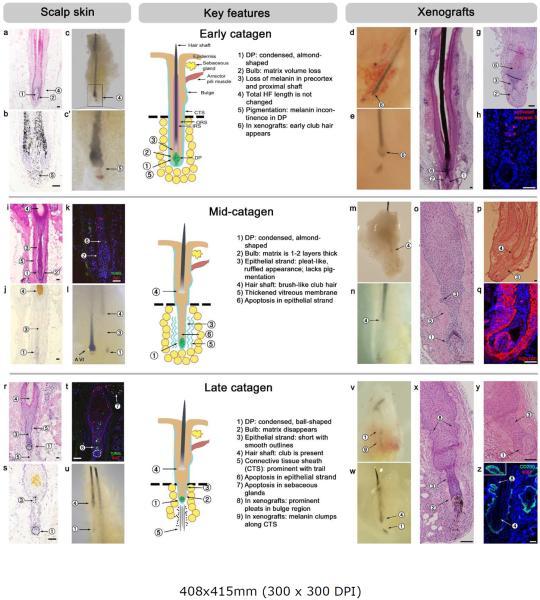
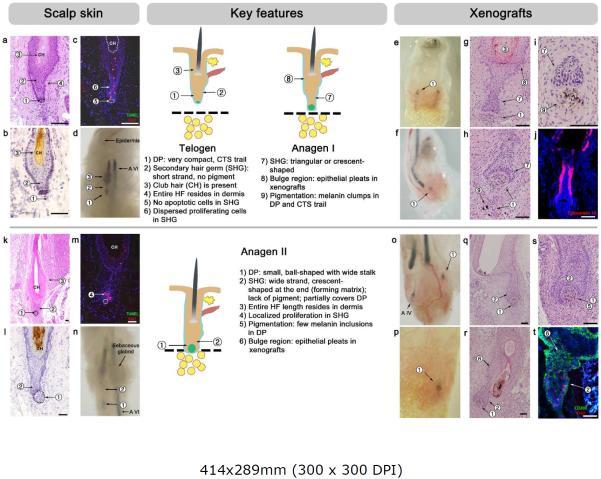
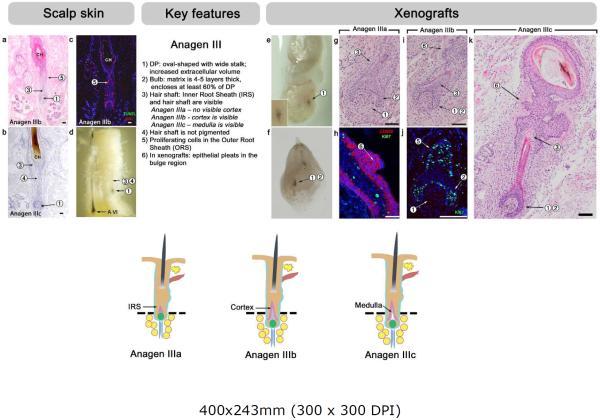
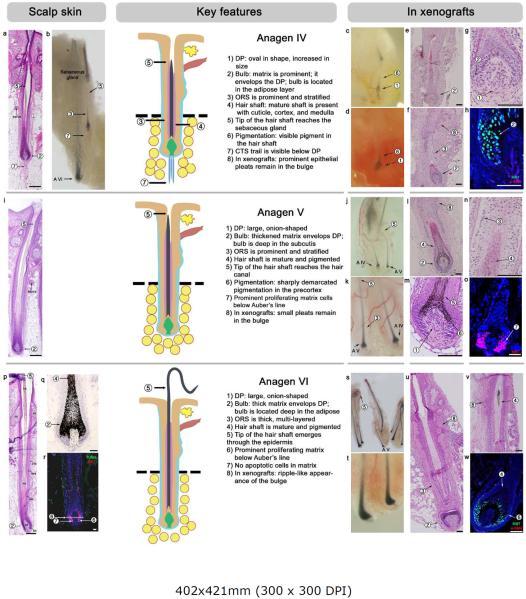
Hair follicles (HFs) undergo lifelong cyclical transformations, progressing through stages of rapid growth (anagen), regression (catagen), and relative "quiescence" (telogen). Given that HF cycling abnormalities underlie many human hair growth disorders, the accurate classification of individual cycle stages within skin biopsies is clinically important and essential for hair research. For preclinical human hair research purposes, human scalp skin can be xenografted onto immunocompromised mice to study human HF cycling and manipulate long-lasting anagen in vivo. Although available for mice, a comprehensive guide on how to recognize different human hair cycle stages in vivo is lacking. In this article, we present such a guide, which uses objective, well-defined, and reproducible criteria, and integrates simple morphological indicators with advanced, (immuno)-histochemical markers. This guide also characterizes human HF cycling in xenografts and highlights the utility of this model for in vivo hair research. Detailed schematic drawings and representative micrographs provide examples of how best to identify human HF stages, even in suboptimally sectioned tissue, and practical recommendations are given for designing human-on-mouse hair cycle experiments. Thus, this guide seeks to offer a benchmark for human hair cycle stage classification, for both hair research experts and newcomers to the field.
毛囊(HFs)经历终身周期性转变,依次经过快速生长阶段(生长期)、退化阶段(退行期)和相对“静止”阶段(休止期)。鉴于毛囊周期异常是许多人类毛发疾病的基础,在皮肤活检中准确分类各个周期阶段在临床上具有重要意义,也是毛发研究的关键。出于临床前人类毛发研究目的,可将人类头皮皮肤异种移植到免疫缺陷小鼠身上,以研究人类毛囊周期并在体内操控持久的生长期。虽然该方法适用于小鼠,但缺乏关于如何在体内识别不同人类毛发周期阶段的全面指南。在本文中,我们提供了这样一份指南,它使用客观、明确且可重复的标准,并将简单的形态学指标与先进的(免疫)组织化学标记相结合。本指南还描述了异种移植中人类毛囊周期的特征,并强调了该模型在体内毛发研究中的实用性。详细的示意图和代表性显微照片提供了即使在切片欠佳的组织中如何最佳识别人类毛囊阶段的示例,并针对设计人源化小鼠毛发周期实验给出了实用建议。因此,本指南旨在为毛发研究专家和该领域的新手提供人类毛发周期阶段分类的基准。
 Zotero 插件