
蛋白质S-谷胱甘肽化将能量代谢与线粒体中的氧化还原信号传导联系起来。
Protein S-glutathionlyation links energy metabolism to redox signaling in mitochondria.
作者信息
Mailloux Ryan J, Treberg Jason R
机构信息
Memorial University of Newfoundland, Department of Biochemistry, St. John's, Newfoundland, Canada.
University of Manitoba, Department of Biological Sciences, Winnipeg, Manitoba, Canada; Department of Human Nutritional Sciences, Winnipeg, Manitoba, Canada; Centre on Aging, Winnipeg, Manitoba, Canada.
出版信息
Redox Biol. 2016 Aug;8:110-8. doi: 10.1016/j.redox.2015.12.010. Epub 2015 Dec 31.
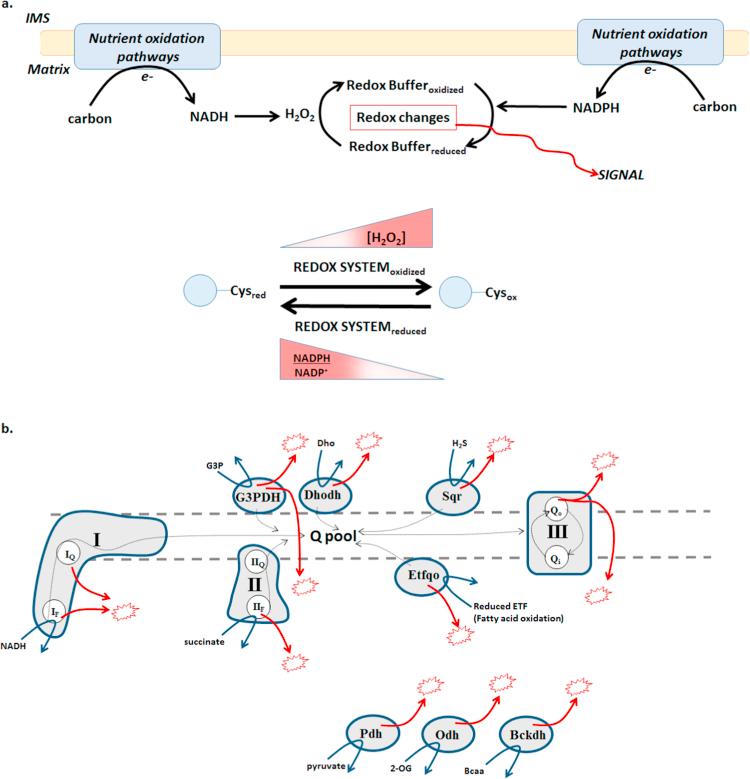
At its core mitochondrial function relies on redox reactions. Electrons stripped from nutrients are used to form NADH and NADPH, electron carriers that are similar in structure but support different functions. NADH supports ATP production but also generates reactive oxygen species (ROS), superoxide (O2(·-)) and hydrogen peroxide (H2O2). NADH-driven ROS production is counterbalanced by NADPH which maintains antioxidants in an active state. Mitochondria rely on a redox buffering network composed of reduced glutathione (GSH) and peroxiredoxins (Prx) to quench ROS generated by nutrient metabolism. As H2O2 is quenched, NADPH is expended to reactivate antioxidant networks and reset the redox environment. Thus, the mitochondrial redox environment is in a constant state of flux reflecting changes in nutrient and ROS metabolism. Changes in redox environment can modulate protein function through oxidation of protein cysteine thiols. Typically cysteine oxidation is considered to be mediated by H2O2 which oxidizes protein thiols (SH) forming sulfenic acid (SOH). However, problems begin to emerge when one critically evaluates the regulatory function of SOH. Indeed SOH formation is slow, non-specific, and once formed SOH reacts rapidly with a variety of molecules. By contrast, protein S-glutathionylation (PGlu) reactions involve the conjugation and removal of glutathione moieties from modifiable cysteine residues. PGlu reactions are driven by fluctuations in the availability of GSH and oxidized glutathione (GSSG) and thus should be exquisitely sensitive to changes ROS flux due to shifts in the glutathione pool in response to varying H2O2 availability. Here, we propose that energy metabolism-linked redox signals originating from mitochondria are mediated indirectly by H2O2 through the GSH redox buffering network in and outside mitochondria. This proposal is based on several observations that have shown that unlike other redox modifications PGlu reactions fulfill the requisite criteria to serve as an effective posttranslational modification that controls protein function.
线粒体功能的核心依赖于氧化还原反应。从营养物质中剥离的电子用于形成NADH和NADPH,这两种电子载体结构相似但支持不同功能。NADH支持ATP的产生,但也会产生活性氧(ROS)、超氧化物(O2(·-))和过氧化氢(H2O2)。由NADH驱动的ROS产生被NADPH所平衡,NADPH可使抗氧化剂维持在活性状态。线粒体依赖于由还原型谷胱甘肽(GSH)和过氧化物酶(Prx)组成的氧化还原缓冲网络来淬灭营养物质代谢产生的ROS。随着H2O2被淬灭,NADPH被消耗以重新激活抗氧化网络并重置氧化还原环境。因此,线粒体氧化还原环境处于不断变化的状态,反映了营养物质和ROS代谢的变化。氧化还原环境的变化可通过蛋白质半胱氨酸硫醇的氧化来调节蛋白质功能。通常认为半胱氨酸氧化是由H2O2介导的,H2O2氧化蛋白质硫醇(SH)形成亚磺酸(SOH)。然而,当人们批判性地评估SOH的调节功能时,问题就开始出现了。事实上,SOH的形成缓慢、非特异性,一旦形成,SOH会迅速与多种分子反应。相比之下,蛋白质S-谷胱甘肽化(PGlu)反应涉及从可修饰的半胱氨酸残基结合和去除谷胱甘肽部分。PGlu反应由GSH和氧化型谷胱甘肽(GSSG)可用性的波动驱动,因此由于谷胱甘肽池响应不同的H2O2可用性而发生变化,PGlu反应应该对ROS通量的变化非常敏感。在这里,我们提出源自线粒体的与能量代谢相关的氧化还原信号是由H2O2通过线粒体内外的GSH氧化还原缓冲网络间接介导的。这一观点基于多项观察结果,这些结果表明,与其他氧化还原修饰不同,PGlu反应符合作为控制蛋白质功能的有效翻译后修饰的必要标准。



 Zotero 插件