
一种新型的非经典骨形态发生蛋白(BMP)信号通路调节果蝇神经肌肉接头处的突触成熟。
A Novel, Noncanonical BMP Pathway Modulates Synapse Maturation at the Drosophila Neuromuscular Junction.
作者信息
Sulkowski Mikolaj J, Han Tae Hee, Ott Carolyn, Wang Qi, Verheyen Esther M, Lippincott-Schwartz Jennifer, Serpe Mihaela
机构信息
Program in Cellular Regulation and Metabolism, Eunice Kennedy Shriver National Institute of Child Health and Human Development (NICHD), National Institutes of Health (NIH), Bethesda, Maryland, United States of America.
Cellular Biology and Metabolism Program, Eunice Kennedy Shriver National Institute of Child Health and Human Development (NICHD), National Institutes of Health (NIH), Bethesda, Maryland, United States of America.
出版信息
PLoS Genet. 2016 Jan 27;12(1):e1005810. doi: 10.1371/journal.pgen.1005810. eCollection 2016 Jan.
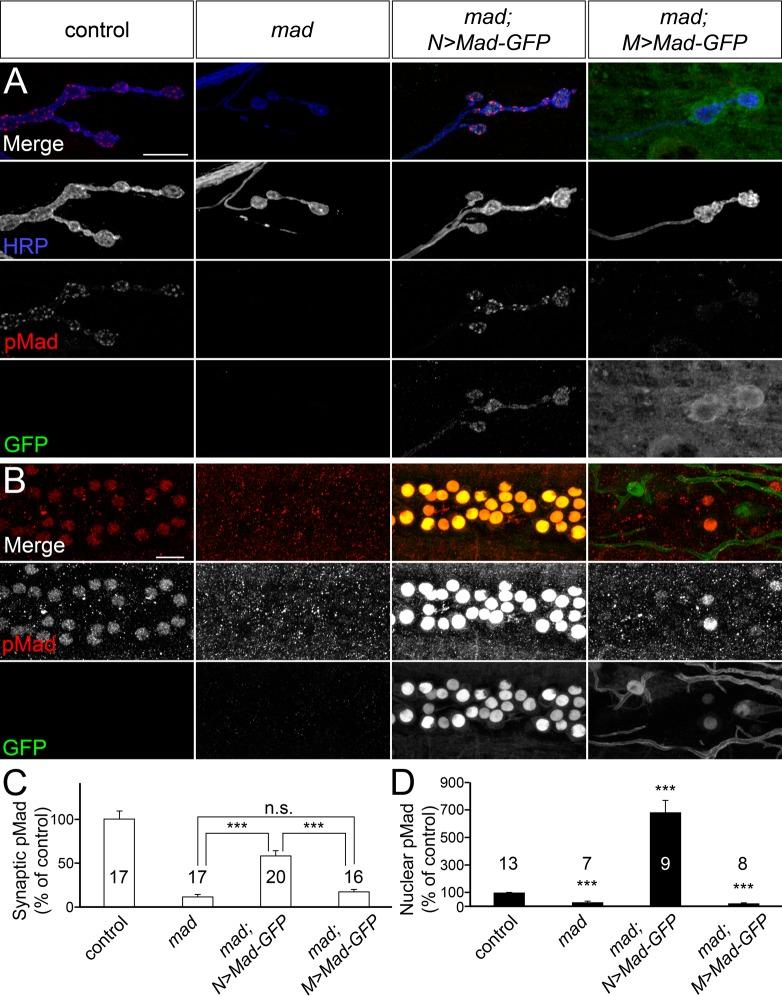
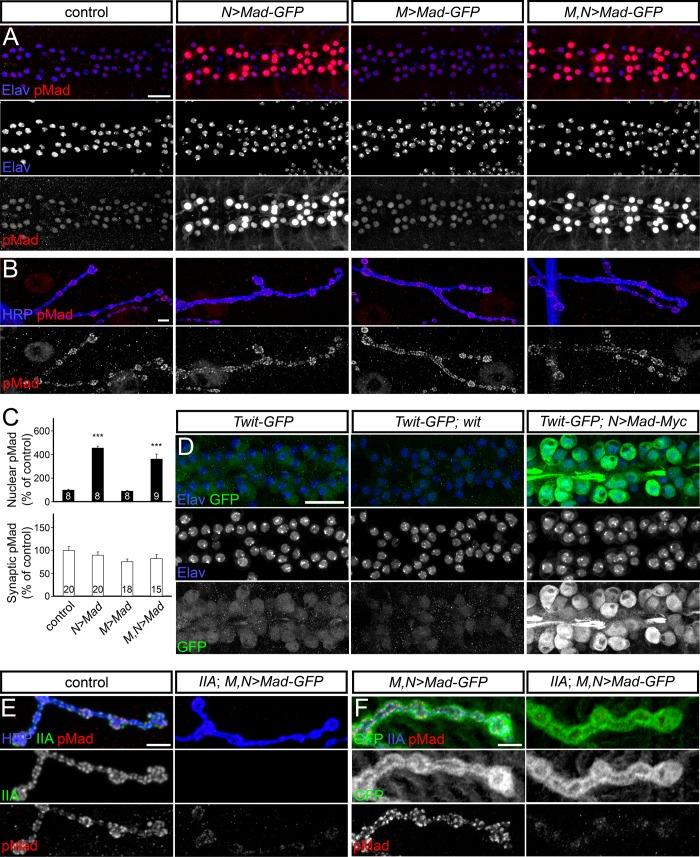
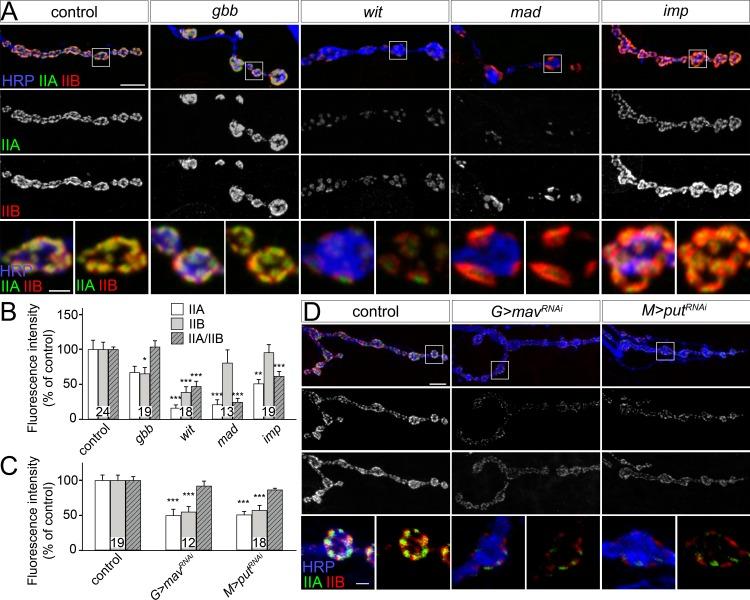
At the Drosophila NMJ, BMP signaling is critical for synapse growth and homeostasis. Signaling by the BMP7 homolog, Gbb, in motor neurons triggers a canonical pathway-which modulates transcription of BMP target genes, and a noncanonical pathway-which connects local BMP/BMP receptor complexes with the cytoskeleton. Here we describe a novel noncanonical BMP pathway characterized by the accumulation of the pathway effector, the phosphorylated Smad (pMad), at synaptic sites. Using genetic epistasis, histology, super resolution microscopy, and electrophysiology approaches we demonstrate that this novel pathway is genetically distinguishable from all other known BMP signaling cascades. This novel pathway does not require Gbb, but depends on presynaptic BMP receptors and specific postsynaptic glutamate receptor subtypes, the type-A receptors. Synaptic pMad is coordinated to BMP's role in the transcriptional control of target genes by shared pathway components, but it has no role in the regulation of NMJ growth. Instead, selective disruption of presynaptic pMad accumulation reduces the postsynaptic levels of type-A receptors, revealing a positive feedback loop which appears to function to stabilize active type-A receptors at synaptic sites. Thus, BMP pathway may monitor synapse activity then function to adjust synapse growth and maturation during development.
在果蝇神经肌肉接头处,骨形态发生蛋白(BMP)信号传导对于突触生长和稳态至关重要。BMP7同源物Gbb在运动神经元中的信号传导触发了一个经典途径(该途径调节BMP靶基因的转录)和一个非经典途径(该途径将局部BMP/BMP受体复合物与细胞骨架相连)。在这里,我们描述了一种新型的非经典BMP途径,其特征在于途径效应物磷酸化的Smad(pMad)在突触部位积累。使用遗传上位性、组织学、超分辨率显微镜和电生理学方法,我们证明了这种新型途径在遗传上与所有其他已知的BMP信号级联不同。这种新型途径不需要Gbb,但依赖于突触前BMP受体和特定的突触后谷氨酸受体亚型,即A型受体。突触pMad通过共享途径成分与BMP在靶基因转录控制中的作用相协调,但它在神经肌肉接头生长的调节中不起作用。相反,选择性破坏突触前pMad积累会降低A型受体的突触后水平,揭示出一个正反馈回路,该回路似乎起到在突触部位稳定活性A型受体的作用。因此,BMP途径可能监测突触活动,然后在发育过程中发挥作用以调节突触生长和成熟。






 Zotero 插件