
韩国成年人中马丁法估算低密度脂蛋白胆固醇水平的验证:来自2009 - 2011年韩国国家健康与营养检查调查的结果
Validation of the Martin Method for Estimating Low-Density Lipoprotein Cholesterol Levels in Korean Adults: Findings from the Korea National Health and Nutrition Examination Survey, 2009-2011.
作者信息
Lee Jongseok, Jang Sungok, Son Heejeong
机构信息
School of Business Administration, Hallym University, Chuncheon, Korea.
Korea Association of Health Promotion Gwangju-Jeonnam Branch, Gwangju, Korea.
出版信息
PLoS One. 2016 Jan 29;11(1):e0148147. doi: 10.1371/journal.pone.0148147. eCollection 2016.
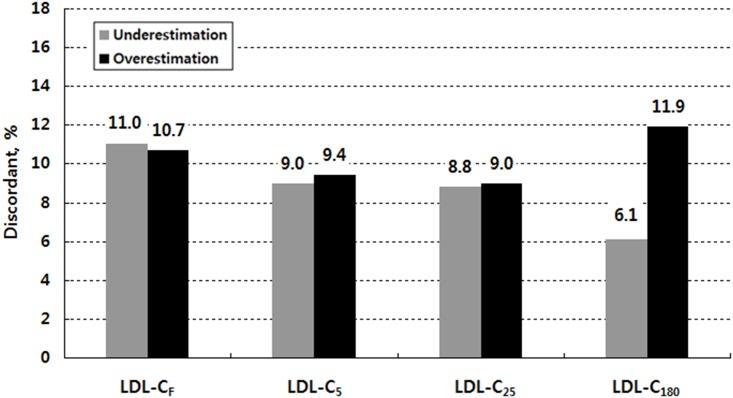
Despite the importance of accurate assessment for low-density lipoprotein cholesterol (LDL-C), the Friedewald formula has primarily been used as a cost-effective method to estimate LDL-C when triglycerides are less than 400 mg/dL. In a recent study, an alternative to the formula was proposed to improve estimation of LDL-C. We evaluated the performance of the novel method versus the Friedewald formula using a sample of 5,642 Korean adults with LDL-C measured by an enzymatic homogeneous assay (LDL-CD). Friedewald LDL-C (LDL-CF) was estimated using a fixed factor of 5 for the ratio of triglycerides to very-low-density lipoprotein cholesterol (TG:VLDL-C ratio). However, the novel LDL-C (LDL-CN) estimates were calculated using the N-strata-specific median TG:VLDL-C ratios, LDL-C5 and LDL-C25 from respective ratios derived from our data set, and LDL-C180 from the 180-cell table reported by the original study. Compared with LDL-CF, each LDL-CN estimate exhibited a significantly higher overall concordance in the NCEP-ATP III guideline classification with LDL-CD (p< 0.001 for each comparison). Overall concordance was 78.2% for LDL-CF, 81.6% for LDL-C5, 82.3% for LDL-C25, and 82.0% for LDL-C180. Compared to LDL-C5, LDL-C25 significantly but slightly improved overall concordance (p = 0.008). LDL-C25 and LDL-C180 provided almost the same overall concordance; however, LDL-C180 achieved superior improvement in classifying LDL-C < 70 mg/dL compared to the other estimates. In subjects with triglycerides of 200 to 399 mg/dL, each LDL-CN estimate showed a significantly higher concordance than that of LDL-CF (p< 0.001 for each comparison). The novel method offers a significant improvement in LDL-C estimation when compared with the Friedewald formula. However, it requires further modification and validation considering the racial differences as well as the specific character of the applied measuring method.
尽管准确评估低密度脂蛋白胆固醇(LDL-C)很重要,但当甘油三酯水平低于400mg/dL时,Friedewald公式主要被用作一种经济有效的方法来估算LDL-C。在最近的一项研究中,有人提出了该公式的替代方法以改进LDL-C的估算。我们使用5642名韩国成年人的样本评估了这种新方法与Friedewald公式的性能,这些成年人的LDL-C通过酶法均相测定(LDL-CD)进行测量。Friedewald LDL-C(LDL-CF)使用甘油三酯与极低密度脂蛋白胆固醇之比(TG:VLDL-C比)的固定因子5进行估算。然而,新的LDL-C(LDL-CN)估算值是使用N分层特定的TG:VLDL-C中位数比率、根据我们的数据集得出的各自比率中的LDL-C5和LDL-C25,以及原始研究报告的180单元格表中的LDL-C180来计算的。与LDL-CF相比,每个LDL-CN估算值在NCEP-ATP III指南分类中与LDL-CD的总体一致性显著更高(每次比较p<0.001)。LDL-CF的总体一致性为78.2%,LDL-C5为81.6%,LDL-C25为82.3%,LDL-C180为82.0%。与LDL-C5相比,LDL-C25显著但略有提高了总体一致性(p = 0.008)。LDL-C25和LDL-C180提供了几乎相同的总体一致性;然而,与其他估算值相比,LDL-C180在将LDL-C分类为<70mg/dL方面有更好的改进。在甘油三酯水平为200至399mg/dL的受试者中,每个LDL-CN估算值的一致性都显著高于LDL-CF(每次比较p<0.001)。与Friedewald公式相比,这种新方法在LDL-C估算方面有显著改进。然而,考虑到种族差异以及所应用测量方法的特殊性,它需要进一步修改和验证。

 Zotero 插件