
pVAC-Seq:一种基于基因组引导的计算机模拟方法来鉴定肿瘤新抗原。
pVAC-Seq: A genome-guided in silico approach to identifying tumor neoantigens.
作者信息
Hundal Jasreet, Carreno Beatriz M, Petti Allegra A, Linette Gerald P, Griffith Obi L, Mardis Elaine R, Griffith Malachi
机构信息
McDonnell Genome Institute, Washington University School of Medicine, St. Louis, MO, USA.
Department of Medicine, Division of Oncology, Washington University School of Medicine, St. Louis, MO, USA.
出版信息
Genome Med. 2016 Jan 29;8(1):11. doi: 10.1186/s13073-016-0264-5.
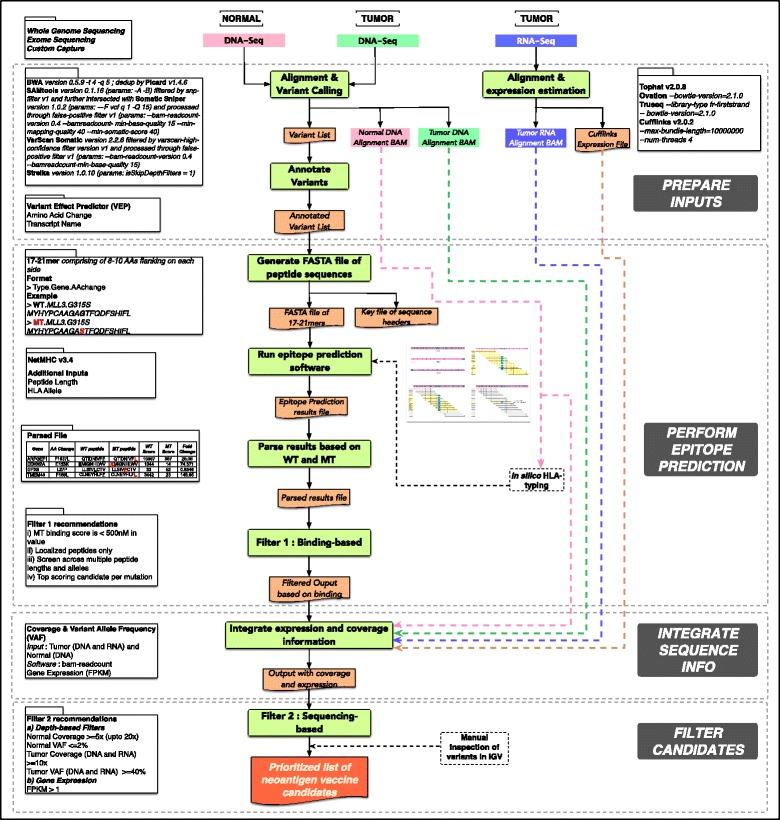
Cancer immunotherapy has gained significant momentum from recent clinical successes of checkpoint blockade inhibition. Massively parallel sequence analysis suggests a connection between mutational load and response to this class of therapy. Methods to identify which tumor-specific mutant peptides (neoantigens) can elicit anti-tumor T cell immunity are needed to improve predictions of checkpoint therapy response and to identify targets for vaccines and adoptive T cell therapies. Here, we present a flexible, streamlined computational workflow for identification of personalized Variant Antigens by Cancer Sequencing (pVAC-Seq) that integrates tumor mutation and expression data (DNA- and RNA-Seq). pVAC-Seq is available at https://github.com/griffithlab/pVAC-Seq .
癌症免疫疗法因近年来检查点阻断抑制的临床成功而获得了显著发展。大规模平行序列分析表明突变负荷与这类疗法的反应之间存在关联。为了改善对检查点疗法反应的预测,并确定疫苗和过继性T细胞疗法的靶点,需要有方法来识别哪些肿瘤特异性突变肽(新抗原)能够引发抗肿瘤T细胞免疫。在此,我们展示了一种灵活、简化的计算工作流程,即通过癌症测序鉴定个性化变异抗原(pVAC-Seq),该流程整合了肿瘤突变和表达数据(DNA测序和RNA测序)。pVAC-Seq可在https://github.com/griffithlab/pVAC-Seq获取。

 Zotero 插件