
顶复门寄生虫弓形虫和疟原虫的基体结构与组成
Basal body structure and composition in the apicomplexans Toxoplasma and Plasmodium.
作者信息
Francia Maria E, Dubremetz Jean-Francois, Morrissette Naomi S
机构信息
Cell Cycle Regulation Laboratory, Instituto Gulbenkian de Ciencia, Oeiras, Portugal.
UMR 5235 CNRS, Université de Montpellier 2, Montpellier, France.
出版信息
Cilia. 2016 Feb 4;5:3. doi: 10.1186/s13630-016-0025-5. eCollection 2015.
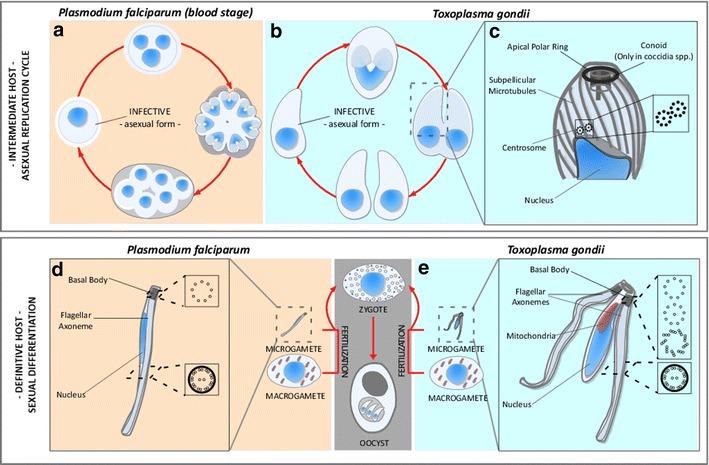
The phylum Apicomplexa encompasses numerous important human and animal disease-causing parasites, including the Plasmodium species, and Toxoplasma gondii, causative agents of malaria and toxoplasmosis, respectively. Apicomplexans proliferate by asexual replication and can also undergo sexual recombination. Most life cycle stages of the parasite lack flagella; these structures only appear on male gametes. Although male gametes (microgametes) assemble a typical 9+2 axoneme, the structure of the templating basal body is poorly defined. Moreover, the relationship between asexual stage centrioles and microgamete basal bodies remains unclear. While asexual stages of Plasmodium lack defined centriole structures, the asexual stages of Toxoplasma and closely related coccidian apicomplexans contain centrioles that consist of nine singlet microtubules and a central tubule. There are relatively few ultra-structural images of Toxoplasma microgametes, which only develop in cat intestinal epithelium. Only a subset of these include sections through the basal body: to date, none have unambiguously captured organization of the basal body structure. Moreover, it is unclear whether this basal body is derived from pre-existing asexual stage centrioles or is synthesized de novo. Basal bodies in Plasmodium microgametes are thought to be synthesized de novo, and their assembly remains ill-defined. Apicomplexan genomes harbor genes encoding δ- and ε-tubulin homologs, potentially enabling these parasites to assemble a typical triplet basal body structure. Moreover, the UNIMOD components (SAS6, SAS4/CPAP, and BLD10/CEP135) are conserved in these organisms. However, other widely conserved basal body and flagellar biogenesis elements are missing from apicomplexan genomes. These differences may indicate variations in flagellar biogenesis pathways and in basal body arrangement within the phylum. As apicomplexan basal bodies are distinct from their metazoan counterparts, it may be possible to selectively target parasite structures in order to inhibit microgamete motility which drives generation of genetic diversity in Toxoplasma and transmission for Plasmodium.
顶复门包含众多重要的导致人类和动物疾病的寄生虫,包括疟原虫属物种以及分别引发疟疾和弓形虫病的刚地弓形虫。顶复门寄生虫通过无性繁殖进行增殖,也能进行有性重组。寄生虫的大多数生命周期阶段缺乏鞭毛;这些结构仅出现在雄配子上。尽管雄配子(小配子)组装出典型的9+2轴丝,但模板化基体的结构却定义不明确。此外,无性阶段中心粒与小配子基体之间的关系仍不清楚。疟原虫的无性阶段缺乏明确的中心粒结构,而弓形虫和密切相关的球虫顶复门寄生虫的无性阶段含有由九条单微管和一条中央微管组成的中心粒。刚地弓形虫小配子的超微结构图像相对较少,它们仅在猫的肠道上皮中发育。其中只有一部分包括穿过基体的切片:迄今为止,没有一张能明确捕捉到基体结构的组织情况。此外,尚不清楚这个基体是源自已有的无性阶段中心粒还是重新合成的。疟原虫小配子中的基体被认为是重新合成的,其组装情况仍不明确。顶复门基因组含有编码δ-和ε-微管蛋白同源物的基因,这可能使这些寄生虫能够组装出典型的三联体基体结构。此外,这些生物中UNIMOD组件(SAS6、SAS4/CPAP和BLD10/CEP135)是保守的。然而,顶复门基因组中缺少其他广泛保守的基体和鞭毛生物发生元件。这些差异可能表明该门内鞭毛生物发生途径和基体排列存在差异。由于顶复门基体与其后生动物对应物不同,有可能选择性地靶向寄生虫结构,以抑制小配子运动,而小配子运动驱动了弓形虫的遗传多样性产生以及疟原虫的传播。

 Zotero 插件