
脂质管理在一株进化葡萄酒酵母菌株的氮和香气代谢中的关键作用
Key role of lipid management in nitrogen and aroma metabolism in an evolved wine yeast strain.
作者信息
Rollero Stéphanie, Mouret Jean-Roch, Sanchez Isabelle, Camarasa Carole, Ortiz-Julien Anne, Sablayrolles Jean-Marie, Dequin Sylvie
机构信息
INRA, UMR1083, 34060, Montpellier, France.
SupAgro, UMR1083, 34060, Montpellier, France.
出版信息
Microb Cell Fact. 2016 Feb 9;15:32. doi: 10.1186/s12934-016-0434-6.
BACKGROUND
Fermentative aromas play a key role in the organoleptic profile of young wines. Their production depends both on yeast strain and fermentation conditions. A present-day trend in the wine industry consists in developing new strains with aromatic properties using adaptive evolution approaches. An evolved strain, Affinity™ ECA5, overproducing esters, was recently obtained. In this study, dynamics of nitrogen consumption and of the fermentative aroma synthesis of the evolved and its ancestral strains were compared and coupled with a transcriptomic analysis approach to better understand the metabolic reshaping of Affinity™ ECA5.
RESULTS
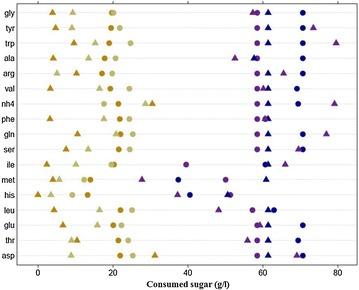
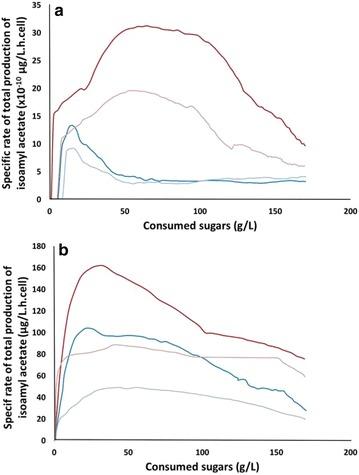
Nitrogen assimilation was different between the two strains, particularly amino acids transported by carriers regulated by nitrogen catabolite repression. We also observed differences in the kinetics of fermentative aroma production, especially in the bioconversion of higher alcohols into acetate esters. Finally, transcriptomic data showed that the enhanced bioconversion into acetate esters by the evolved strain was associated with the repression of genes involved in sterol biosynthesis rather than an enhanced expression of ATF1 and ATF2 (genes coding for the enzymes responsible for the synthesis of acetate esters from higher alcohols).
CONCLUSIONS
An integrated approach to yeast metabolism-combining transcriptomic analyses and online monitoring data-showed differences between the two strains at different levels. Differences in nitrogen source consumption were observed suggesting modifications of NCR in the evolved strain. Moreover, the evolved strain showed a different way of managing the lipid source, which notably affected the production of acetate esters, likely because of a greater availability of acetyl-CoA for the evolved strain.
背景
发酵香气在年轻葡萄酒的感官特征中起着关键作用。其产生既取决于酵母菌株,也取决于发酵条件。葡萄酒行业目前的一个趋势是利用适应性进化方法开发具有芳香特性的新菌株。最近获得了一种进化菌株Affinity™ ECA5,它能过量产生酯类物质。在本研究中,比较了进化菌株及其原始菌株的氮消耗和发酵香气合成动态,并结合转录组分析方法,以更好地理解Affinity™ ECA5的代谢重塑。
结果
两种菌株之间的氮同化存在差异,特别是由氮分解代谢物阻遏调节的载体转运的氨基酸。我们还观察到发酵香气产生动力学的差异,尤其是高级醇向乙酸酯的生物转化。最后,转录组数据表明,进化菌株增强的乙酸酯生物转化与甾醇生物合成相关基因的抑制有关,而不是与ATF1和ATF2(编码负责从高级醇合成乙酸酯的酶的基因)的表达增强有关。
结论
一种综合酵母代谢的方法——结合转录组分析和在线监测数据——在不同水平上显示了两种菌株之间的差异。观察到氮源消耗的差异,表明进化菌株中氮分解代谢物阻遏发生了改变。此外,进化菌株表现出不同的脂质源管理方式,这显著影响了乙酸酯的产生,可能是因为进化菌株有更多的乙酰辅酶A可用。




 Zotero 插件