
度洛西汀对抑郁症疼痛性躯体症状的影响是抑郁症状改善的间接结果吗?三项随机对照试验的汇总分析。
Is duloxetine's effect on painful physical symptoms in depression an indirect result of improvement of depressive symptoms? Pooled analyses of three randomized controlled trials.
作者信息
Harada Eiji, Tokuoka Hirofumi, Fujikoshi Shinji, Funai Jumpei, Wohlreich Madelaine M, Ossipov Michael H, Iwata Nakao
机构信息
Medical Science, Eli Lilly Japan K.K., Kobe, Hyogo, Japan Statistical Science, Eli Lilly Japan K.K., Kobe, Hyogo, Japan Science Communications, Eli Lilly Japan K.K., Kobe, Hyogo, Japan Global Neuroscience, Eli Lilly and Company, Indianapolis, IN, USA inVentiv Health Clinical, LLC, Ann Arbor, MI, USA Department of Psychiatry, Fujita Health University School of Medicine, Toyoake, Aichi, Japan.
出版信息
Pain. 2016 Mar;157(3):577-584. doi: 10.1097/j.pain.0000000000000406.
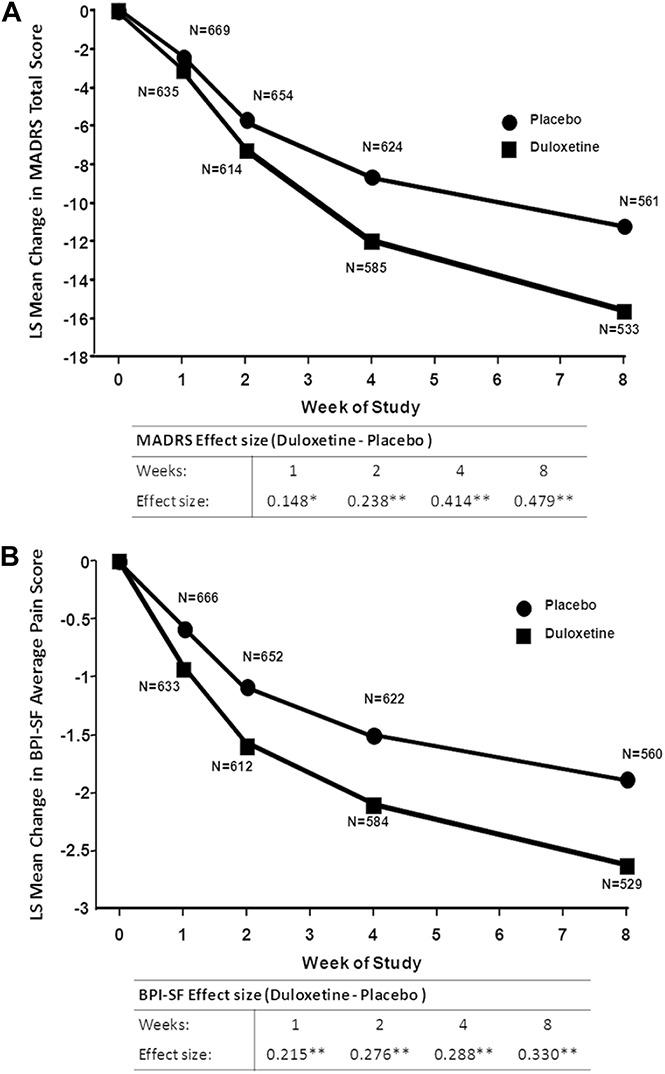
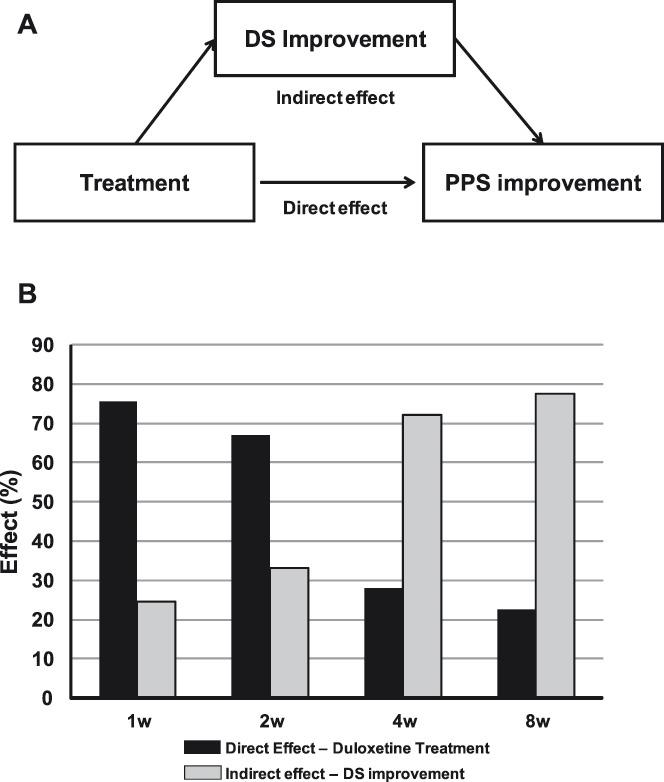
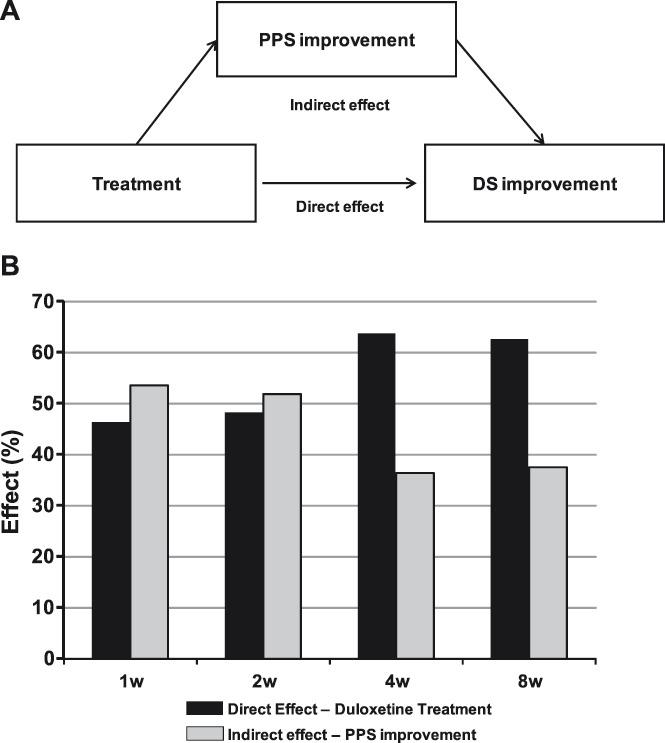
In treating Major Depressive Disorder with associated painful physical symptoms (PPS), the effect of duloxetine on PPS has been shown to decompose into a direct effect on PPS and an indirect effect on PPS via depressive symptoms (DS) improvement. To evaluate the changes in relative contributions of the direct and indirect effects over time, we analyzed pooled data from 3 randomized double-blind studies comparing duloxetine 60 mg/d with placebo in patients with major depressive disorder and PPS. Changes from baseline in Montgomery-Åsberg Depression Rating Scale total and Brief Pain Inventory-Short Form average pain score were assessed over 8 weeks. Path analysis examined the (1) direct effect of treatment on PPS and/or indirect effect on PPS via DS improvement and (2) direct effect of treatment on DS and/or indirect effect on DS via PPS improvement. At week 1, the direct effect of duloxetine on PPS (75.3%) was greater than the indirect effect through DS improvement (24.7%) but became less (22.6%) than the indirect effect (77.4%) by week 8. Initially, the direct effect of duloxetine on PPS was markedly greater than its indirect effect, whereas later the indirect effect predominated. Conversely, at week 1, the direct effect of treatment on DS (46.4%) was less than the indirect effect (53.6%), and by week 8 it superseded (62.6%) the indirect effect (37.4%). Thus, duloxetine would relieve PPS directly in the initial phase and indirectly via improving DS in the later phase.
在治疗伴有疼痛性躯体症状(PPS)的重度抑郁症时,度洛西汀对PPS的疗效已被证明可分解为对PPS的直接作用和通过改善抑郁症状(DS)对PPS产生的间接作用。为了评估直接作用和间接作用的相对贡献随时间的变化,我们分析了3项随机双盲研究的汇总数据,这些研究比较了60mg/d度洛西汀与安慰剂对重度抑郁症伴PPS患者的疗效。在8周内评估蒙哥马利-Åsberg抑郁评定量表总分和简明疼痛量表简表平均疼痛评分相对于基线的变化。路径分析考察了(1)治疗对PPS的直接作用和/或通过改善DS对PPS的间接作用,以及(2)治疗对DS的直接作用和/或通过改善PPS对DS的间接作用。在第1周,度洛西汀对PPS的直接作用(75.3%)大于通过改善DS产生的间接作用(24.7%),但到第8周时,直接作用(22.6%)小于间接作用(77.4%)。最初,度洛西汀对PPS的直接作用明显大于其间接作用,而后来间接作用占主导地位。相反,在第1周,治疗对DS的直接作用(46.4%)小于间接作用(53.6%),到第8周时,直接作用(62.6%)超过了间接作用(37.4%)。因此,度洛西汀在初始阶段直接缓解PPS,在后期通过改善DS间接缓解PPS。
 Zotero 插件