
集体细胞行为的时间调制控制血管网络拓扑结构。
Temporal modulation of collective cell behavior controls vascular network topology.
作者信息
Kur Esther, Kim Jiha, Tata Aleksandra, Comin Cesar H, Harrington Kyle I, Costa Luciano da F, Bentley Katie, Gu Chenghua
机构信息
Department of Neurobiology, Harvard Medical School, Boston, United States.
Instituto de Física de São Carlos, University of Sao Paulo, Sao Carlos, Brazil.
出版信息
Elife. 2016 Feb 24;5:e13212. doi: 10.7554/eLife.13212.
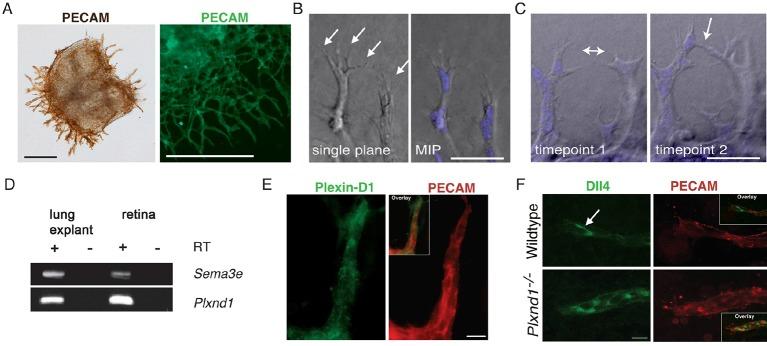
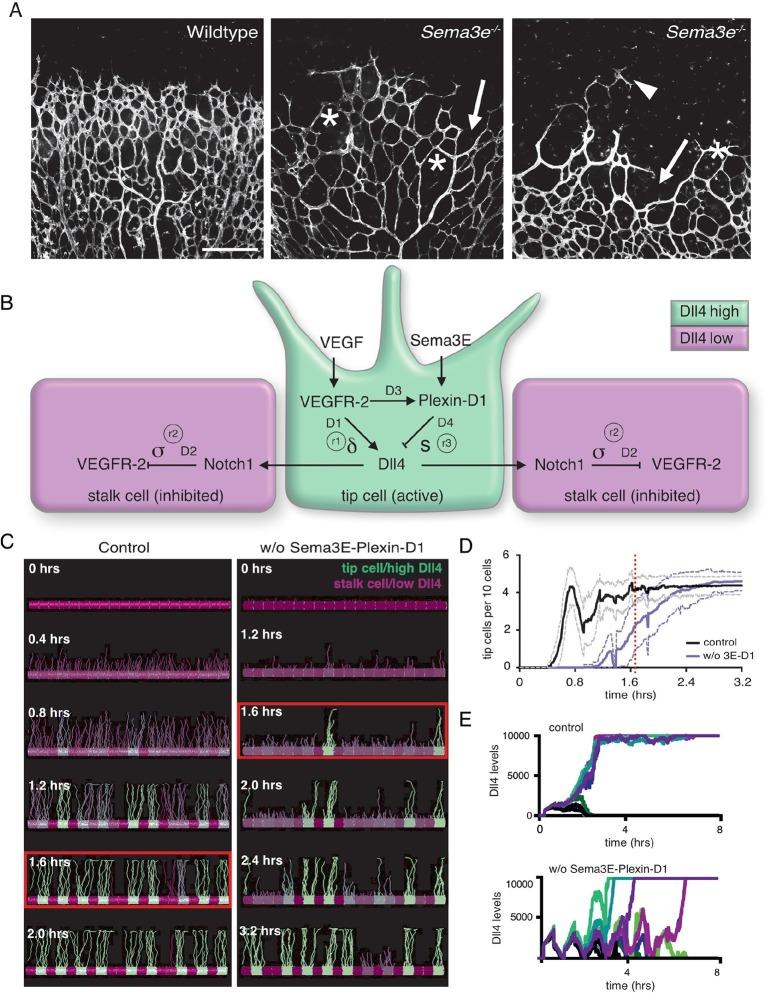
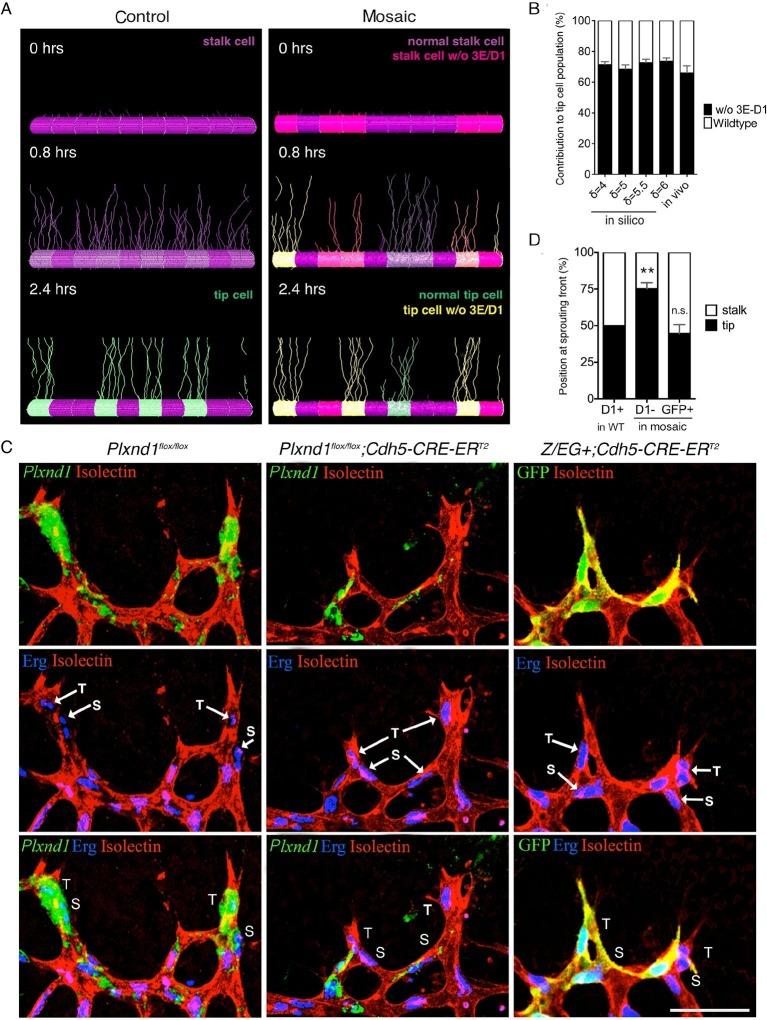
Vascular network density determines the amount of oxygen and nutrients delivered to host tissues, but how the vast diversity of densities is generated is unknown. Reiterations of endothelial-tip-cell selection, sprout extension and anastomosis are the basis for vascular network generation, a process governed by the VEGF/Notch feedback loop. Here, we find that temporal regulation of this feedback loop, a previously unexplored dimension, is the key mechanism to determine vascular density. Iterating between computational modeling and in vivo live imaging, we demonstrate that the rate of tip-cell selection determines the length of linear sprout extension at the expense of branching, dictating network density. We provide the first example of a host tissue-derived signal (Semaphorin3E-Plexin-D1) that accelerates tip cell selection rate, yielding a dense network. We propose that temporal regulation of this critical, iterative aspect of network formation could be a general mechanism, and additional temporal regulators may exist to sculpt vascular topology.
血管网络密度决定了输送到宿主组织的氧气和营养物质的量,但如此多样的密度是如何产生的尚不清楚。内皮尖端细胞的选择、芽的延伸和吻合的反复进行是血管网络形成的基础,这一过程由VEGF/Notch反馈回路控制。在这里,我们发现这个反馈回路的时间调节(一个以前未被探索的维度)是决定血管密度的关键机制。通过在计算模型和体内实时成像之间反复研究,我们证明尖端细胞的选择速率决定了线性芽延伸的长度,代价是分支减少,从而决定了网络密度。我们提供了第一个宿主组织衍生信号(Semaphorin3E-Plexin-D1)的例子,该信号可加速尖端细胞的选择速率,产生致密的网络。我们提出,对网络形成这一关键的反复过程进行时间调节可能是一种普遍机制,并且可能存在其他时间调节因子来塑造血管拓扑结构。


 Zotero 插件