
在时间和空间尺度上检测选择:对袋獾面部肿瘤病选择性反应的基因组时间序列评估
Detecting Selection on Temporal and Spatial Scales: A Genomic Time-Series Assessment of Selective Responses to Devil Facial Tumor Disease.
作者信息
Brüniche-Olsen Anna, Austin Jeremy J, Jones Menna E, Holland Barbara R, Burridge Christopher P
机构信息
School of Biological Sciences, University of Tasmania, Private Bag 55, Hobart 7001, Tasmania, Australia.
School of Earth & Environmental Sciences, University of Adelaide, North Terrace Campus, South Australia, 5005, Australia.
出版信息
PLoS One. 2016 Mar 1;11(3):e0147875. doi: 10.1371/journal.pone.0147875. eCollection 2016.
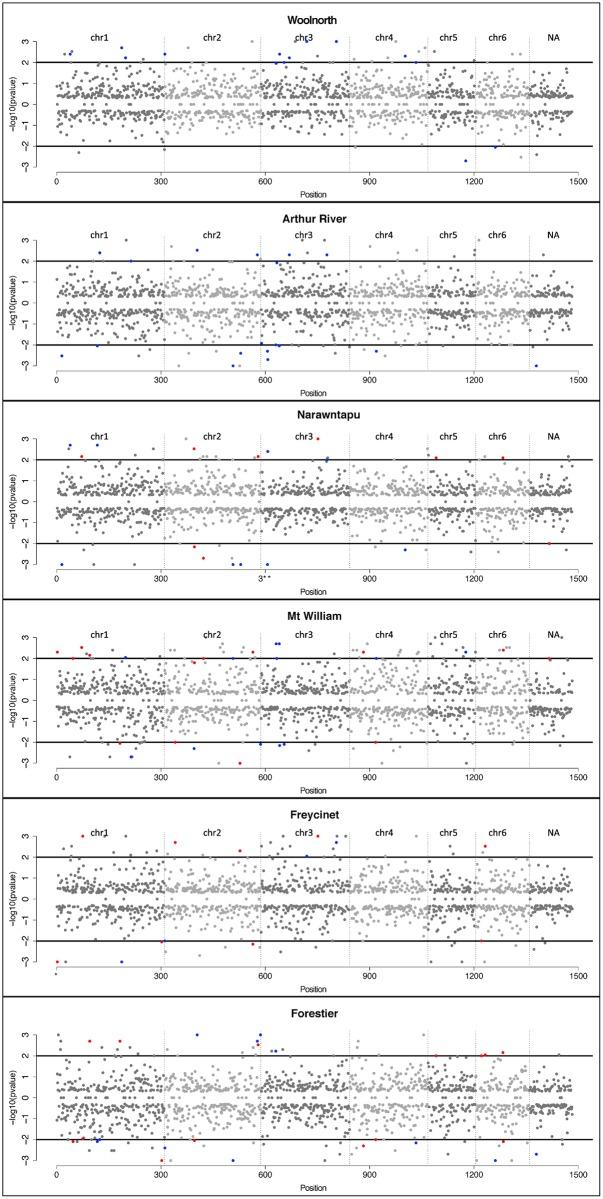
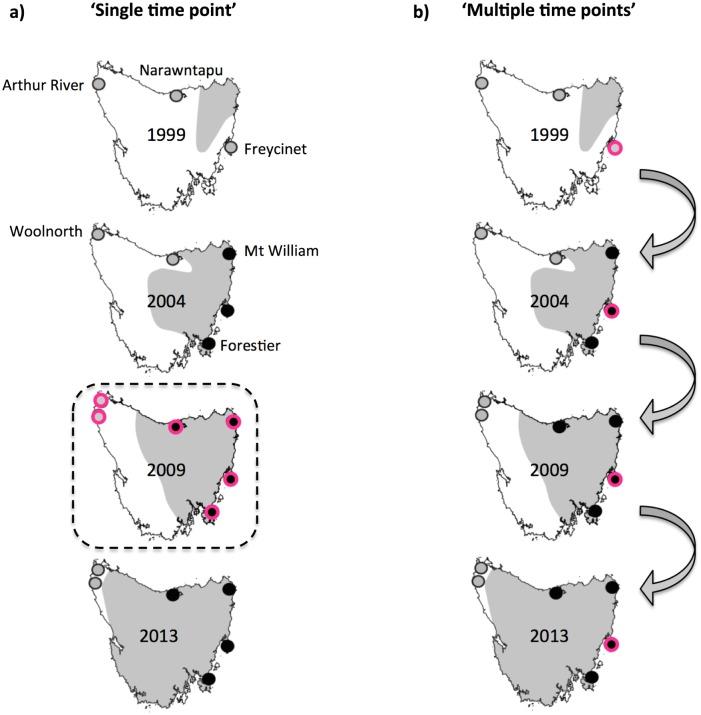
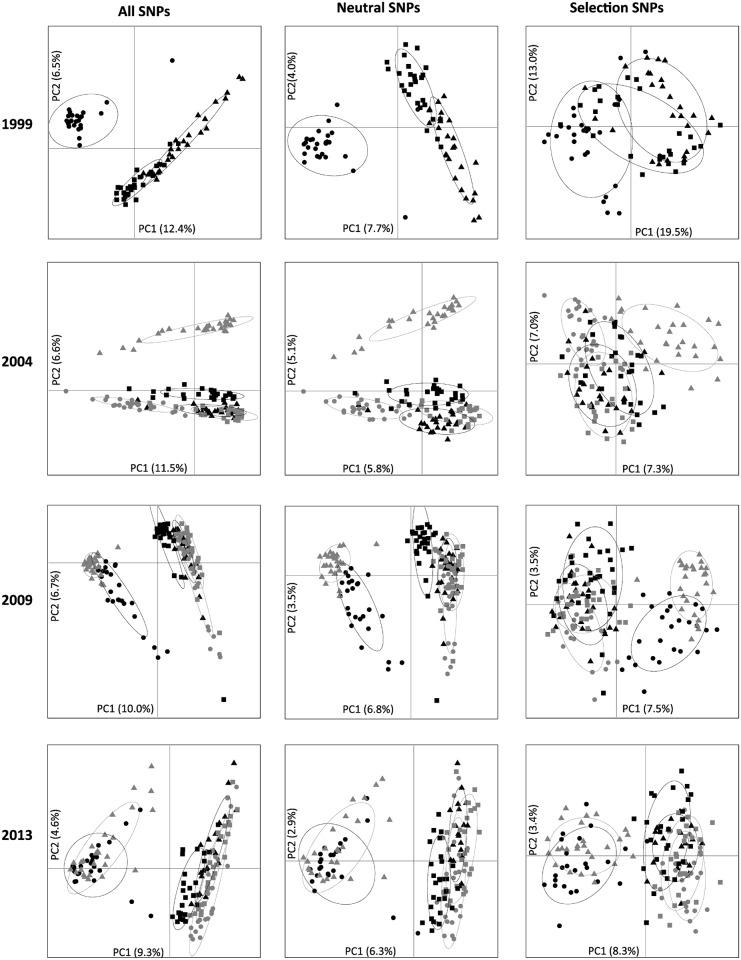
Detecting loci under selection is an important task in evolutionary biology. In conservation genetics detecting selection is key to investigating adaptation to the spread of infectious disease. Loci under selection can be detected on a spatial scale, accounting for differences in demographic history among populations, or on a temporal scale, tracing changes in allele frequencies over time. Here we use these two approaches to investigate selective responses to the spread of an infectious cancer--devil facial tumor disease (DFTD)--that since 1996 has ravaged the Tasmanian devil (Sarcophilus harrisii). Using time-series 'restriction site associated DNA' (RAD) markers from populations pre- and post DFTD arrival, and DFTD free populations, we infer loci under selection due to DFTD and investigate signatures of selection that are incongruent among methods, populations, and times. The lack of congruence among populations influenced by DFTD with respect to inferred loci under selection, and the direction of that selection, fail to implicate a consistent selective role for DFTD. Instead genetic drift is more likely driving the observed allele frequency changes over time. Our study illustrates the importance of applying methods with different performance optima e.g. accounting for population structure and background selection, and assessing congruence of the results.
检测受到选择作用的基因座是进化生物学中的一项重要任务。在保护遗传学中,检测选择作用是研究对传染病传播适应性的关键。可以在空间尺度上检测受到选择作用的基因座,同时考虑不同种群在种群历史上的差异;也可以在时间尺度上进行检测,追踪等位基因频率随时间的变化。在此,我们运用这两种方法来研究对一种传染性癌症——袋獾面部肿瘤疾病(DFTD)传播的选择性反应,自1996年以来,这种疾病一直在肆虐袋獾(袋獾属哈里斯袋獾)。利用DFTD出现前后种群以及未受DFTD影响种群的时间序列“限制性位点关联DNA”(RAD)标记,我们推断出因DFTD而受到选择作用的基因座,并研究在方法、种群和时间方面不一致的选择特征。受DFTD影响的种群在推断出的受到选择作用的基因座以及该选择作用的方向上缺乏一致性,这表明DFTD并没有起到一致的选择作用。相反,遗传漂变更有可能推动了随时间观察到的等位基因频率变化。我们的研究说明了应用具有不同最佳性能的方法(例如考虑种群结构和背景选择)以及评估结果一致性的重要性。

 Zotero 插件