
利用野生大豆(Glycine soja Sieb. & Zucc.)染色体片段代换系对百粒重进行QTL定位及上位性效应分析
QTL Location and Epistatic Effect Analysis of 100-Seed Weight Using Wild Soybean (Glycine soja Sieb. & Zucc.) Chromosome Segment Substitution Lines.
作者信息
Xin Dawei, Qi Zhaoming, Jiang Hongwei, Hu Zhenbang, Zhu Rongsheng, Hu Jiahui, Han Heyu, Hu Guohua, Liu Chunyan, Chen Qingshan
机构信息
Key Laboratory of Soybean Biology of Chinese Ministry of Education, Key Laboratory of Soybean Biology and Breeding/Genetics of Chinese Agriculture Ministry, College of Science, Northeast Agricultural University, Harbin, Heilongjiang Province, People's Republic of China.
School of Life Sciences and Center for Soybean Research of the Partner State Key Laboratory of Agrobiotechnology, The Chinese University of Hong Kong, Shatin, Hong Kong, SAR, China.
出版信息
PLoS One. 2016 Mar 2;11(3):e0149380. doi: 10.1371/journal.pone.0149380. eCollection 2016.
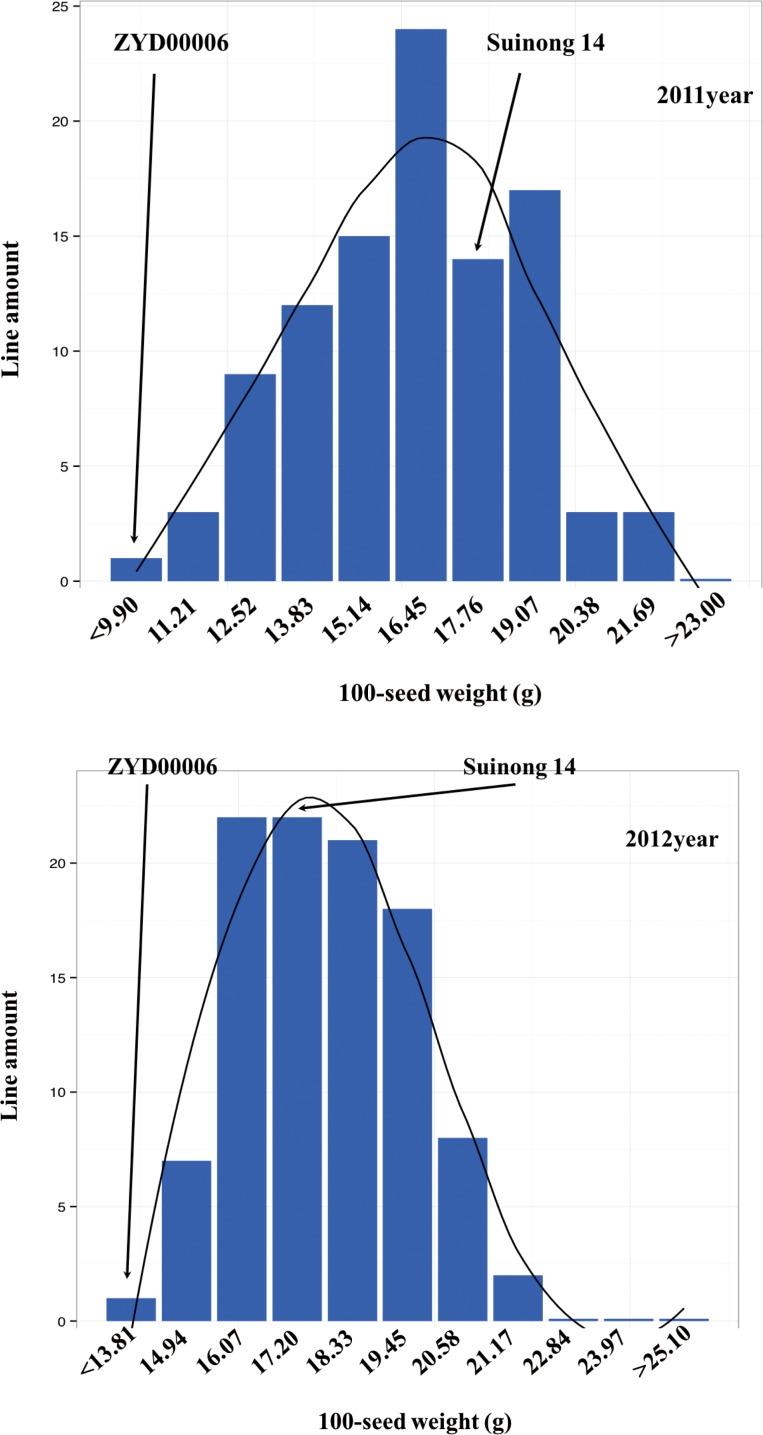
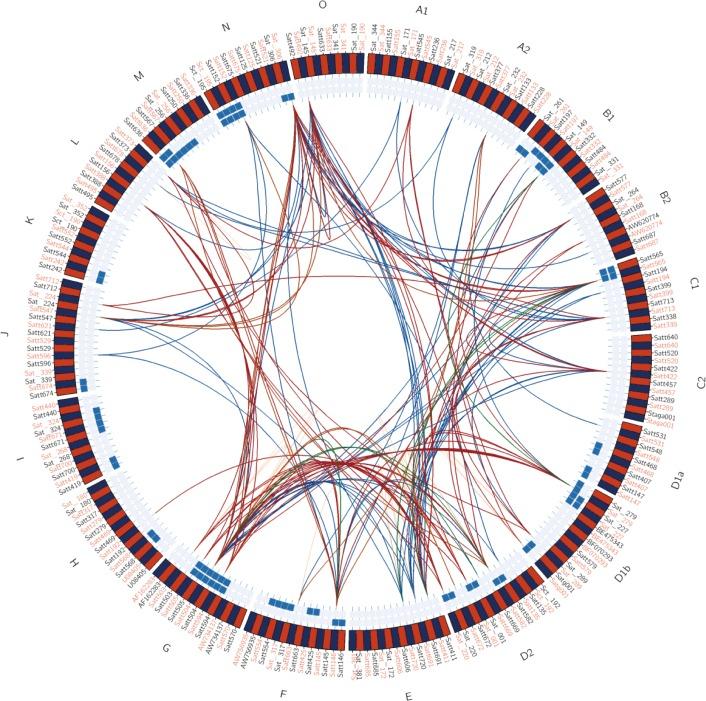
Increasing the yield of soybean (Glycine max L. Merrill) is a main aim of soybean breeding. The 100-seed weight is a critical factor for soybean yield. To facilitate genetic analysis of quantitative traits and to improve the accuracy of marker-assisted breeding in soybean, a valuable mapping population consisting of 194 chromosome segment substitution lines (CSSLs) was developed. In these lines, different chromosomal segments of the Chinese cultivar Suinong 14 were substituted into the genetic background of wild soybean (Glycine soja Sieb. & Zucc.) ZYD00006. Based on these CSSLs, a genetic map covering the full genome was generated using 121 simple sequence repeat (SSR) markers. In the quantitative trait loci (QTL) analysis, twelve main effect QTLs (qSW-B1-1/2/3, qSW-D1b-1/2, qSW-D2-1/2, qSW-G-1/2/3, qSW-M-2 and qSW-N-2) underlying 100-seed weight were identified in 2011 and 2012. The epistatic effects of pairwise interactions between markers were analyzed in 2011 and 2012. The results clearly demonstrated that these CSSLs could be used to identify QTLs, and that an epistatic analysis was able to detect several sites with important epistatic effects on 100-seed weight. Thus, we identified loci that will be valuable for improving soybean 100-seed weight. These results provide a valuable foundation for identifying the precise location of genes of interest, and for designing cloning and marker-assisted selection breeding strategies targeting the 100-seed weight of soybean.
提高大豆(Glycine max L. Merrill)产量是大豆育种的主要目标。百粒重是影响大豆产量的关键因素。为便于对数量性状进行遗传分析并提高大豆标记辅助育种的准确性,构建了一个由194个染色体片段代换系(CSSLs)组成的珍贵作图群体。在这些品系中,中国品种绥农14的不同染色体片段被代换到野生大豆(Glycine soja Sieb. & Zucc.)ZYD00006的遗传背景中。基于这些CSSLs,利用121个简单序列重复(SSR)标记构建了覆盖全基因组的遗传图谱。在数量性状位点(QTL)分析中,2011年和2012年共鉴定出12个控制百粒重的主效QTL(qSW-B1-1/2/3、qSW-D1b-1/2、qSW-D2-1/2、qSW-G-1/2/3、qSW-M-2和qSW-N-2)。2011年和2012年对标记间成对互作的上位性效应进行了分析。结果清楚地表明,这些CSSLs可用于鉴定QTL,且上位性分析能够检测到几个对百粒重具有重要上位性效应的位点。因此,我们鉴定出了对提高大豆百粒重有价值的位点。这些结果为确定目标基因的精确位置,以及设计针对大豆百粒重的克隆和标记辅助选择育种策略提供了宝贵的基础。


 Zotero 插件