
非穿孔性急性阑尾炎抗生素治疗与阑尾切除术的荟萃分析。
Meta-analysis of antibiotics versus appendicectomy for non-perforated acute appendicitis.
作者信息
Sallinen V, Akl E A, You J J, Agarwal A, Shoucair S, Vandvik P O, Agoritsas T, Heels-Ansdell D, Guyatt G H, Tikkinen K A O
机构信息
Departments of Abdominal Surgery, Helsinki University Hospital and University of Helsinki, Helsinki, Finland.
Departments of Transplantation and Liver Surgery, Helsinki University Hospital and University of Helsinki, Helsinki, Finland.
出版信息
Br J Surg. 2016 May;103(6):656-667. doi: 10.1002/bjs.10147. Epub 2016 Mar 17.
BACKGROUND
For more than a century, appendicectomy has been the treatment of choice for appendicitis. Recent trials have challenged this view. This study assessed the benefits and harms of antibiotic therapy compared with appendicectomy in patients with non-perforated appendicitis.
METHODS
A comprehensive search was conducted for randomized trials comparing antibiotic therapy with appendicectomy in patients with non-perforated appendicitis. Key outcomes were analysed using random-effects meta-analysis, and the quality of evidence was assessed using the Grading of Recommendations Assessment, Development and Evaluation (GRADE) approach.
RESULTS
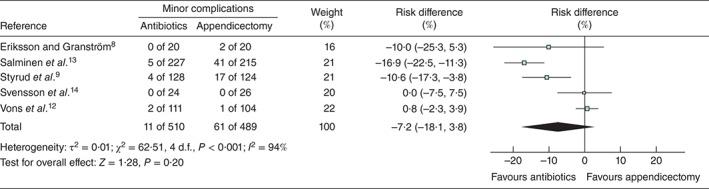
Five studies including 1116 patients reported major complications in 25 (4·9 per cent) of 510 patients in the antibiotic and 41 (8·4 per cent) of 489 in the appendicectomy group: risk difference -2·6 (95 per cent c.i. -6·3 to 1·1) per cent (low-quality evidence). Minor complications occurred in 11 (2·2 per cent) of 510 and 61 (12·5 per cent) of 489 patients respectively: risk difference -7·2 (-18·1 to 3·8) per cent (very low-quality evidence). Of 550 patients in the antibiotic group, 47 underwent appendicectomy within 1 month: pooled estimate 8·2 (95 per cent c.i. 5·2 to 11·8) per cent (high-quality evidence). Within 1 year, appendicitis recurred in 114 of 510 patients in the antibiotic group: pooled estimate 22·6 (15·6 to 30·4) per cent (high-quality evidence). For every 100 patients with non-perforated appendicitis, initial antibiotic therapy compared with prompt appendicectomy may result in 92 fewer patients receiving surgery within the first month, and 23 more experiencing recurrent appendicitis within the first year.
CONCLUSION
The choice of medical versus surgical management in patients with clearly uncomplicated appendicitis is value- and preference-dependent, suggesting a change in practice towards shared decision-making is necessary.
背景
一个多世纪以来,阑尾切除术一直是阑尾炎的首选治疗方法。近期的试验对这一观点提出了挑战。本研究评估了非穿孔性阑尾炎患者中抗生素治疗与阑尾切除术相比的益处和危害。
方法
对比较非穿孔性阑尾炎患者抗生素治疗与阑尾切除术的随机试验进行全面检索。使用随机效应荟萃分析对关键结局进行分析,并使用推荐分级评估、制定和评价(GRADE)方法评估证据质量。
结果
五项研究共纳入1116例患者,报告抗生素组510例患者中有25例(4.9%)发生主要并发症,阑尾切除组489例患者中有41例(8.4%)发生主要并发症:风险差为-2.6(95%可信区间-6.3至1.1)%(低质量证据)。抗生素组510例患者中有11例(2.2%)发生轻微并发症,阑尾切除组489例患者中有61例(12.5%)发生轻微并发症:风险差为-7.2(-18.1至3.8)%(极低质量证据)。抗生素组550例患者中,47例在1个月内接受了阑尾切除术:汇总估计值为8.2(95%可信区间5.2至11.8)%(高质量证据)。1年内,抗生素组510例患者中有114例阑尾炎复发:汇总估计值为22.6(15.6至30.4)%(高质量证据)。对于每100例非穿孔性阑尾炎患者,与立即进行阑尾切除术相比,初始抗生素治疗可能导致第一个月内接受手术的患者减少92例,第一年阑尾炎复发的患者增加23例。
结论
对于明确无并发症的阑尾炎患者,选择药物治疗还是手术治疗取决于价值和偏好,这表明有必要改变实践方式,转向共同决策。


 Zotero 插件