
与经动脉化疗栓塞术或索拉非尼相比,肝切除术治疗伴有门静脉癌栓的肝细胞癌的生存结局。
Survival outcomes of hepatic resection compared with transarterial chemoembolization or sorafenib for hepatocellular carcinoma with portal vein tumor thrombosis.
作者信息
Lee Jung Min, Jang Byoung Kuk, Lee Yoo Jin, Choi Wang Yong, Choi Sei Myong, Chung Woo Jin, Hwang Jae Seok, Kang Koo Jeong, Kim Young Hwan, Chauhan Anil Kumar, Park Soo Young, Tak Won Young, Kweon Young Oh, Kim Byung Seok, Lee Chang Hyeong
机构信息
Department of Internal Medicine, Keimyung University School of Medicine, Daegu, Korea.
Department of Surgery, Keimyung University School of Medicine, Daegu, Korea.
出版信息
Clin Mol Hepatol. 2016 Mar;22(1):160-7. doi: 10.3350/cmh.2016.22.1.160. Epub 2016 Mar 28.
BACKGROUND/AIMS: Treating hepatocellular carcinoma (HCC) with portal vein tumor thrombosis (PVTT) remains controversial. We compared the outcomes of hepatic resection (HR), transarterial chemoembolization (TACE), and sorafenib therapy as treatments for HCC with PVTT.
METHODS
Patients diagnosed as HCC with PVTT between January 2000 and December 2011 who received treatment with sorafenib, HR, or TACE were included. Patients with main PVTT, superior mesenteric vein tumor thrombosis, or Child-Turcotte-Pugh (CTP) class C were excluded. The records of 172 patients were analyzed retrospectively. HR, TACE, and sorafenib treatment were performed is 40, 80, and 52 patients respectively. PVTT was classified as either involving the segmental branch (type I) or extending to involve the right or left portal vein (type II).
RESULTS
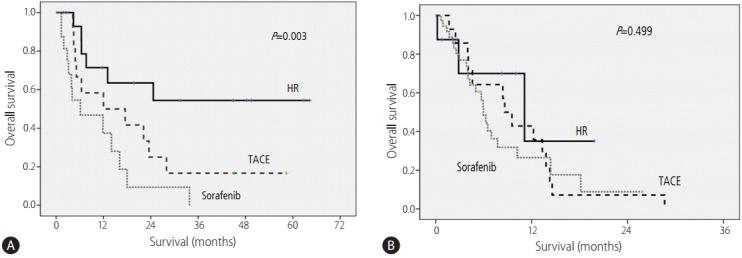
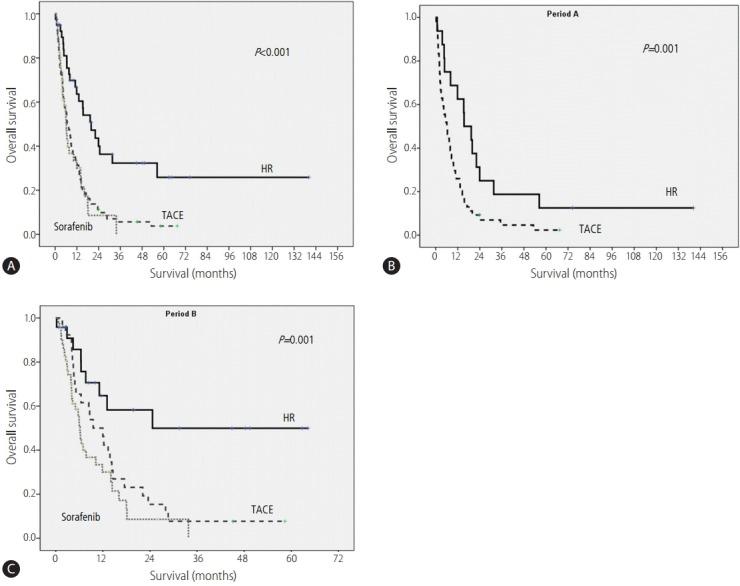
The median survival time was significantly longer in the HR group (19.9 months) than in the TACE and sorafenib groups (6.6 and 6.2 months, respectively; both p<0.001), and did not differ significantly between the latter two groups (p=0.698). Among patients with CTP class A, type I PVTT or unilobar-involved HCC, the median survival time was longer in the HR group than in the TACE and sorafenib groups (p=0.006). In univariate analyses, the initial treatment method, tumor size, PVTT type, involved lobe, CTP class, and presence of cirrhosis or ascites were correlated with overall survival. The significant prognostic factors for overall survival in Cox proportional-hazards regression analysis were initial treatment method (HR vs. TACE: hazard ratio=1.750, p=0.036; HR vs. sorafenib: hazard ratio=2.262, p=0.006), involved lobe (hazard ratio=1.705, p=0.008), PVTT type (hazard ratio=1.617, p=0.013), and CTP class (hazard ratio=1.712, p=0.012).
CONCLUSIONS
Compared with TACE or sorafenib, HR may prolong the survival of patients with HCC in cases of CTP class A, type I PVTT or unilobar-involved HCC.
背景/目的:门静脉癌栓(PVTT)的肝细胞癌(HCC)治疗仍存在争议。我们比较了肝切除(HR)、经动脉化疗栓塞(TACE)和索拉非尼治疗HCC合并PVTT的疗效。
方法
纳入2000年1月至2011年12月期间诊断为HCC合并PVTT并接受索拉非尼、HR或TACE治疗的患者。排除主要PVTT、肠系膜上静脉癌栓或Child-Turcotte-Pugh(CTP)C级患者。回顾性分析172例患者的记录。分别有40、80和52例患者接受了HR、TACE和索拉非尼治疗。PVTT分为累及节段性分支(I型)或延伸至累及右或左门静脉(II型)。
结果
HR组的中位生存时间(19.9个月)显著长于TACE组和索拉非尼组(分别为6.6个月和6.2个月;均p<0.001),后两组之间无显著差异(p=0.698)。在CTP A级、I型PVTT或单叶受累HCC患者中,HR组的中位生存时间长于TACE组和索拉非尼组(p=0.006)。单因素分析中,初始治疗方法、肿瘤大小、PVTT类型、受累肝叶、CTP分级以及是否存在肝硬化或腹水与总生存相关。Cox比例风险回归分析中总生存的显著预后因素为初始治疗方法(HR与TACE比较:风险比=1.750,p=0.036;HR与索拉非尼比较:风险比=2.262,p=0.006)、受累肝叶(风险比=1.705,p=0.008)、PVTT类型(风险比=1.617,p=0.013)和CTP分级(风险比=1.712,p=0.012)。
结论
与TACE或索拉非尼相比,对于CTP A级、I型PVTT或单叶受累HCC患者,HR可能延长其生存期。
 Zotero 插件