
非参检者中进行人乳头瘤病毒检测的自我采样可提高挪威宫颈癌筛查计划的参检率。
Self-Sampling for Human Papillomavirus Testing among Non-Attenders Increases Attendance to the Norwegian Cervical Cancer Screening Programme.
作者信息
Enerly Espen, Bonde Jesper, Schee Kristina, Pedersen Helle, Lönnberg Stefan, Nygård Mari
机构信息
Department of Research, Cancer Registry of Norway, Oslo University Hospital, Oslo, Norway.
Department of Pathology, Copenhagen University Hospital Hvidovre, Hvidovre, Denmark.
出版信息
PLoS One. 2016 Apr 13;11(4):e0151978. doi: 10.1371/journal.pone.0151978. eCollection 2016.
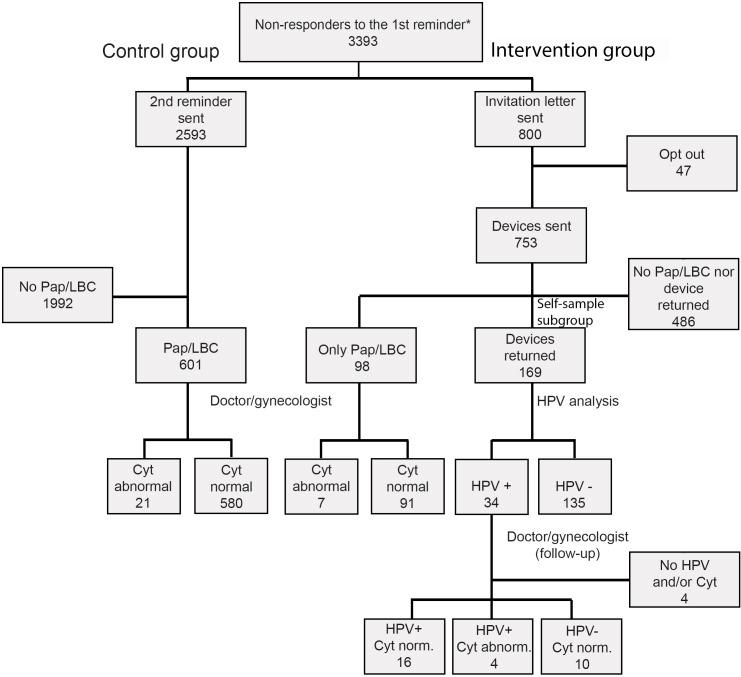
Increasing attendance to screening offers the best potential for improving the effectiveness of well-established cervical cancer screening programs. Self-sampling at home for human papillomavirus (HPV) testing as an alternative to a clinical sampling can be a useful policy to increase attendance. To determine whether self-sampling improves screening attendance for women who do not regularly attend the Norwegian Cervical Cancer Screening Programme (NCCSP), 800 women aged 25-69 years in the Oslo area who were due to receive a 2nd reminder to attend regular screening were randomly selected and invited to be part of the intervention group. Women in this group received one of two self-sampling devices, Evalyn Brush or Delphi Screener. To attend screening, women in the intervention group had the option of using the self-sampling device (self-sampling subgroup) or visiting their physician for a cervical smear. Self-sampled specimens were split and analyzed for the presence of high-risk (hr) HPV by the CLART® HPV2 test and the digene® Hybrid Capture (HC)2 test. The control group consisted of 2593 women who received a 2nd reminder letter according to the current guidelines of the NCCSP. The attendance rates were 33.4% in the intervention group and 23.2% in the control group, with similar attendance rates for both self-sampling devices. Women in the self-sampling subgroup responded favorably to both self-sampling devices and cited not remembering receiving a call for screening as the most dominant reason for previous non-attendance. Thirty-two of 34 (94.1%) hrHPV-positive women in the self-sampling subgroup attended follow-up. In conclusion, self-sampling increased attendance rates and was feasible and well received. This study lends further support to the proposal that self-sampling may be a valuable alternative for increasing cervical cancer screening coverage in Norway.
提高筛查参与率为提升成熟的宫颈癌筛查项目的有效性提供了最佳潜力。在家进行人乳头瘤病毒(HPV)检测的自我采样作为临床采样的替代方法,可能是提高参与率的一项有用政策。为了确定自我采样是否能提高未定期参加挪威宫颈癌筛查项目(NCCSP)的女性的筛查参与率,随机选取了奥斯陆地区800名年龄在25至69岁、即将收到第二次定期筛查提醒的女性,并邀请她们加入干预组。该组女性收到两种自我采样设备之一,即Evalyn刷或Delphi筛查器。为了参加筛查,干预组的女性可以选择使用自我采样设备(自我采样亚组)或去看医生进行宫颈涂片检查。自我采集的样本被分开,并通过CLART® HPV2检测和digene® Hybrid Capture(HC)2检测分析高危(hr)HPV的存在情况。对照组由2593名根据NCCSP现行指南收到第二次提醒信的女性组成。干预组的参与率为33.4%,对照组为23.2%,两种自我采样设备的参与率相似。自我采样亚组的女性对两种自我采样设备反应良好,并指出不记得收到过筛查通知是之前未参与的最主要原因。自我采样亚组中34名hrHPV阳性女性中有32名(94.1%)参加了随访。总之,自我采样提高了参与率,是可行的且受到好评。这项研究进一步支持了自我采样可能是增加挪威宫颈癌筛查覆盖率的一种有价值替代方法的提议。
 Zotero 插件