
河南省输入性非洲恶性疟原虫分离株中pfcrt基因的分子突变谱
Molecular mutation profile of pfcrt in Plasmodium falciparum isolates imported from Africa in Henan province.
作者信息
Zhou Rui-Min, Zhang Hong-Wei, Yang Cheng-Yun, Liu Ying, Zhao Yu-Ling, Li Su-Hua, Qian Dan, Xu Bian-Li
机构信息
Department of Parasite Disease Control and Prevention, Henan Province Center for Disease Control and Prevention, Zhengzhou, 450016, People's Republic of China.
出版信息
Malar J. 2016 May 10;15(1):265. doi: 10.1186/s12936-016-1306-6.
BACKGROUND
Anti-malarial drug resistance is a primary public health problem. Haplotypes of pfcrt gene have been implicated to be molecular markers of chloroquine (CQ) resistance. This study aims to explore the prevalence of polymorphisms in pfcrt in Plasmodium falciparum-infected patients imported from Africa in Henan province.
METHODS
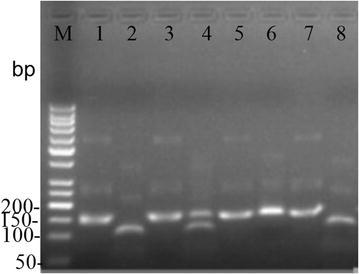
Blood samples were collected from 502 patients who were infected with P. falciparum returning from Africa in Henan province during 2012-2015. The single nucleotide polymorphisms in pfcrt (codons 72-76) were assessed by nested PCR with DNA sequencing and restriction digestion, the haplotype prevalences were also determined.
RESULTS
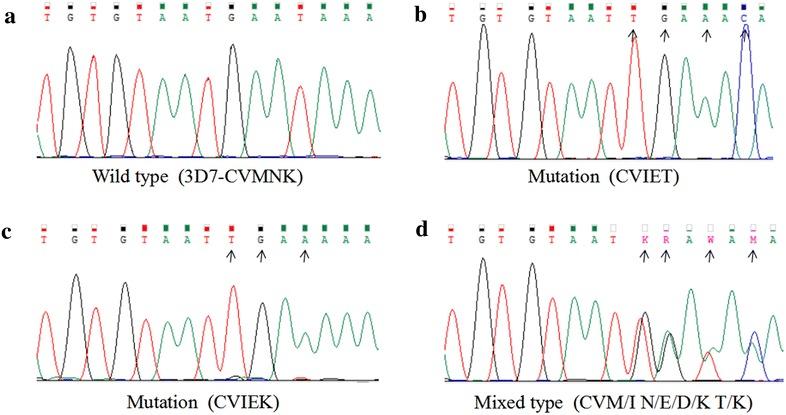
Four haplotypes coding 72-76 of pfcrt were found including CVMNK (wild type), CVIET (mutation type), CVIEK (mutation type), and CV M/I N/E/D/K K/T (mixed type), with 61.95 % (311/502), 33.07 % (166/502), 0.20 % (1/502), and 4.78 % (24/502) prevalence, respectively. Except mixed type, CVIET and CVIEK were the largest proportion of the mutant type in West Africa, accounting for 44.83 % (91/203), followed by East Africa (8/21, 38.10 %), North Africa (4/11, 36.36 %), Central Africa (36/135, 26.67 %), and South Africa (28/132, 21.21 %). There was significant difference among the groups (χ(2) = 23.78, P < 0.05). Mixed type was the largest proportion in North Africa (9.09 %), followed by Central Africa (6.67 %), East Africa (4.76 %), South Africa (4.55 %), and West Africa (3.45 %). There was no significant difference among the groups (χ(2) = 2.31, P > 0.05). The position 72 and 73 of pfcrt showed predominance for the wild type with rates of 100 % (502/502).
CONCLUSIONS
This study identified four haplotypes of pfcrt in P. falciparum-infected patients imported from Africa in Henan province. The prevalence of mutations in the pfcrt was dropped comparing with other people's researches. It establishes fundamental data for detection of P. falciparum CQR with molecular markers for the imported P. falciparum in China, and it also provides complementary information of CQR for the malaria endemic countries and assesses the evolution of anti-malarial drug resistance.
背景
抗疟药物耐药性是一个主要的公共卫生问题。恶性疟原虫转运蛋白(pfcrt)基因单倍型被认为是氯喹(CQ)耐药性的分子标志物。本研究旨在探讨河南省从非洲输入的恶性疟原虫感染患者中pfcrt基因多态性的流行情况。
方法
收集2012 - 2015年期间河南省502例从非洲返回且感染恶性疟原虫的患者的血样。采用巢式PCR结合DNA测序和限制性酶切分析评估pfcrt(第72 - 76密码子)的单核苷酸多态性,并确定单倍型的流行情况。
结果
发现编码pfcrt第72 - 76位的四种单倍型,包括CVMNK(野生型)、CVIET(突变型)、CVIEK(突变型)和CV M/I N/E/D/K K/T(混合型),其流行率分别为61.95%(311/502)、33.07%(166/502)、0.20%(1/502)和4.78%(24/502)。除混合型外,CVIET和CVIEK在西非突变型中占比最大,为44.83%(91/203),其次是东非(8/21,38.10%)、北非(4/11,36.36%)、中非(36/135,26.67%)和南非(28/132,21.21%)。各群体间差异有统计学意义(χ(2)=23.78,P<0.05)。混合型在北非占比最大(9.09%),其次是中非(6.67%)、东非(4.76%)、南非(4.55%)和西非(3.45%)。各群体间差异无统计学意义(χ(2)=2.31,P>0.05)。pfcrt第72和73位以野生型为主,比例为100%(502/502)。
结论
本研究在河南省从非洲输入的恶性疟原虫感染患者中鉴定出四种pfcrt单倍型。与其他人的研究相比,pfcrt基因突变的流行率有所下降。本研究为我国输入性恶性疟原虫以分子标志物检测恶性疟原虫氯喹耐药性建立了基础数据,也为疟疾流行国家提供了氯喹耐药性的补充信息,并评估了抗疟药物耐药性的演变。
 Zotero 插件