
吸气肌训练促进机械通气患者康复:一项随机试验
Inspiratory muscle training to enhance recovery from mechanical ventilation: a randomised trial.
作者信息
Bissett Bernie M, Leditschke I Anne, Neeman Teresa, Boots Robert, Paratz Jennifer
机构信息
School of Medicine, University of Queensland, Brisbane, Queensland, Australia Discipline of Physiotherapy, University of Canberra, Australia Physiotherapy Department, Canberra Hospital, Canberra, Australian Capital Territory, Australia.
Intensive Care Unit, Canberra Hospital, Canberra, Australian Capital Territory, Australia Intensive Care Unit, Mater Hospital, Brisbane, Queensland, Australia School of Medicine, Australian National University, Canberra, Australian Capital Territory, Australia.
出版信息
Thorax. 2016 Sep;71(9):812-9. doi: 10.1136/thoraxjnl-2016-208279. Epub 2016 Jun 2.
BACKGROUND
In patients who have been mechanically ventilated, inspiratory muscles remain weak and fatigable following ventilatory weaning, which may contribute to dyspnoea and limited functional recovery. Inspiratory muscle training may improve inspiratory muscle strength and endurance following weaning, potentially improving dyspnoea and quality of life in this patient group.
METHODS
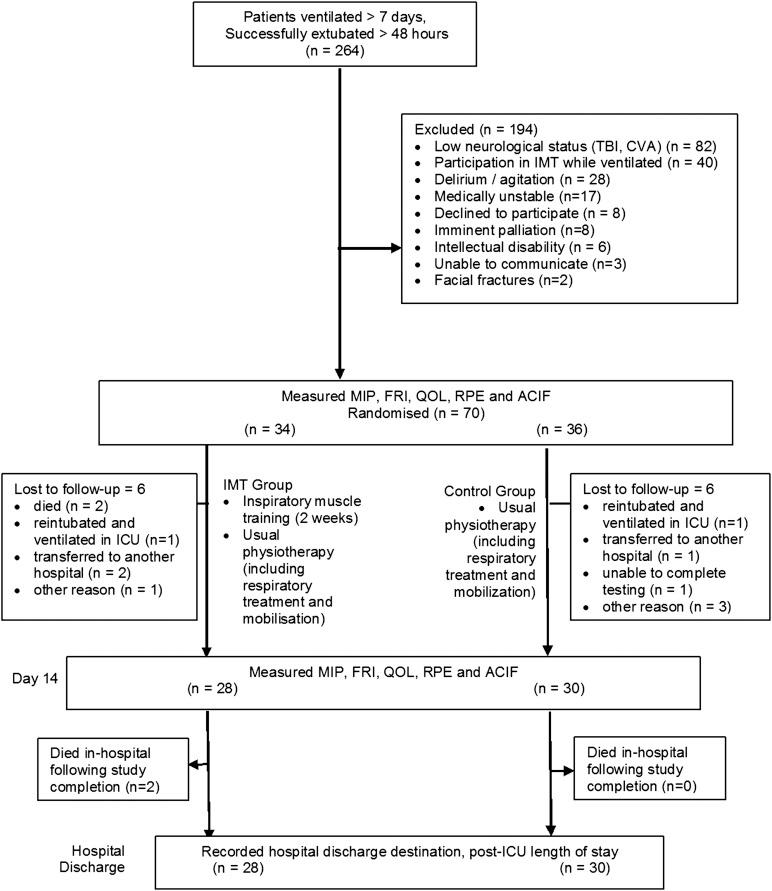
We conducted a randomised trial with assessor-blinding and intention-to-treat analysis. Following 48 hours of successful weaning, 70 participants (mechanically ventilated ≥7 days) were randomised to receive inspiratory muscle training once daily 5 days/week for 2 weeks in addition to usual care, or usual care (control). Primary endpoints were inspiratory muscle strength and fatigue resistance index (FRI) 2 weeks following enrolment. Secondary endpoints included dyspnoea, physical function and quality of life, post-intensive care length of stay and in-hospital mortality.
RESULTS
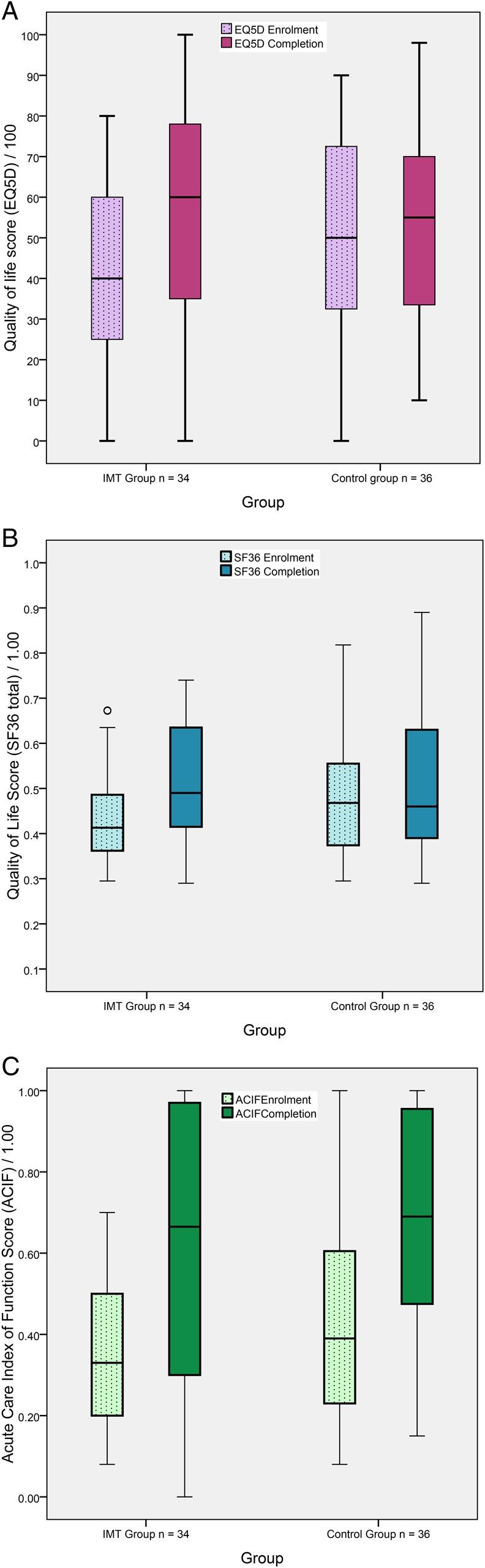
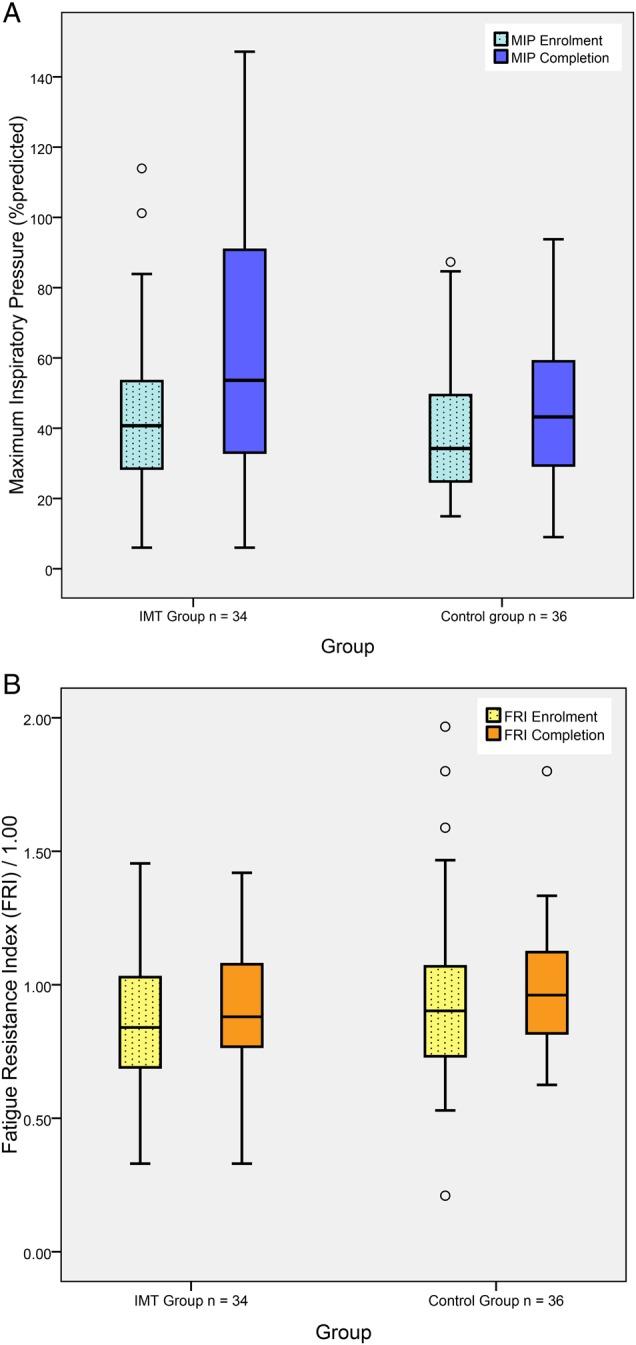
34 participants were randomly allocated to the training group and 36 to control. The training group demonstrated greater improvements in inspiratory strength (training: 17%, control: 6%, mean difference: 11%, p=0.02). There were no statistically significant differences in FRI (0.03 vs 0.02, p=0.81), physical function (0.25 vs 0.25, p=0.97) or dyspnoea (-0.5 vs 0.2, p=0.22). Improvement in quality of life was greater in the training group (14% vs 2%, mean difference 12%, p=0.03). In-hospital mortality was higher in the training group (4 vs 0, 12% vs 0%, p=0.051).
CONCLUSIONS
Inspiratory muscle training following successful weaning increases inspiratory muscle strength and quality of life, but we cannot confidently rule out an associated increased risk of in-hospital mortality.
TRIAL REGISTRATION NUMBER
ACTRN12610001089022, results.
背景
在接受机械通气的患者中,撤机后吸气肌仍会保持虚弱且易疲劳,这可能会导致呼吸困难以及功能恢复受限。吸气肌训练可能会改善撤机后的吸气肌力量和耐力,从而有可能改善该患者群体的呼吸困难症状和生活质量。
方法
我们进行了一项采用评估者盲法和意向性分析的随机试验。在成功撤机48小时后,70名参与者(机械通气≥7天)被随机分组,一组除接受常规护理外,还每周5天、每天接受一次吸气肌训练,共2周;另一组仅接受常规护理(对照组)。主要终点是入组2周后的吸气肌力量和疲劳抵抗指数(FRI)。次要终点包括呼吸困难、身体功能和生活质量、重症监护后的住院时间以及院内死亡率。
结果
34名参与者被随机分配至训练组,36名被分配至对照组。训练组在吸气力量方面有更大改善(训练组:17%,对照组:6%,平均差异:11%,p = 0.02)。FRI(0.03对0.02,p = 0.81)、身体功能(0.25对0.25,p = 0.97)或呼吸困难(-0.5对0.2,p = 0.22)方面无统计学显著差异。训练组生活质量的改善更大(14%对2%,平均差异12%,p = 0.03)。训练组的院内死亡率更高(4例对0例,12%对0%,p = 0.051)。
结论
成功撤机后进行吸气肌训练可增加吸气肌力量和生活质量,但我们不能确定地排除其与院内死亡率增加相关的风险。
试验注册号
ACTRN12610001089022,结果 。

 Zotero 插件