
对1型、2型、3型、6型和7型脊髓小脑共济失调患者认知与疾病进展的纵向研究。
A longitudinal investigation into cognition and disease progression in spinocerebellar ataxia types 1, 2, 3, 6, and 7.
作者信息
Moriarty Amy, Cook Arron, Hunt Helen, Adams Matthew E, Cipolotti Lisa, Giunti Paola
机构信息
Department of Neuropsychology, National Hospital for Neurology and Neurosurgery, Queen Square, London, WC1N 3BG, UK.
Department of Molecular Neuroscience, Ataxia Centre, UCL Institute of Neurology, Queen Square, London, WC1N 3BG, UK.
出版信息
Orphanet J Rare Dis. 2016 Jun 22;11(1):82. doi: 10.1186/s13023-016-0447-6.
BACKGROUND
The natural history of clinical symptoms in the spinocerebellar ataxias (SCA)s has been well characterised. However there is little longitudinal data comparing cognitive changes in the most common SCA subtypes over time. The present study provides a preliminary longitudinal characterisation of the clinical and cognitive profiles in patients with SCA1, SCA2, SCA3, SCA6 and SCA7, with the aim of elucidating the role of the cerebellum in cognition.
METHODS
13 patients with different SCAs all caused by CAG repeat expansion (SCA1, n = 2; SCA2, n = 2; SCA3, n = 2; SCA6, n = 4; and SCA7, n = 3) completed a comprehensive battery of cognitive and mood assessments at two time points, a mean of 7.35 years apart. All patients were evaluated clinically using the Scale for the Rating and Assessment of Ataxia (SARA) and the Inventory of Non-Ataxia Signs (INAS). Patients underwent structural MRI imaging at follow-up.
RESULTS
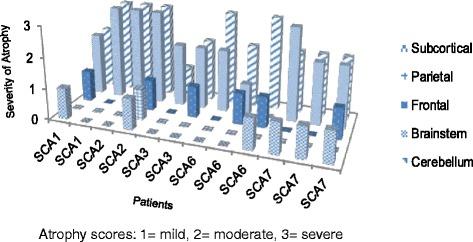
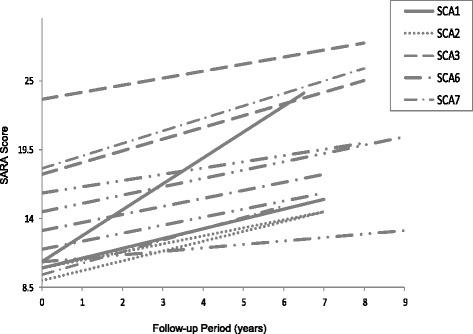
Clinical scale scores increased in all patients over time, most prominently in the SCA1 (SARA) and SCA3 (INAS) groups. New impairments on neuropsychological tests were most commonly observed with executive functions, speed, attention, visual memory and Theory of Mind. Results suggest possible differences in cognitive decline in SCA subtypes, with the most rapid cognitive decline observed in the SCA1 patients, and the least in the SCA6 patients, congruent with observed patterns of motor deterioration. Minimal changes in mood were observed, and MRI measures of atrophy did not correlate with cognitive decline.
CONCLUSION
As well as increasing physical impairment, cognitive decline over time appears to be a distinct aspect of the SCA phenotype, in keeping with the cerebellar cognitive-affective syndrome. Our data suggest a trend of cognitive decline that is different for each SCA subtype, and for the majority is related to the severity of cerebellar motor impairment.
背景
脊髓小脑共济失调(SCA)临床症状的自然史已得到充分描述。然而,关于最常见的SCA亚型随时间推移认知变化的纵向数据很少。本研究对SCA1、SCA2、SCA3、SCA6和SCA7患者的临床和认知特征进行了初步纵向描述,旨在阐明小脑在认知中的作用。
方法
13例均由CAG重复扩增引起的不同类型SCA患者(SCA1,n = 2;SCA2,n = 2;SCA3,n = 2;SCA6,n = 4;SCA7,n = 3)在两个时间点完成了一系列全面的认知和情绪评估,两个时间点平均间隔7.35年。所有患者均使用共济失调评定和评估量表(SARA)和非共济失调体征量表(INAS)进行临床评估。患者在随访时接受了结构MRI成像检查。
结果
所有患者的临床量表评分随时间增加,在SCA1(SARA)和SCA3(INAS)组中最为明显。神经心理测试中最常出现的新损伤是执行功能、速度、注意力、视觉记忆和心理理论方面。结果表明SCA亚型在认知衰退方面可能存在差异,SCA1患者的认知衰退最快,SCA6患者最慢,这与观察到的运动恶化模式一致。观察到情绪变化最小,MRI测量的萎缩与认知衰退无关。
结论
随着时间的推移,认知衰退似乎是SCA表型的一个独特方面,这与小脑认知情感综合征一致,同时身体损伤也在增加。我们的数据表明,每种SCA亚型的认知衰退趋势不同,并且对于大多数亚型而言,认知衰退与小脑运动损伤的严重程度有关。
 Zotero 插件