
应对方式对慢性阻塞性肺疾病患者躯体和心理状态的影响:一项横断面研究
The impact of coping on the somatic and mental status of patients with COPD: a cross-sectional study.
作者信息
Papava Ion, Oancea Cristian, Enatescu Virgil Radu, Bredicean Ana Cristina, Dehelean Liana, Romosan Radu Stefan, Timar Bogdan
机构信息
Department of Neurosciences - Discipline of Psychiatry.
Department of Infectious Diseases.
出版信息
Int J Chron Obstruct Pulmon Dis. 2016 Jun 20;11:1343-51. doi: 10.2147/COPD.S106765. eCollection 2016.
BACKGROUND AND OBJECTIVES
Chronic obstructive pulmonary disease (COPD) is one of the most debilitating somatic diseases, having anxiety and depression frequently as comorbidities. The coping style, the way in which the subject manages to control the difficult and stressful situations of life, can influence its evolution and also the existence of the comorbidities. In this study, coping styles in a group of subjects with COPD and their association with the intensity of depressive and anxiety symptoms as well as medical determinants were identified.
MATERIALS AND METHODS
In this cross-sectional study, 28 male patients with COPD risk class D were enrolled. The patients performed spirometry tests, Borg scale, 6-minute walking test, Hospital Anxiety and Depression Scale, and COPE Inventory were recorded.
RESULTS
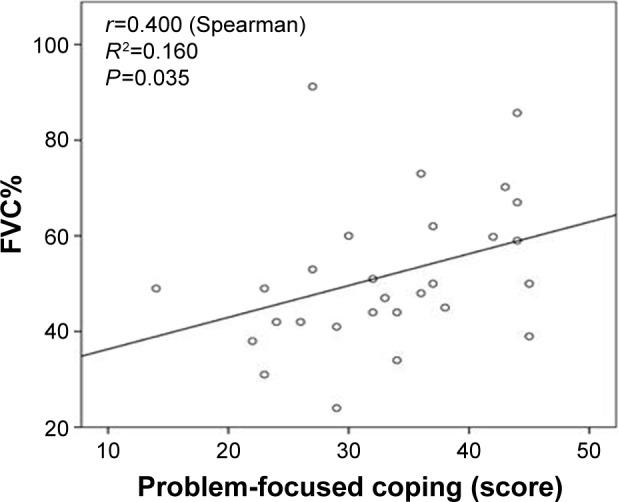
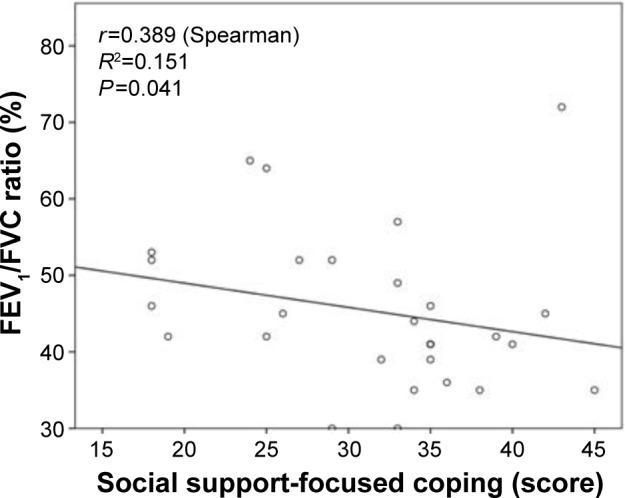
According to their higher coping subscale score, the depression score was the highest in patients with avoidance-type coping and the lowest in patients with problem-focused coping (11.0 vs 5.6; P=0.042), respectively, patients with social support-focused coping having the highest anxiety score in contrast to patients with emotion-focused coping, which had the lowest anxiety score (11.6 vs 5.0; P=0.006). Regarding respiratory parameters, significant differences were present for the variation of the medians between the four groups only for forced vital capacity (FVC%) (the lowest FVC% was in patients with predominant social support-focused coping and the highest in patients with problem-focused coping) and 6-minute walking test (%) (the lowest score for patients with social support-focused coping and the highest value in patients with avoidance-type coping). Problem-coping score was significantly and positively associated with FVC% (Spearman's r=0.400; P=0.035), emotion-focused coping score was significantly and positively associated with FVC% (Spearman's r=0.395; P=0.038), and social support-focused coping score was negatively and significantly correlated with forced expiratory volume in 1 second/FVC% ratio (Spearman's r=0.389; P=0.041). A significant, negative correlation was found only between depression score and forced expiratory volume in 1 second (Spearman's r=-0.435; P=0.026) with respect to psychiatric symptoms.
CONCLUSION
Coping styles in patients with COPD affect the intensity of associated depressive and anxiety symptoms as well as medical determinants, thus the coping style should be considered an important part in the multidisciplinary approach of these patients.
背景与目的
慢性阻塞性肺疾病(COPD)是最使人衰弱的躯体疾病之一,常伴有焦虑和抑郁等合并症。应对方式,即个体应对生活中困难和压力情境的方式,会影响其病情发展以及合并症的存在。本研究旨在确定一组慢性阻塞性肺疾病患者的应对方式及其与抑郁和焦虑症状强度以及医学决定因素之间的关联。
材料与方法
在这项横断面研究中,纳入了28名D级慢性阻塞性肺疾病风险男性患者。记录患者的肺活量测定试验、博格量表、6分钟步行试验、医院焦虑抑郁量表及应对方式量表。
结果
根据应对分量表得分较高的情况,回避型应对患者的抑郁得分最高,问题聚焦型应对患者的抑郁得分最低(分别为11.0对5.6;P = 0.042),社会支持聚焦型应对患者的焦虑得分最高,而情绪聚焦型应对患者的焦虑得分最低(11.6对5.0;P = 0.006)。关于呼吸参数,四组之间仅在用力肺活量(FVC%)(社会支持聚焦型应对为主的患者FVC%最低,问题聚焦型应对患者最高)和6分钟步行试验(%)(社会支持聚焦型应对患者得分最低,回避型应对患者得分最高)的中位数变化方面存在显著差异。问题应对得分与FVC%显著正相关(斯皮尔曼r = 0.400;P = 0.035),情绪聚焦型应对得分与FVC%显著正相关(斯皮尔曼r = 0.395;P = 0.038),社会支持聚焦型应对得分与1秒用力呼气量/FVC%比值呈显著负相关(斯皮尔曼r = 0.389;P = 0.041)。就精神症状而言,仅在抑郁得分与1秒用力呼气量之间发现显著的负相关(斯皮尔曼r = -0.435;P = 0.026)。
结论
慢性阻塞性肺疾病患者的应对方式会影响相关抑郁和焦虑症状的强度以及医学决定因素,因此应对方式应被视为这些患者多学科治疗方法的重要组成部分。


 Zotero 插件