
成人肥胖、代谢健康与死亡率:韩国一项基于全国人口的研究
Obesity, metabolic health, and mortality in adults: a nationwide population-based study in Korea.
作者信息
Yang Hae Kyung, Han Kyungdo, Kwon Hyuk-Sang, Park Yong-Moon, Cho Jae-Hyoung, Yoon Kun-Ho, Kang Moo-Il, Cha Bong-Yun, Lee Seung-Hwan
机构信息
Division of Endocrinology and Metabolism, Department of Internal Medicine, Seoul St. Mary's Hospital, College of Medicine, The Catholic University of Korea, Seoul 06591, Korea.
Department of Medical Statistics, College of Medicine, The Catholic University of Korea, Seoul 06591, Korea.
出版信息
Sci Rep. 2016 Jul 22;6:30329. doi: 10.1038/srep30329.
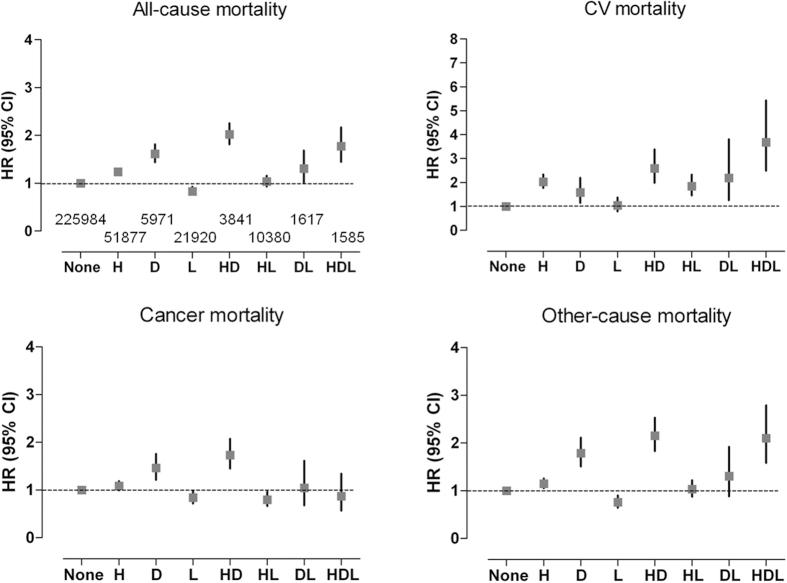
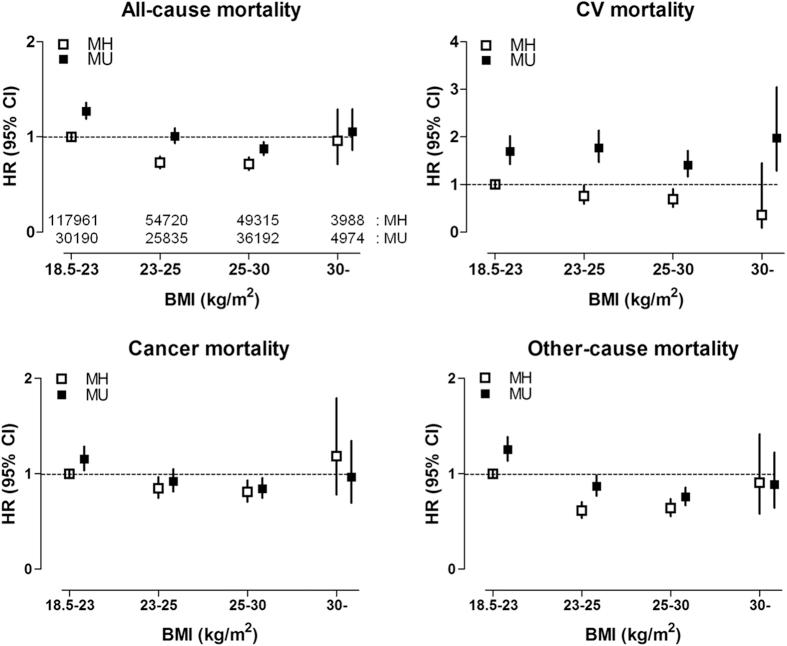
BMI, metabolic health status, and their interactions should be considered for estimating mortality risk; however, the data are controversial and unknown in Asians. We aimed to investigate this issue in Korean population. Total 323175 adults were followed-up for 96 (60-120) (median [5-95%]) months in a nationwide population-based cohort study. Participants were classified as "obese" (O) or "non-obese" (NO) using a BMI cut-off of 25 kg/m(2). People who developed ≥1 metabolic disease component (hypertension, diabetes, dyslipidaemia) in the index year were considered "metabolically unhealthy" (MU), while those with none were considered "metabolically healthy" (MH). The MUNO group had a significantly higher risk of all-cause (hazard ratio, 1.28 [95% CI, 1.21-1.35]) and cardiovascular (1.88 [1.63-2.16]) mortality, whereas the MHO group had a lower mortality risk (all-cause: 0.81 [0.74-0.88]), cardiovascular: 0.73 [0.57-0.95]), compared to the MHNO group. A similar pattern was noted for cancer and other-cause mortality. Metabolically unhealthy status was associated with higher risk of all-cause and cardiovascular mortality regardless of BMI levels, and there was a dose-response relationship between the number of incident metabolic diseases and mortality risk. In conclusion, poor metabolic health status contributed more to mortality than high BMI did, in Korean adults.
在评估死亡风险时应考虑体重指数(BMI)、代谢健康状况及其相互作用;然而,在亚洲人群中,相关数据存在争议且尚不明确。我们旨在对韩国人群中的这一问题展开调查。在一项全国性的基于人群的队列研究中,对总计323175名成年人进行了96(60 - 120)(中位数[5 - 95%])个月的随访。使用25 kg/m²的BMI切点将参与者分为“肥胖”(O)或“非肥胖”(NO)。在索引年份出现≥1种代谢疾病成分(高血压、糖尿病、血脂异常)的人被视为“代谢不健康”(MU),而没有这些疾病的人则被视为“代谢健康”(MH)。与代谢健康非肥胖(MHNO)组相比,代谢不健康肥胖(MUNO)组全因死亡(风险比,1.28 [95%置信区间,1.21 - 1.35])和心血管死亡(1.88 [1.63 - 2.16])风险显著更高,而代谢健康肥胖(MHO)组死亡风险较低(全因:0.81 [0.74 - 0.88],心血管:0.73 [0.57 - 0.95])。癌症和其他原因导致的死亡也呈现出类似模式。无论BMI水平如何,代谢不健康状态与全因和心血管死亡风险较高相关,并且新发代谢疾病的数量与死亡风险之间存在剂量反应关系。总之,在韩国成年人中,代谢健康状况不佳对死亡的影响比高BMI更大。
 Zotero 插件