
英国约克郡的多重疾病模式及其与健康结局的关联:约克郡健康研究的基线结果
Patterns of multimorbidity and their association with health outcomes within Yorkshire, England: baseline results from the Yorkshire Health Study.
作者信息
Li Jessica, Green Mark, Kearns Ben, Holding Eleanor, Smith Christine, Haywood Annette, Cooper Cindy, Strong Mark, Relton Clare
机构信息
School of Health and Related Research (ScHARR), University of Sheffield, Sheffield, UK.
Public Health Section, ScHARR, Regent Court, University of Sheffield, 30 Regent Street, Sheffield, S1 4DA, UK.
出版信息
BMC Public Health. 2016 Jul 27;16:649. doi: 10.1186/s12889-016-3335-z.
BACKGROUND
Multimorbidity is increasingly being recognized as a serious public health concern. Research into its determinants, prevalence, and management is needed and as the risk of experiencing multiple chronic conditions increases over time, attention should be given to investigating the development of multimorbidity through prospective cohort design studies. Here we examine the baseline patterns of multimorbidity and their association with health outcomes for residents in Yorkshire, England using data from the Yorkshire Health Study.
METHODS
Baseline data from the Yorkshire Health Study (YHS) was collected from 27,806 patients recruited between 2010 and 2012. A two-stage sampling strategy was implemented which first involved recruiting 43 general practice surgeries and then having them consent to mailing invitations to their patients to complete postal or online questionnaires. The questionnaire collected information on chronic health conditions, demographics, health-related behaviours, healthcare and medication usage, and a range of other health related variables. Descriptive statistics (chi-square and t tests) were used to examine associations between these variables and multimorbidity.
RESULTS
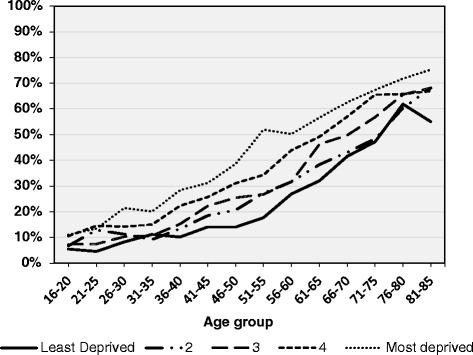
In the YHS cohort, 10,332 participants (37.2 %) reported having at least two or more long-term health conditions (multimorbidity). Older age, BMI and deprivation were all positively associated with multimorbidity. Nearly half (45.7 %) of participants from the most deprived areas experienced multimorbidity. Based on the weighted sample, average health-related quality of life decreased with the number of health conditions reported; the mean EQ-5D score for participants with no conditions was 0.945 compared to 0.355 for participants with five or more. The mean number of medications used for those without multimorbidity was 1.81 (range 1-13, SD = 1.25) compared to 3.81 (range 1-14, SD = 2.44) for those with at least two long-term conditions and 7.47 (range 1-37, SD = 7.47) for those with 5+ conditions.
CONCLUSION
Patterns of multimorbidity within the Yorkshire Health Study support research on multimorbidity within previous observational cross-sectional studies. The YHS provides both a facility for participant recruitment to intervention trials, and a large population-based longitudinal cohort for observational research. It is planned to continue to record chronic conditions and other health related behaviours in future waves which will be useful for examining determinants and trends in chronic disease and multimorbidity.
背景
多重疾病共患日益被视为一个严重的公共卫生问题。需要对其决定因素、患病率及管理进行研究,并且随着患多种慢性病风险随时间增加,应通过前瞻性队列设计研究关注多重疾病共患的发展情况。在此,我们利用约克郡健康研究的数据,研究了英格兰约克郡居民多重疾病共患的基线模式及其与健康结局的关联。
方法
约克郡健康研究(YHS)的基线数据收集自2010年至2012年招募的27806名患者。实施了两阶段抽样策略,首先招募43家全科医疗诊所,然后让它们同意向患者邮寄邀请,以完成邮政或在线问卷。问卷收集了有关慢性健康状况、人口统计学、健康相关行为、医疗保健和药物使用以及一系列其他健康相关变量的信息。描述性统计(卡方检验和t检验)用于检验这些变量与多重疾病共患之间的关联。
结果
在YHS队列中,10332名参与者(37.2%)报告患有至少两种或更多长期健康状况(多重疾病共患)。年龄较大、体重指数和贫困程度均与多重疾病共患呈正相关。最贫困地区近一半(45.7%)的参与者患有多重疾病共患。基于加权样本,与健康相关的平均生活质量随着报告的健康状况数量的增加而下降;无健康状况的参与者的平均EQ-5D评分为0.945,而患有五种或更多健康状况的参与者为0.355。无多重疾病共患的参与者使用的药物平均数量为1.81种(范围1 - 13种,标准差 = 1.25),而患有至少两种长期健康状况的参与者为3.81种(范围1 - 14种,标准差 = 2.44),患有5种及以上健康状况的参与者为7.47种(范围1 - 37种,标准差 = 7.47)。
结论
约克郡健康研究中的多重疾病共患模式支持了以往观察性横断面研究中关于多重疾病共患的研究。YHS既为参与干预试验提供了招募设施,也为观察性研究提供了一个基于大量人群的纵向队列。计划在未来的随访中继续记录慢性病状况和其他健康相关行为,这将有助于研究慢性病和多重疾病共患的决定因素及趋势。

 Zotero 插件