
移植前NPM1微小残留病水平可预测急性髓系白血病患者异基因造血干细胞移植后的预后。
Pretransplant NPM1 MRD levels predict outcome after allogeneic hematopoietic stem cell transplantation in patients with acute myeloid leukemia.
作者信息
Kayser S, Benner A, Thiede C, Martens U, Huber J, Stadtherr P, Janssen J W G, Röllig C, Uppenkamp M J, Bochtler T, Hegenbart U, Ehninger G, Ho A D, Dreger P, Krämer A
机构信息
Department of Internal Medicine V, University of Heidelberg, Heidelberg, Germany.
Clinical Cooperation Unit Molecular Hematology/Oncology, German Cancer Research Center (DKFZ) and Department of Internal Medicine V, University of Heidelberg, Heidelberg, Germany.
出版信息
Blood Cancer J. 2016 Jul 29;6(7):e449. doi: 10.1038/bcj.2016.46.
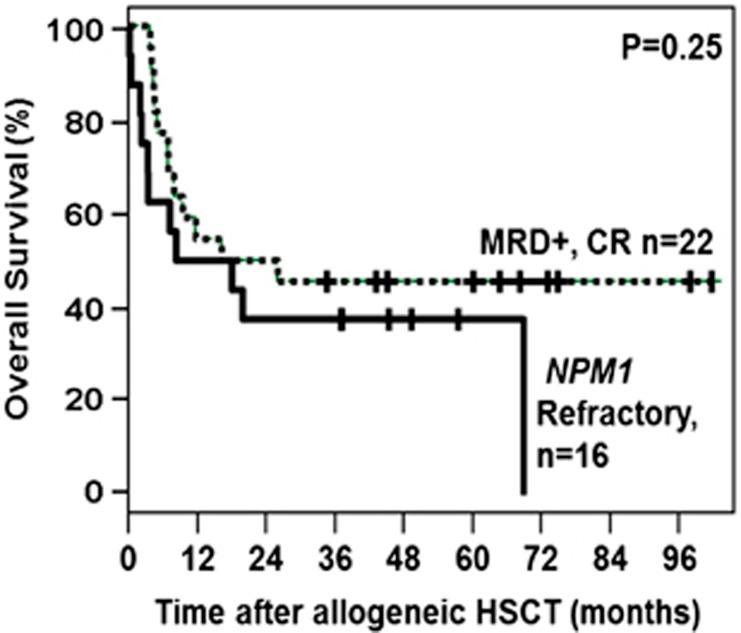
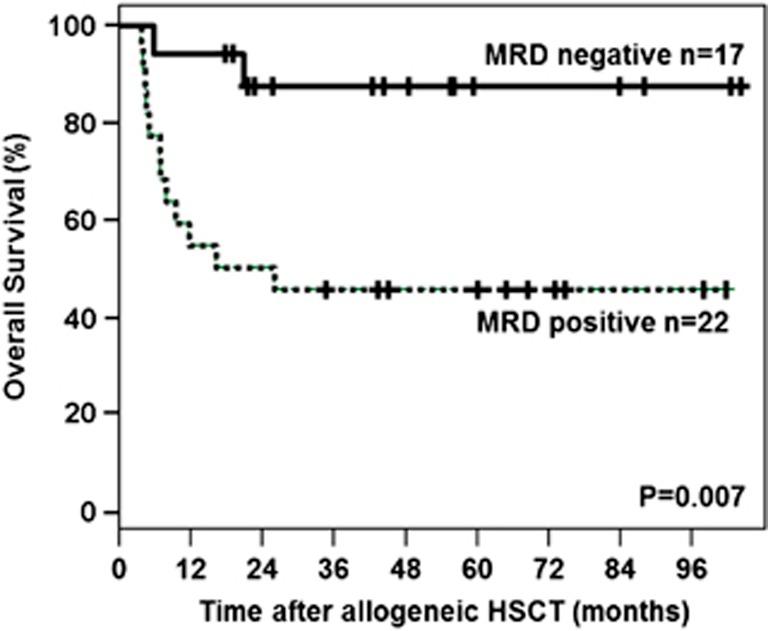
The objective was to evaluate the prognostic impact of pre-transplant minimal residual disease (MRD) as determined by real-time quantitative polymerase chain reaction in 67 adult NPM1-mutated acute myeloid leukemia patients receiving allogeneic hematopoietic stem cell transplantation (HSCT). Twenty-eight of the 67 patients had a FLT3-ITD (42%). Median age at transplantation was 54.7 years, median follow-up for survival from time of allografting was 4.9 years. At transplantation, 31 patients were in first, 20 in second complete remission (CR) and 16 had refractory disease (RD). Pre-transplant NPM1 MRD levels were measured in 39 CR patients. Overall survival (OS) for patients transplanted in CR was significantly longer as compared to patients with RD (P=0.004), irrespective of whether the patients were transplanted in first or second CR (P=0.74). There was a highly significant difference in OS after allogeneic HSCT between pre-transplant MRD-positive and MRD-negative patients (estimated 5-year OS rates of 40 vs 89%; P=0.007). Multivariable analyses on time to relapse and OS revealed pre-transplant NPM1 MRD levels >1% as an independent prognostic factor for poor survival after allogeneic HSCT, whereas FLT3-ITD had no impact. Notably, outcome of patients with pre-transplant NPM1 MRD positivity >1% was as poor as that of patients transplanted with RD.
目的是评估通过实时定量聚合酶链反应测定的移植前微小残留病(MRD)对67例接受异基因造血干细胞移植(HSCT)的成年NPM1突变急性髓系白血病患者的预后影响。67例患者中有28例存在FLT3-ITD(42%)。移植时的中位年龄为54.7岁,自移植后生存的中位随访时间为4.9年。移植时,31例患者处于首次完全缓解,20例处于第二次完全缓解(CR),16例患有难治性疾病(RD)。在39例CR患者中检测了移植前NPM1 MRD水平。与RD患者相比,CR患者移植后的总生存期(OS)显著更长(P=0.004),无论患者是处于首次还是第二次CR(P=0.74)。移植前MRD阳性和阴性患者异基因HSCT后的OS存在高度显著差异(估计5年OS率分别为40%和89%;P=0.007)。对复发时间和OS的多变量分析显示,移植前NPM1 MRD水平>1%是异基因HSCT后生存不良的独立预后因素,而FLT3-ITD无影响。值得注意的是,移植前NPM1 MRD阳性>1%的患者的结局与RD患者移植后的结局一样差。

 Zotero 插件