
结直肠癌患者体内转移灶间的基因异质性是根治性肝切除术后生存的关键决定因素。
Intra-patient Inter-metastatic Genetic Heterogeneity in Colorectal Cancer as a Key Determinant of Survival after Curative Liver Resection.
作者信息
Sveen Anita, Løes Inger Marie, Alagaratnam Sharmini, Nilsen Gro, Høland Maren, Lingjærde Ole Christian, Sorbye Halfdan, Berg Kaja Christine Graue, Horn Arild, Angelsen Jon-Helge, Knappskog Stian, Lønning Per Eystein, Lothe Ragnhild A
机构信息
Department of Molecular Oncology, Institute for Cancer Research, Oslo University Hospital, Oslo, Norway.
K.G. Jebsen Colorectal Cancer Research Centre, Oslo University Hospital, Oslo, Norway.
出版信息
PLoS Genet. 2016 Jul 29;12(7):e1006225. doi: 10.1371/journal.pgen.1006225. eCollection 2016 Jul.
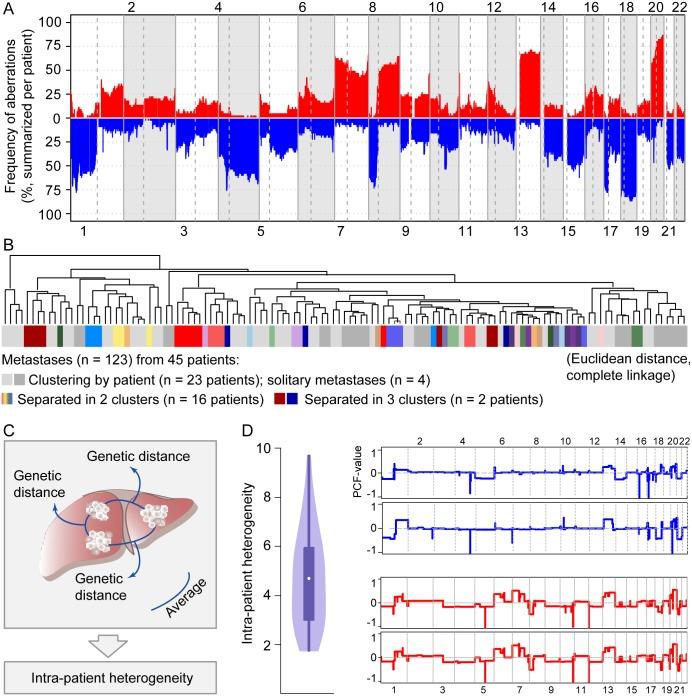
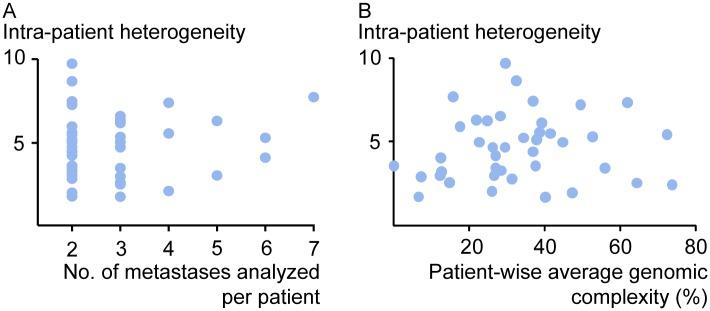
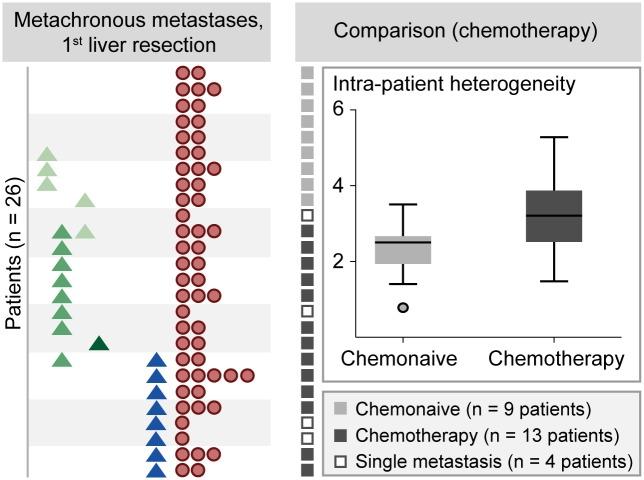
Chromosomal instability is a well-defined hallmark of tumor aggressiveness and metastatic progression in colorectal cancer. The magnitude of genetic heterogeneity among distinct liver metastases from the same patient at the copy number level, as well as its relationship with chemotherapy exposure and patient outcome, remains unknown. We performed high-resolution DNA copy number analyses of 134 liver metastatic deposits from 45 colorectal cancer patients to assess: (i) intra-patient inter-metastatic genetic heterogeneity using a heterogeneity score based on pair-wise genetic distances among tumor deposits; and (ii) genomic complexity, defined as the proportion of the genome harboring aberrant DNA copy numbers. Results were analyzed in relation to the patients' clinical course; previous chemotherapy exposure and outcome after surgical resection of liver metastases. We observed substantial variation in the level of intra-patient inter-metastatic heterogeneity. Heterogeneity was not associated with the number of metastatic lesions or their genomic complexity. In metachronous disease, heterogeneity was higher in patients previously exposed to chemotherapy. Importantly, intra-patient inter-metastatic heterogeneity was a strong prognostic determinant, stronger than known clinicopathological prognostic parameters. Patients with a low level of heterogeneity (below the median level) had a three-year progression-free and overall survival rate of 23% and 66% respectively, versus 5% and 18% for patients with a high level (hazard ratio0.4, 95% confidence interval 0.2-0.8, P = 0.01; and hazard ratio0.3,95% confidence interval 0.1-0.7, P = 0.007). A low patient-wise level of genomic complexity (below 25%) was also a favorable prognostic factor; however, the prognostic association of intra-patient heterogeneity was independent of genomic complexity in multivariable analyses. In conclusion, intra-patient inter-metastatic genetic heterogeneity is a pronounced feature of metastatic colorectal cancer, and the strong prognostic association reinforces its clinical relevance and places it as a key feature to be explored in future patient cohorts.
染色体不稳定是结直肠癌肿瘤侵袭性和转移进展的一个明确标志。同一患者不同肝转移灶在拷贝数水平上的遗传异质性程度,及其与化疗暴露和患者预后的关系,仍然未知。我们对45例结直肠癌患者的134个肝转移灶进行了高分辨率DNA拷贝数分析,以评估:(i)使用基于肿瘤灶之间成对遗传距离的异质性评分来评估患者内转移灶间的遗传异质性;以及(ii)基因组复杂性,定义为携带异常DNA拷贝数的基因组比例。结合患者的临床病程、既往化疗暴露情况以及肝转移灶手术切除后的预后对结果进行分析。我们观察到患者内转移灶间异质性水平存在显著差异。异质性与转移灶数量或其基因组复杂性无关。在异时性疾病中,先前接受化疗的患者异质性更高。重要的是,患者内转移灶间异质性是一个强有力的预后决定因素,比已知的临床病理预后参数更强。异质性水平低(低于中位数水平)的患者三年无进展生存率和总生存率分别为23%和66%,而异质性水平高的患者分别为5%和18%(风险比0.4,95%置信区间0.2 - 0.8,P = 0.01;风险比0.3,95%置信区间0.1 - 0.7,P = 0.007)。患者水平的基因组复杂性低(低于25%)也是一个有利的预后因素;然而,在多变量分析中,患者内异质性的预后关联独立于基因组复杂性。总之,患者内转移灶间遗传异质性是转移性结直肠癌的一个显著特征,其与预后的强关联强化了其临床相关性,并使其成为未来患者队列中有待探索的关键特征。


 Zotero 插件