
西洛他唑通过神经元细胞中与SIRT1偶联的LKB1/AMPKα信号通路调节β-淀粉样肽的自噬降解。
Cilostazol Modulates Autophagic Degradation of β-Amyloid Peptide via SIRT1-Coupled LKB1/AMPKα Signaling in Neuronal Cells.
作者信息
Park So Youn, Lee Hye Rin, Lee Won Suk, Shin Hwa Kyoung, Kim Hye Young, Hong Ki Whan, Kim Chi Dae
机构信息
Department of Pharmacology, School of Korean Medicine, Pusan National University, Gyeongsangnam-do, 50612, Republic of Korea.
Gene & Cell Therapy Research Center for Vessel-associated Diseases, Pusan National University, Gyeongsangnam-do, 50612, Republic of Korea.
出版信息
PLoS One. 2016 Aug 5;11(8):e0160620. doi: 10.1371/journal.pone.0160620. eCollection 2016.
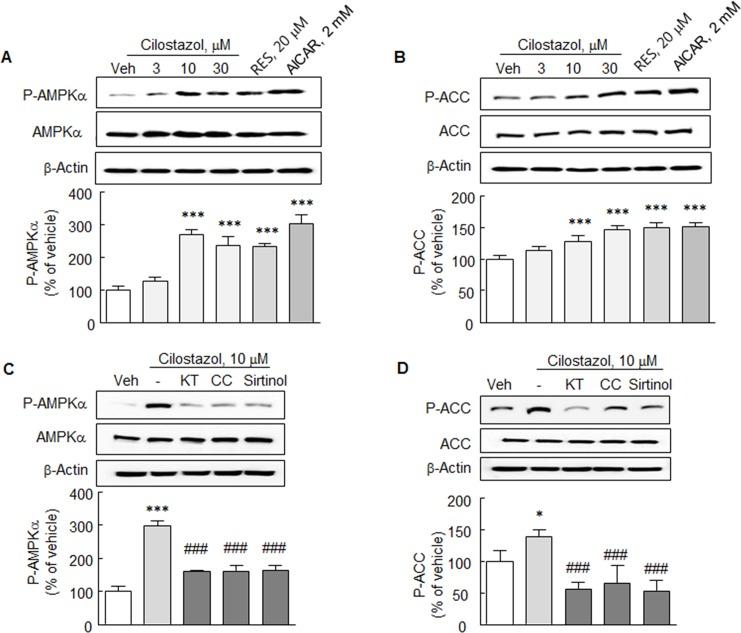
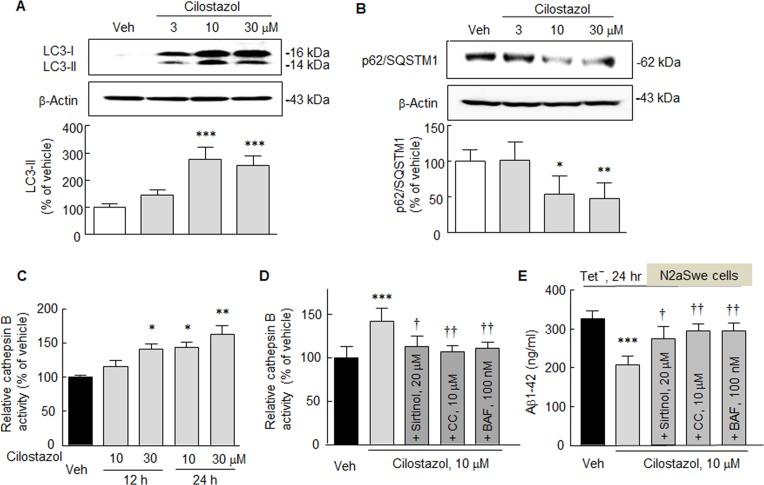
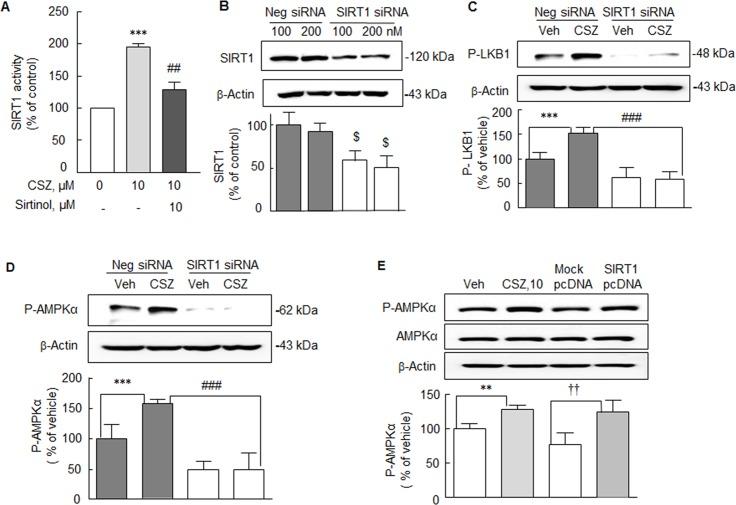
A neuroprotective role of autophagy mediates the degradation of β-amyloid peptide (Aβ) in Alzheimer's disease (AD). The previous study showed cilostazol modulates autophagy by increasing beclin1, Atg5 and LC3-II expressions, and depletes intracellular Aβ accumulation. This study elucidated the mechanisms through which cilostazol modulates the autophagic degradation of Aβ in neurons. In N2a cells, cilostazol (10-30 μM), significantly increased the expression of P-AMPKα (Thr 172) and downstream P-ACC (acetyl-CoA carboxylase) (Ser 79) as did resveratrol (SIRT1 activator), or AICAR (AMPK activator), which were blocked by KT5720, compound C (AMPK inhibitor), or sirtinol. Furthermore, phosphorylated-mTOR (Ser 2448) and phosphorylated-P70S6K (Thr 389) expressions were suppressed, and LC3-II levels were elevated in association with decreased P62/Sqstm1 by cilostazol. Cilostazol increased cathepsin B activity and decreased p62/SQSTM 1, consequently decreased accumulation of Aβ1-42 in the activated N2aSwe cells, and these results were blocked by sirtinol, compound C and bafilomycin A1 (autophagosome blocker), suggesting enhanced autophagosome formation by cilostazol. In SIRT1 gene-silenced N2a cells, cilostazol failed to increase the expressions of P-LKB1 (Ser 428) and P-AMPKα, which contrasted with its effect in negative control cells transfected with scrambled siRNA duplex. Further, N2a cells transfected with expression vectors encoding pcDNA SIRT1 showed increased P-AMPKα expression, which mimicked the effect of cilostazol in N2a cells; suggesting cilostazol-stimulated expressions of P-LKB1 and P-AMPKα were SIRT1-dependent. Unlike their effects in N2a cells, in HeLa cells, which lack LKB1, cilostazol and resveratrol did not elevate SIRT1 or P-AMPKα expression, indicating cilostazol and resveratrol-stimulated expressions of SIRT1 and P-AMPKα are LKB1-dependent. In conclusion, cilostazol upregulates autophagy by activating SIRT1-coupled P-LKB1/P-AMPKα and inhibiting mTOR activation, thereby decreasing Aβ accumulation.
自噬的神经保护作用介导了阿尔茨海默病(AD)中β-淀粉样肽(Aβ)的降解。先前的研究表明西洛他唑通过增加beclin1、Atg5和LC3-II的表达来调节自噬,并减少细胞内Aβ的积累。本研究阐明了西洛他唑调节神经元中Aβ自噬降解的机制。在N2a细胞中,西洛他唑(10 - 30 μM)显著增加了P-AMPKα(Thr 172)和下游P-ACC(乙酰辅酶A羧化酶)(Ser 79)的表达,白藜芦醇(SIRT1激活剂)或AICAR(AMPK激活剂)也有同样的作用,而这些作用被KT5720、化合物C(AMPK抑制剂)或sirtinol阻断。此外,西洛他唑抑制了磷酸化-mTOR(Ser 2448)和磷酸化-P70S6K(Thr 389)的表达,并且随着P62/Sqstm1的减少,LC3-II水平升高。西洛他唑增加了组织蛋白酶B的活性并降低了p62/SQSTM 1,从而减少了活化的N2aSwe细胞中Aβ1-42的积累,而这些结果被sirtinol、化合物C和巴弗洛霉素A1(自噬体阻断剂)阻断,表明西洛他唑增强了自噬体的形成。在SIRT1基因沉默的N2a细胞中,西洛他唑未能增加P-LKB1(Ser 428)和P-AMPKα的表达,这与其在转染了乱序siRNA双链体的阴性对照细胞中的作用形成对比。此外,用编码pcDNA SIRT1的表达载体转染的N2a细胞显示P-AMPKα表达增加,这模拟了西洛他唑在N2a细胞中的作用;表明西洛他唑刺激的P-LKB1和P-AMPKα表达是SIRT1依赖性的。与它们在N2a细胞中的作用不同,在缺乏LKB1的HeLa细胞中,西洛他唑和白藜芦醇没有提高SIRT1或P-AMPKα的表达,表明西洛他唑和白藜芦醇刺激的SIRT1和P-AMPKα表达是LKB1依赖性的。总之,西洛他唑通过激活SIRT1偶联的P-LKB1/P-AMPKα并抑制mTOR激活来上调自噬,从而减少Aβ的积累。




 Zotero 插件