
释放转运RNA:大肠杆菌中翻译与解毒之间的一场拔河比赛。
Discharging tRNAs: a tug of war between translation and detoxification in Escherichia coli.
作者信息
Avcilar-Kucukgoze Irem, Bartholomäus Alexander, Cordero Varela Juan A, Kaml Robert Franz-Xaver, Neubauer Peter, Budisa Nediljko, Ignatova Zoya
机构信息
Institute of Biochemistry and Biology, University of Potsdam, Karl-Liebknecht-Str. 24-25, 14467 Potsdam, Germany.
Institute of Biochemistry and Biology, University of Potsdam, Karl-Liebknecht-Str. 24-25, 14467 Potsdam, Germany Biochemistry and Molecular Biology, University of Hamburg, Martin-Luther-King-Pl. 6, 20146 Hamburg, Germany.
出版信息
Nucleic Acids Res. 2016 Sep 30;44(17):8324-34. doi: 10.1093/nar/gkw697. Epub 2016 Aug 9.
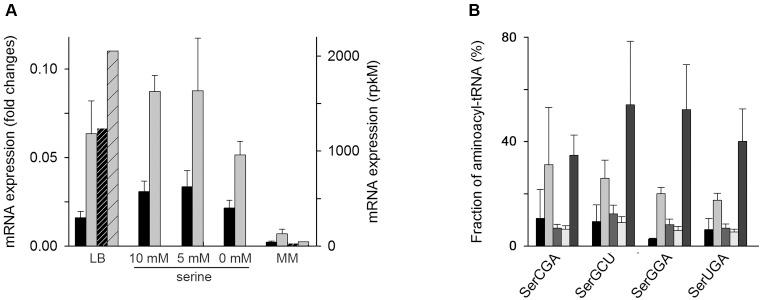
Translation is a central cellular process and is optimized for speed and fidelity. The speed of translation of a single codon depends on the concentration of aminoacyl-tRNAs. Here, we used microarray-based approaches to analyze the charging levels of tRNAs in Escherichia coli growing at different growth rates. Strikingly, we observed a non-uniform aminoacylation of tRNAs in complex media. In contrast, in minimal medium, the level of aminoacyl-tRNAs is more uniform and rises to approximately 60%. Particularly, the charging level of tRNA(Ser), tRNA(Cys), tRNA(Thr) and tRNA(His) is below 50% in complex medium and their aminoacylation levels mirror the degree that amino acids inhibit growth when individually added to minimal medium. Serine is among the most toxic amino acids for bacteria and tRNAs(Ser) exhibit the lowest charging levels, below 10%, at high growth rate although intracellular serine concentration is plentiful. As a result some serine codons are among the most slowly translated codons. A large fraction of the serine is most likely degraded by L-serine-deaminase, which competes with the seryl-tRNA-synthetase that charges the tRNAs(Ser) These results indicate that the level of aminoacylation in complex media might be a competition between charging for translation and degradation of amino acids that inhibit growth.
翻译是细胞的核心过程,并在速度和保真度方面进行了优化。单个密码子的翻译速度取决于氨酰-tRNA的浓度。在这里,我们使用基于微阵列的方法来分析在不同生长速率下生长的大肠杆菌中tRNA的负载水平。令人惊讶的是,我们观察到在复杂培养基中tRNA的氨酰化不均匀。相比之下,在基本培养基中,氨酰-tRNA的水平更加均匀,并且上升到大约60%。特别地,tRNA(Ser)、tRNA(Cys)、tRNA(Thr)和tRNA(His)在复杂培养基中的负载水平低于50%,并且它们的氨酰化水平反映了单独添加到基本培养基中时氨基酸抑制生长的程度。丝氨酸是对细菌毒性最大的氨基酸之一,尽管细胞内丝氨酸浓度充足,但在高生长速率下tRNA(Ser)的负载水平最低,低于10%。因此,一些丝氨酸密码子是翻译最慢的密码子之一。大部分丝氨酸很可能被L-丝氨酸脱氨酶降解,该酶与为tRNA(Ser)负载的丝氨酰-tRNA合成酶竞争。这些结果表明,复杂培养基中的氨酰化水平可能是翻译负载与抑制生长的氨基酸降解之间的竞争。


 Zotero 插件