
高脂饮食期间及体重减轻后骨骼完整性和骨髓脂肪含量的变化。
Changes in Skeletal Integrity and Marrow Adiposity during High-Fat Diet and after Weight Loss.
作者信息
Scheller Erica L, Khoury Basma, Moller Kayla L, Wee Natalie K Y, Khandaker Shaima, Kozloff Kenneth M, Abrishami Simin H, Zamarron Brian F, Singer Kanakadurga
机构信息
Division of Bone and Mineral Diseases, Department of Medicine, Washington University, St. Louis, MO, USA; Department of Molecular and Integrative Physiology, University of Michigan, Ann Arbor, MI, USA.
Department of Orthopaedic Surgery, University of Michigan , Ann Arbor, MI , USA.
出版信息
Front Endocrinol (Lausanne). 2016 Jul 27;7:102. doi: 10.3389/fendo.2016.00102. eCollection 2016.
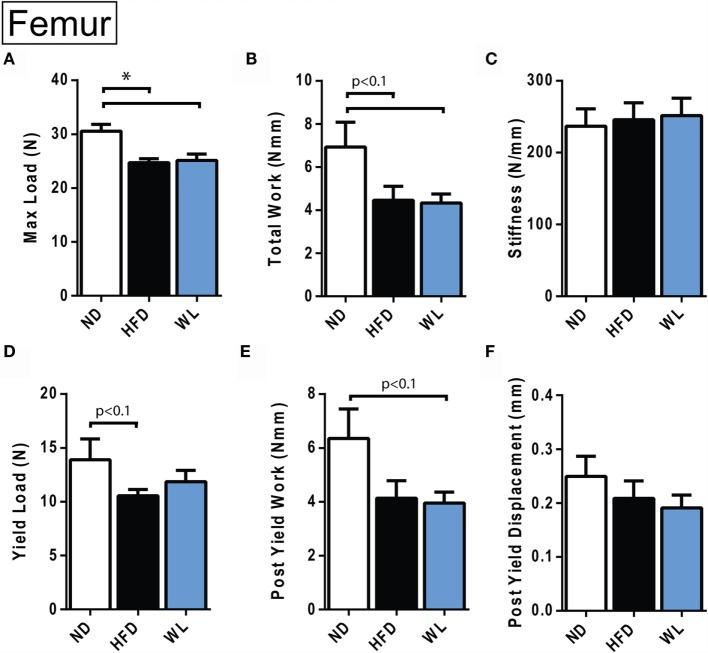
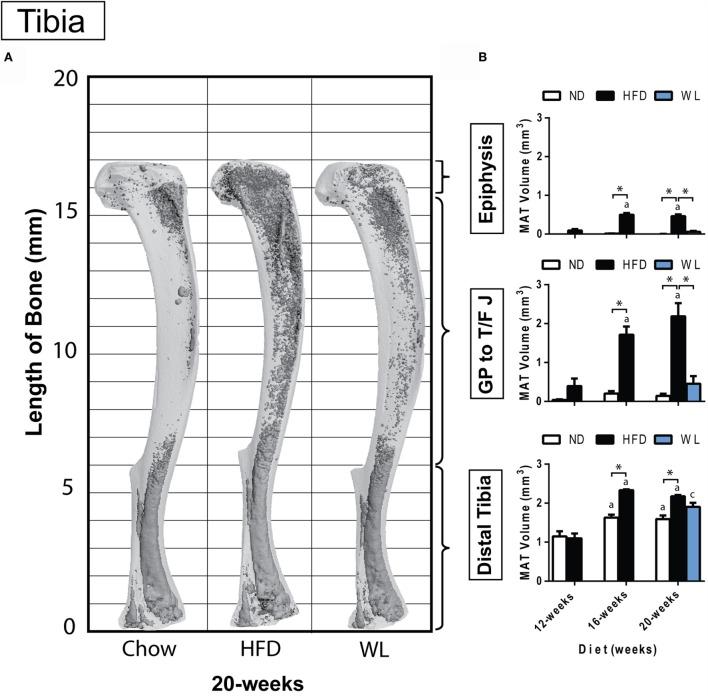
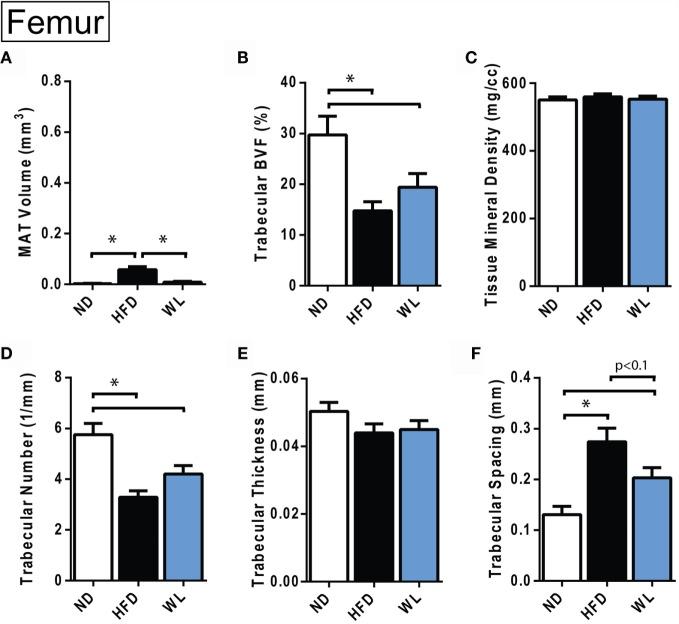
The prevalence of obesity has continued to rise over the past three decades leading to significant increases in obesity-related medical care costs from metabolic and non-metabolic sequelae. It is now clear that expansion of body fat leads to an increase in inflammation with systemic effects on metabolism. In mouse models of diet-induced obesity, there is also an expansion of bone marrow adipocytes. However, the persistence of these changes after weight loss has not been well described. The objective of this study was to investigate the impact of high-fat diet (HFD) and subsequent weight loss on skeletal parameters in C57Bl6/J mice. Male mice were given a normal chow diet (ND) or 60% HFD at 6 weeks of age for 12, 16, or 20 weeks. A third group of mice was put on HFD for 12 weeks and then on ND for 8 weeks to mimic weight loss. After these dietary challenges, the tibia and femur were removed and analyzed by micro computed-tomography for bone morphology. Decalcification followed by osmium staining was used to assess bone marrow adiposity, and mechanical testing was performed to assess bone strength. After 12, 16, or 20 weeks of HFD, mice had significant weight gain relative to controls. Body mass returned to normal after weight loss. Marrow adipose tissue (MAT) volume in the tibia increased after 16 weeks of HFD and persisted in the 20-week HFD group. Weight loss prevented HFD-induced MAT expansion. Trabecular bone volume fraction, mineral content, and number were decreased after 12, 16, or 20 weeks of HFD, relative to ND controls, with only partial recovery after weight loss. Mechanical testing demonstrated decreased fracture resistance after 20 weeks of HFD. Loss of mechanical integrity did not recover after weight loss. Our study demonstrates that HFD causes long-term, persistent changes in bone quality, despite prevention of marrow adipose tissue accumulation, as demonstrated through changes in bone morphology and mechanical strength in a mouse model of diet-induced obesity and weight loss.
在过去三十年中,肥胖症的患病率持续上升,导致与肥胖相关的代谢和非代谢后遗症的医疗费用大幅增加。现在很清楚,体内脂肪的增加会导致炎症加剧,并对新陈代谢产生全身性影响。在饮食诱导的肥胖小鼠模型中,骨髓脂肪细胞也会增加。然而,体重减轻后这些变化的持续性尚未得到充分描述。本研究的目的是调查高脂饮食(HFD)和随后的体重减轻对C57Bl6/J小鼠骨骼参数的影响。雄性小鼠在6周龄时给予正常饲料饮食(ND)或60%高脂饮食12、16或20周。第三组小鼠先给予高脂饮食12周,然后给予正常饲料饮食8周以模拟体重减轻。在这些饮食挑战之后,取出胫骨和股骨,通过微型计算机断层扫描分析骨形态。脱钙后进行锇染色以评估骨髓脂肪含量,并进行力学测试以评估骨强度。高脂饮食12、16或20周后,小鼠体重相对于对照组显著增加。体重减轻后体重恢复正常。高脂饮食16周后胫骨骨髓脂肪组织(MAT)体积增加,并在20周高脂饮食组中持续存在。体重减轻可防止高脂饮食诱导的MAT扩张。与正常饲料对照组相比,高脂饮食12、16或20周后,小梁骨体积分数、矿物质含量和数量均降低,体重减轻后仅部分恢复。力学测试表明,高脂饮食20周后抗骨折能力下降。体重减轻后力学完整性并未恢复。我们的研究表明,尽管高脂饮食可防止骨髓脂肪组织积聚,但通过饮食诱导的肥胖和体重减轻小鼠模型中的骨形态和力学强度变化表明,高脂饮食会导致骨质量长期、持续的变化。




 Zotero 插件