
间歇性适度能量限制可提高饮食诱导肥胖小鼠的体重减轻效率。
Intermittent Moderate Energy Restriction Improves Weight Loss Efficiency in Diet-Induced Obese Mice.
作者信息
Seimon Radhika V, Shi Yan-Chuan, Slack Katy, Lee Kailun, Fernando Hamish A, Nguyen Amy D, Zhang Lei, Lin Shu, Enriquez Ronaldo F, Lau Jackie, Herzog Herbert, Sainsbury Amanda
机构信息
The Boden Institute of Obesity, Nutrition, Exercise & Eating Disorders, Sydney Medical School, Charles Perkins Centre, The University of Sydney, Camperdown, Australia.
Neuroscience Division, Garvan Institute of Medical Research, Darlinghurst, Australia.
出版信息
PLoS One. 2016 Jan 19;11(1):e0145157. doi: 10.1371/journal.pone.0145157. eCollection 2016.
BACKGROUND
Intermittent severe energy restriction is popular for weight management. To investigate whether intermittent moderate energy restriction may improve this approach by enhancing weight loss efficiency, we conducted a study in mice, where energy intake can be controlled.
METHODS
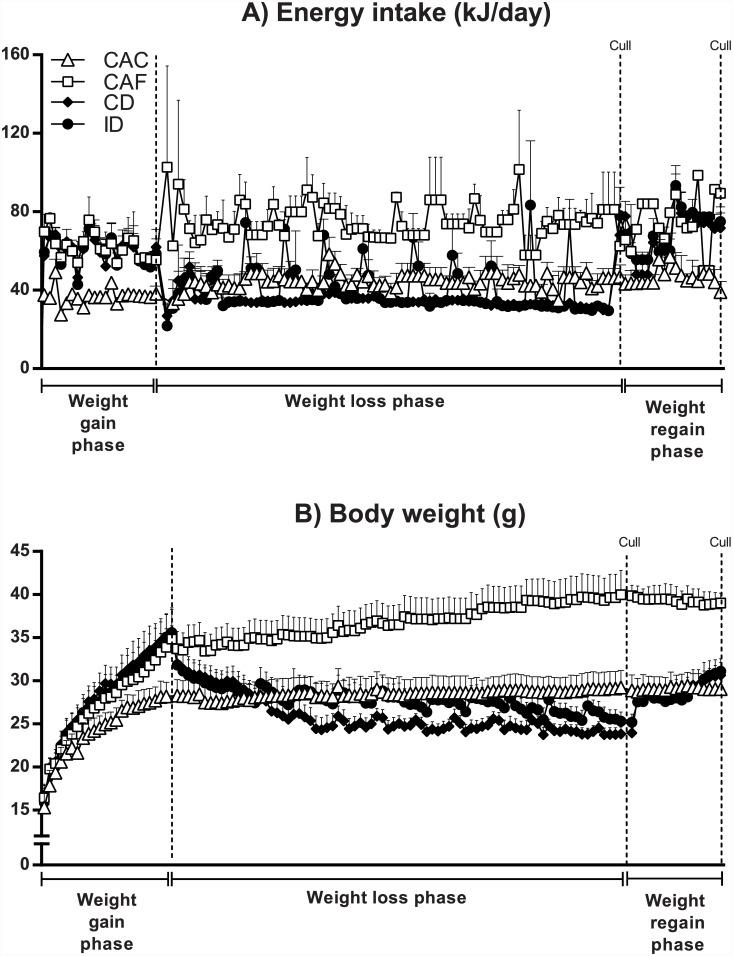
Male C57/Bl6 mice that had been rendered obese by an ad libitum diet high in fat and sugar for 22 weeks were then fed one of two energy-restricted normal chow diets for a 12-week weight loss phase. The continuous diet (CD) provided 82% of the energy intake of age-matched ad libitum chow-fed controls. The intermittent diet (ID) provided cycles of 82% of control intake for 5-6 consecutive days, and ad libitum intake for 1-3 days. Weight loss efficiency during this phase was calculated as (total weight change) ÷ [(total energy intake of mice on CD or ID)-(total average energy intake of controls)]. Subsets of mice then underwent a 3-week weight regain phase involving ad libitum re-feeding.
RESULTS
Mice on the ID showed transient hyperphagia relative to controls during each 1-3-day ad libitum feeding period, and overall ate significantly more than CD mice (91.1±1.0 versus 82.2±0.5% of control intake respectively, n = 10, P<0.05). There were no significant differences between CD and ID groups at the end of the weight loss or weight regain phases with respect to body weight, fat mass, circulating glucose or insulin concentrations, or the insulin resistance index. Weight loss efficiency was significantly greater with ID than with CD (0.042±0.007 versus 0.018±0.001 g/kJ, n = 10, P<0.01). Mice on the CD exhibited significantly greater hypothalamic mRNA expression of proopiomelanocortin (POMC) relative to ID and control mice, with no differences in neuropeptide Y or agouti-related peptide mRNA expression between energy-restricted groups.
CONCLUSION
Intermittent moderate energy restriction may offer an advantage over continuous moderate energy restriction, because it induces significantly greater weight loss relative to energy deficit in mice.
背景
间歇性严重能量限制在体重管理中很常见。为了研究间歇性适度能量限制是否可以通过提高减肥效率来改善这种方法,我们在可以控制能量摄入的小鼠中进行了一项研究。
方法
雄性C57/Bl6小鼠通过随意喂食高脂肪和高糖饮食22周而变得肥胖,然后在为期12周的减肥阶段喂食两种能量限制的正常饲料之一。持续饮食(CD)提供的能量摄入量为年龄匹配的随意喂食普通饲料对照组的82%。间歇性饮食(ID)提供连续5 - 6天摄入对照摄入量82%的周期,以及1 - 3天的随意摄入量。该阶段的减肥效率计算为(体重总变化)÷[(CD或ID组小鼠的总能量摄入量) - (对照组的总平均能量摄入量)]。然后,部分小鼠进入为期3周的体重恢复阶段,包括随意重新喂食。
结果
在每个1 - 3天的随意喂食期,ID组小鼠相对于对照组表现出短暂的食欲亢进,总体摄入量明显高于CD组小鼠(分别为对照摄入量的91.1±1.0%和82.2±0.5%,n = 10,P<0.05)。在减肥或体重恢复阶段结束时,CD组和ID组在体重、脂肪量、循环葡萄糖或胰岛素浓度或胰岛素抵抗指数方面没有显著差异。ID组的减肥效率显著高于CD组(0.042±0.007对0.018±0.001 g/kJ,n = 10,P<0.01)。相对于ID组和对照组小鼠,CD组小鼠下丘脑促阿片黑素皮质素(POMC)的mRNA表达显著更高,能量限制组之间神经肽Y或刺鼠相关肽mRNA表达没有差异。
结论
间歇性适度能量限制可能比持续适度能量限制具有优势,因为相对于小鼠的能量不足,它能诱导显著更多的体重减轻。




 Zotero 插件