
通过原位拉曼光谱揭示单晶铂电化学氧化的中间阶段。
Intermediate stages of electrochemical oxidation of single-crystalline platinum revealed by in situ Raman spectroscopy.
机构信息
Leiden Institute of Chemistry, Leiden University, Einsteinweg 55, PO Box 9502, 2300 RA Leiden, The Netherlands.
ChemE, Faculty of Applied Sciences, Delft University of Technology, Julianalaan 136, 2628 BL Delft, The Netherlands.
出版信息
Nat Commun. 2016 Aug 12;7:12440. doi: 10.1038/ncomms12440.
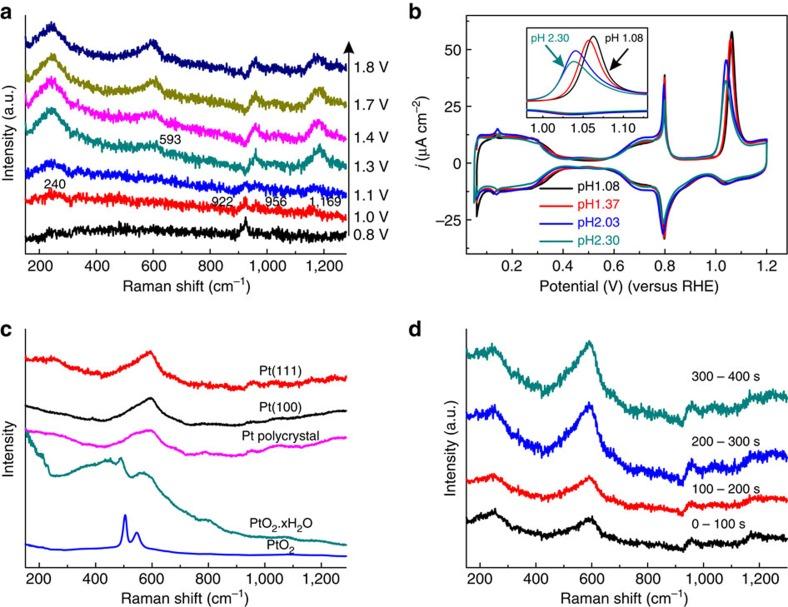
Understanding the atomistic details of how platinum surfaces are oxidized under electrochemical conditions is of importance for many electrochemical devices such as fuel cells and electrolysers. Here we use in situ shell-isolated nanoparticle-enhanced Raman spectroscopy to identify the intermediate stages of the electrochemical oxidation of Pt(111) and Pt(100) single crystals in perchloric acid. Density functional theory calculations were carried out to assist in assigning the experimental Raman bands by simulating the vibrational frequencies of possible intermediates and products. The perchlorate anion is suggested to interact with hydroxyl phase formed on the surface. Peroxo-like and superoxo-like two-dimensional (2D) surface oxides and amorphous 3D α-PtO2 are sequentially formed during the anodic polarization. Our measurements elucidate the process of the electrochemical oxidation of platinum single crystals by providing evidence for the structure-sensitive formation of a 2D platinum-(su)peroxide phase. These results may contribute towards a fundamental understanding of the mechanism of degradation of platinum electrocatalysts.
了解铂表面在电化学条件下氧化的原子细节对于许多电化学设备(如燃料电池和电解槽)非常重要。在这里,我们使用原位壳层隔离纳米粒子增强拉曼光谱来识别高氯酸中 Pt(111) 和 Pt(100) 单晶电化学氧化的中间阶段。进行密度泛函理论计算以通过模拟可能的中间体和产物的振动频率来协助分配实验拉曼带。建议高氯酸根阴离子与表面上形成的羟基相相互作用。在阳极极化过程中,依次形成过氧和超氧类似的二维(2D)表面氧化物和无定形 3Dα-PtO2。我们的测量通过提供二维铂-(过)氧化物相结构敏感形成的证据,阐明了铂单晶电化学氧化的过程。这些结果可能有助于对铂电催化剂降解机制的基本理解。


 Zotero 插件