
Ephrin B3与多种EphA受体相互作用,并驱动非小细胞肺癌的迁移和侵袭。
Ephrin B3 interacts with multiple EphA receptors and drives migration and invasion in non-small cell lung cancer.
作者信息
Efazat Ghazal, Novak Metka, Kaminskyy Vitaliy O, De Petris Luigi, Kanter Lena, Juntti Therese, Bergman Per, Zhivotovsky Boris, Lewensohn Rolf, Hååg Petra, Viktorsson Kristina
机构信息
Karolinska Biomics Center, Department of Oncology-Pathology, Karolinska Institutet, SE-171 76 Stockholm, Sweden.
Institute of Environmental Medicine, Division of Toxicology, Karolinska Institutet, SE-171 77 Stockholm, Sweden.
出版信息
Oncotarget. 2016 Sep 13;7(37):60332-60347. doi: 10.18632/oncotarget.11219.
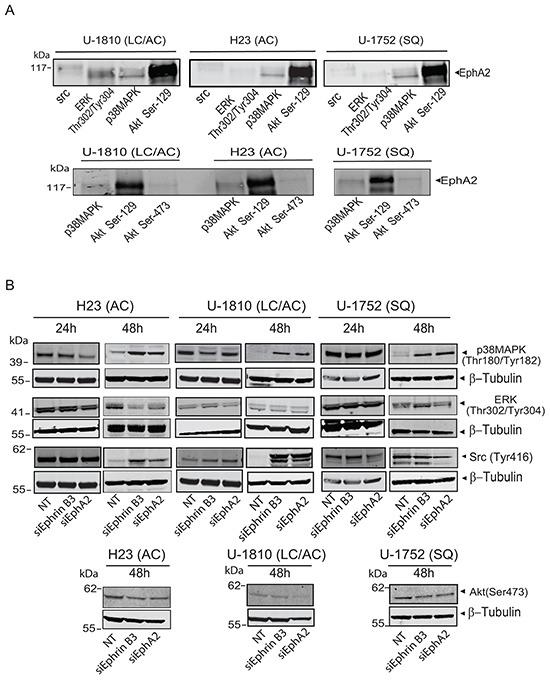
Ephrin receptors (Ephs) are reported to control metastatic signaling of non-small cell lung cancer (NSCLC) and other tumors. Here we show for the first time that blocking expression of the Eph ligand Ephrin B3 inhibits NSCLC cell migration and invasion. We demonstrate that Ephrin B3 directly binds the EphAs EphA2, EphA3, EphA4, and EphA5. EphA2 Ser897 was previously shown to drive migration propensity of tumor cells and our study reveals that EphA2 stays phosphorylated on Ser897 in the Ephrin B3/EphA2 complex in NSCLC cells of different histology. Moreover, we report that within such Ephrin B3/EphA2 complex both Akt Ser 129 and p38MAPK are found indicating a potential to drive migration/proliferation. We also found the EMT marker E-cadherin expression to be maintained or increased upon Ephrin B3 blockade in NSCLC cells. Expression of Ephrin B3 was furthermore analyzed in a cohort of NSCLC stage IA-IB cases (n=200) alongside EphA2 and Ephrin A1. We found that Ephrin B3 was concomitantly expressed with EphA2 and Ephrin A1 with higher Ephrin B3 levels found in non-squamous than in squamous tumors, whereas EphA2 was higher expressed in well-differentiated than in low-differentiated tumors. In the entire NSCLC cohort, Ephrin B3 expression was not linked to patient survival, whereas a high EphA2 expression was associated with improved survival (p=0.03). In conclusion, we show that blocking Ephrin B3 expression inhibits NSCLC proliferation-, migration- and invasion capacity which calls for further studies on interference with Ephrin B3 as a possible therapeutic avenue in this tumor malignancy.
据报道,Ephrin受体(Ephs)可控制非小细胞肺癌(NSCLC)和其他肿瘤的转移信号。在此,我们首次表明,阻断Eph配体Ephrin B3的表达可抑制NSCLC细胞的迁移和侵袭。我们证明Ephrin B3直接结合EphA家族的EphA2、EphA3、EphA4和EphA5。先前研究表明EphA2的Ser897位点可驱动肿瘤细胞的迁移倾向,我们的研究揭示,在不同组织学类型的NSCLC细胞中,Ephrin B3/EphA2复合物中的EphA2在Ser897位点保持磷酸化状态。此外,我们报告在这种Ephrin B3/EphA2复合物中发现Akt Ser 129和p38MAPK,表明其具有驱动迁移/增殖的潜力。我们还发现,在NSCLC细胞中阻断Ephrin B3后,上皮-间质转化(EMT)标志物E-钙黏蛋白的表达得以维持或增加。此外,我们在一组NSCLC IA-IB期病例(n = 200)中分析了Ephrin B3以及EphA2和Ephrin A1的表达。我们发现Ephrin B3与EphA2和Ephrin A1同时表达,在非鳞状肿瘤中Ephrin B3水平高于鳞状肿瘤,而EphA2在高分化肿瘤中的表达高于低分化肿瘤。在整个NSCLC队列中,Ephrin B3的表达与患者生存率无关,而高EphA2表达与生存率提高相关(p = 0.03)。总之,我们表明阻断Ephrin B3的表达可抑制NSCLC的增殖、迁移和侵袭能力,这需要进一步研究干扰Ephrin B3作为该肿瘤恶性治疗的可能途径。


 Zotero 插件