
阿巴卡韦/拉米夫定联合达芦那韦/利托那韦与其他蛋白酶抑制剂对临床实践中接受过治疗的HIV感染患者的病毒学疗效
Virologic Effectiveness of Abacavir/Lamivudine with Darunavir/Ritonavir Versus Other Protease Inhibitors in Treatment-Experienced HIV-Infected Patients in Clinical Practice.
作者信息
Lackey Philip, Mills Anthony, Carpio Felix, Hsu Ricky, DeJesus Edwin, Pierone Gerald, Henegar Cassidy, Fusco Jennifer, Fusco Gregory, Wohlfeiler Mike
机构信息
Carolinas Healthcare System, Charlotte, NC, USA.
OPERA Clinical and Epidemiological Advisory Board, Epividian Inc., Durham, NC, USA.
出版信息
Clin Drug Investig. 2017 Jan;37(1):51-60. doi: 10.1007/s40261-016-0456-1.
BACKGROUND AND OBJECTIVES
The standard of care for HIV treatment is a three-drug regimen consisting of two nucleoside reverse transcriptase inhibitors (NRTIs) and either a non-nucleoside reverse transcriptase inhibitor, a protease inhibitor (PI) or an integrase strand transfer inhibitor. Darunavir boosted with ritonavir (DRV/r) is the only preferred PI in the US Department of Health and Human Services (DHHS) HIV treatment guidelines for antiretroviral-naïve patients, recommended in combination with tenofovir/emtricitabine for antiretroviral-naïve patients. For treatment-experienced and certain antiretroviral-naïve patients, abacavir and lamivudine (ABC/3TC) in combination with DRV/r is considered an effective and tolerable alternative, despite limited research on the effectiveness of this particular combination. This study evaluated virologic outcomes in treatment-experienced patients taking ABC/3TC + DRV/r compared to treatment-experienced patients taking ABC/3TC with any other PI.
METHODS
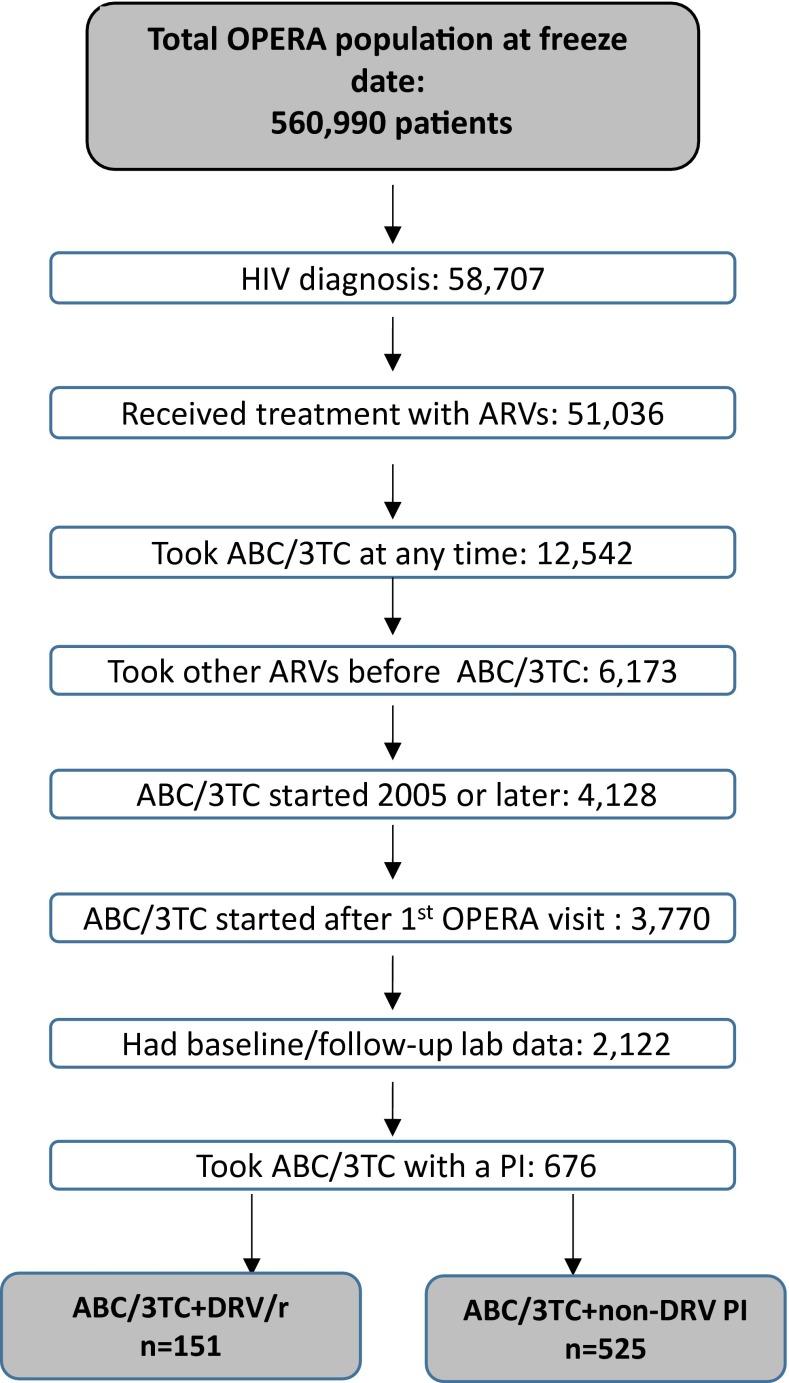
Treatment-experienced HIV-infected patients initiating their first regimen containing ABC/3TC in combination with any PI in the year 2005 or later were selected from the Observational Pharmaco-Epidemiology Research and Analysis (OPERA) cohort, a prospective observational cohort reflecting routine medical care. Viral load measurements taken during follow-up were compared between patients taking ABC/3TC + DRV/r and ABC/3TC with a PI other than DRV/r. Logistic regression models were fit to assess the association between regimen exposure and viral load suppression.
RESULTS
A total of 151 patients initiating ABC/3TC + DRV/r and 525 patients initiating ABC/3TC + a non-darunavir PI were included. Patients in both treatment groups had comparable clinical indicators (viral load, CD4) at baseline. A regimen of ABC/3TC + DRV/r was more likely to be prescribed in the later years of the study period, leading to a shorter median follow-up in the DRV/r treatment group (as-treated analysis: 14 vs. 17 months, p = 0.04; intent-to-treat analysis: 33 vs. 68 months, p < 0.001). Multivariable logistic regression models accounting for year of regimen initiation, among other factors, indicated no statistically significant differences in achieving an undetectable viral load for patients taking DRV/r with ABC/3TC compared with other PIs, both in the as-treated (odds ratio [95 % confidence interval]: 0.84 [0.53-1.34]) and intent-to-treat analyses (0.82 [0.48-1.40]). Patients in both treatment groups also showed similar reductions in viral load (median darunavir vs. non-darunavir: -23.0 vs. -23.0 copies/mL; p = 0.72) and gains in CD4 T cell counts (median darunavir vs. non-darunavir: 106 vs. 108 cells/mm; p = 0.59] while being treated with the regimen of interest.
CONCLUSIONS
Patients receiving ABC/3TC + DRV/r appear to experience similar treatment benefit to patients taking ABC/3TC with other PIs in terms of achieving suppression, as well as absolute reductions in viral load and CD4 lymphocyte gains.
背景与目的
艾滋病病毒(HIV)治疗的标准护理方案是一种三联药物疗法,由两种核苷类逆转录酶抑制剂(NRTIs)和一种非核苷类逆转录酶抑制剂、蛋白酶抑制剂(PI)或整合酶链转移抑制剂组成。达芦那韦与利托那韦联用(DRV/r)是美国卫生与公众服务部(DHHS)针对未接受过抗逆转录病毒治疗患者的HIV治疗指南中唯一推荐的首选PI,推荐与替诺福韦/恩曲他滨联合用于未接受过抗逆转录病毒治疗的患者。对于有治疗经验的患者以及某些未接受过抗逆转录病毒治疗的患者,阿巴卡韦和拉米夫定(ABC/3TC)与DRV/r联合使用被认为是一种有效且耐受性良好的替代方案,尽管关于这种特定联合用药有效性的研究有限。本研究评估了接受ABC/3TC + DRV/r治疗的有治疗经验患者与接受ABC/3TC联合任何其他PI治疗的有治疗经验患者的病毒学结局。
方法
从观察性药物流行病学研究与分析(OPERA)队列中选取2005年或之后开始其首个包含ABC/3TC联合任何PI治疗方案的有治疗经验的HIV感染患者,该队列是一个反映常规医疗护理的前瞻性观察队列。比较接受ABC/3TC + DRV/r治疗的患者与接受ABC/3TC联合DRV/r以外PI治疗的患者在随访期间的病毒载量测量值。采用逻辑回归模型评估治疗方案暴露与病毒载量抑制之间的关联。
结果
共纳入151例开始接受ABC/3TC + DRV/r治疗的患者和525例开始接受ABC/3TC + 一种非达芦那韦PI治疗的患者。两个治疗组的患者在基线时具有可比的临床指标(病毒载量、CD4细胞计数)。在研究期的后期更有可能开具ABC/3TC + DRV/r方案,导致DRV/r治疗组的中位随访时间较短(实际治疗分析:14个月对17个月,p = 0.04;意向性治疗分析:33个月对68个月,p < 0.001)。在考虑治疗方案起始年份等因素的多变量逻辑回归模型中,接受ABC/3TC联合DRV/r治疗的患者与接受其他PI治疗的患者在实现病毒载量不可检测方面无统计学显著差异,实际治疗分析(比值比[95%置信区间]:0.84[0.53 - 1.34])和意向性治疗分析(0.82[0.48 - 1.40])均如此。两个治疗组的患者在接受相关治疗方案治疗期间病毒载量的下降幅度也相似(达芦那韦组与非达芦那韦组的中位数:-23.0对-23.0拷贝/mL;p = 0.72),CD4 T细胞计数的增加幅度也相似(达芦那韦组与非达芦那韦组的中位数:106对108个细胞/mm³;p = 0.59)。
结论
在实现病毒载量抑制以及病毒载量的绝对下降和CD4淋巴细胞增加方面,接受ABC/3TC + DRV/r治疗的患者与接受ABC/3TC联合其他PI治疗的患者似乎具有相似的治疗获益。
 Zotero 插件