
HuR基因沉默引发氧化应激和DNA损伤,并使人类三阴性乳腺癌细胞对放疗敏感。
HuR silencing elicits oxidative stress and DNA damage and sensitizes human triple-negative breast cancer cells to radiotherapy.
作者信息
Mehta Meghna, Basalingappa Kanthesh, Griffith James N, Andrade Daniel, Babu Anish, Amreddy Narsireddy, Muralidharan Ranganayaki, Gorospe Myriam, Herman Terence, Ding Wei-Qun, Ramesh Rajagopal, Munshi Anupama
机构信息
Department of Radiation Oncology, The University of Oklahoma Health Sciences Center, Oklahoma City, Oklahoma, USA.
Department of Pathology, The University of Oklahoma Health Sciences Center, Oklahoma City, Oklahoma, USA.
出版信息
Oncotarget. 2016 Oct 4;7(40):64820-64835. doi: 10.18632/oncotarget.11706.
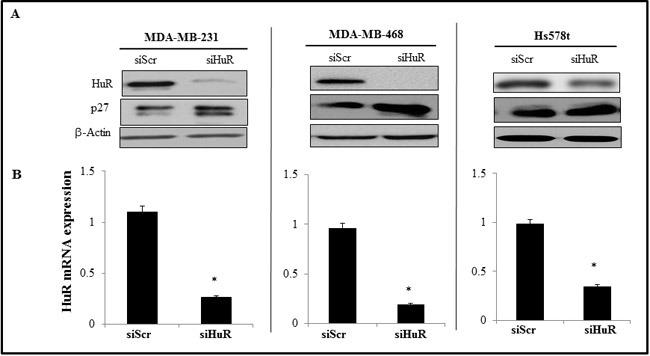
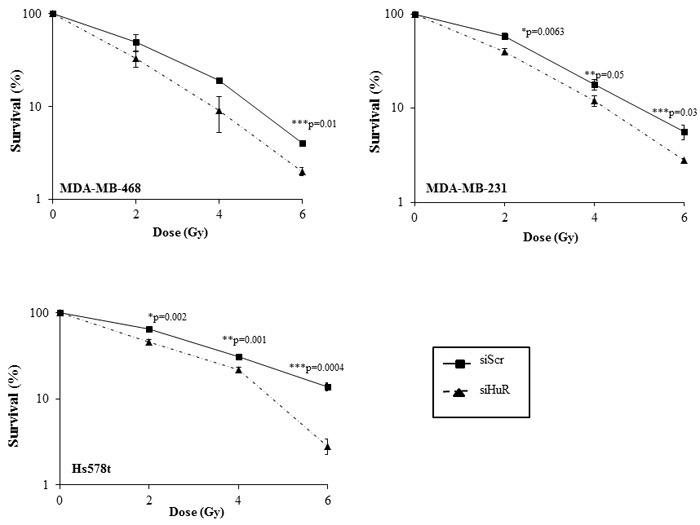
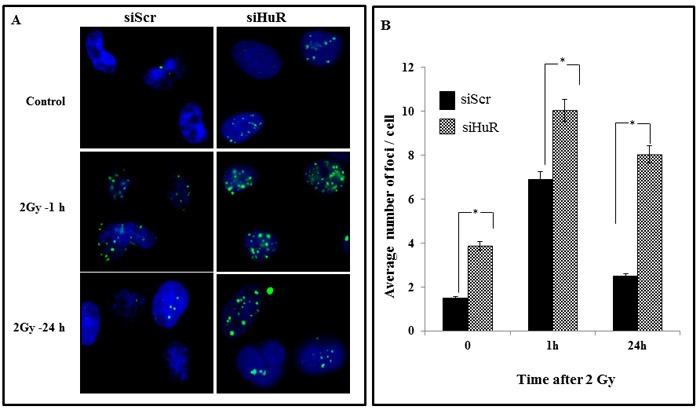
HuR is an mRNA-binding protein whose overexpression in cancer cells has been associated with poor prognosis and resistance to therapy. While reports on HuR overexpression contributing to chemoresistance exist, limited information is available on HuR and radioresistance especially in triple-negative breast cancer (TNBC).In this study we investigated the role of HuR in radiation resistance in three TNBC (MDA-MB-231, MDA-MB-468 and Hs578t) cell lines. Endogenous HuR expression was higher in TNBC cells compared to normal cells. siRNA mediated knockdown of HuR (siHuR) markedly reduced HuR mRNA and protein levels compared to scrambled siRNA (siScr) treatment. Further, siHuR treatment sensitized TNBC cells to ionizing radiation at 2 Gy compared to siScr treatment as evidenced by the significant reduction in clonogenic cell survival from 59%, 49%, and 65% in siScr-treated cells to 40%, 33%, and 46% in siHuR-treated MDA-MB-231, MDA-MB-468 and Hs578t cells, respectively. Molecular studies showed increased ROS production and inhibition of thioredoxin reductase (TrxR) in HuR knockdown cells contributed to radiosensitization. Associated with increased ROS production was evidence of increased DNA damage, demonstrated by a significant increase (p < 0.05) in γ-H2AX foci that persisted for up to 24 h in siHuR plus radiation treated cells compared to control cells. Further, comet assay revealed that HuR-silenced cells had larger and longer-lasting tails than control cells, indicating higher levels of DNA damage. In conclusion, our studies demonstrate that HuR knockdown in TNBC cells elicits oxidative stress and DNA damage resulting in radiosensitization.
HuR是一种mRNA结合蛋白,其在癌细胞中的过表达与预后不良和治疗耐药性相关。虽然有关于HuR过表达导致化疗耐药的报道,但关于HuR与放射抗性的信息有限,尤其是在三阴性乳腺癌(TNBC)中。在本研究中,我们调查了HuR在三种TNBC(MDA-MB-231、MDA-MB-468和Hs578t)细胞系的放射抗性中的作用。与正常细胞相比,TNBC细胞中内源性HuR表达更高。与乱序siRNA(siScr)处理相比,siRNA介导的HuR敲低(siHuR)显著降低了HuR mRNA和蛋白水平。此外,与siScr处理相比,siHuR处理使TNBC细胞对2 Gy的电离辐射敏感,这通过克隆形成细胞存活率从siScr处理细胞中的59%、49%和65%分别显著降低到siHuR处理的MDA-MB-231、MDA-MB-468和Hs578t细胞中的40%、33%和46%得到证明。分子研究表明,HuR敲低细胞中活性氧(ROS)产生增加和硫氧还蛋白还原酶(TrxR)受到抑制有助于放射增敏。与ROS产生增加相关的是DNA损伤增加的证据,与对照细胞相比,在siHuR加辐射处理的细胞中,γ-H2AX焦点显著增加(p < 0.05),并持续长达24小时。此外,彗星试验显示,HuR沉默的细胞比对照细胞有更大、更持久的尾巴,表明DNA损伤水平更高。总之,我们的研究表明,TNBC细胞中HuR敲低引发氧化应激和DNA损伤,从而导致放射增敏。




 Zotero 插件