
2012年4月至2014年3月英格兰大肠杆菌菌血症的描述性流行病学
Descriptive epidemiology of Escherichia coli bacteraemia in England, April 2012 to March 2014.
作者信息
Bou-Antoun Sabine, Davies John, Guy Rebecca, Johnson Alan P, Sheridan Elizabeth A, Hope Russell J
机构信息
Department of Healthcare Associated Infections and Antimicrobial Resistance, Centre for Infectious Disease Surveillance and Control, National Infection Service, Public Health England, United Kingdom.
出版信息
Euro Surveill. 2016 Sep 1;21(35). doi: 10.2807/1560-7917.ES.2016.21.35.30329.
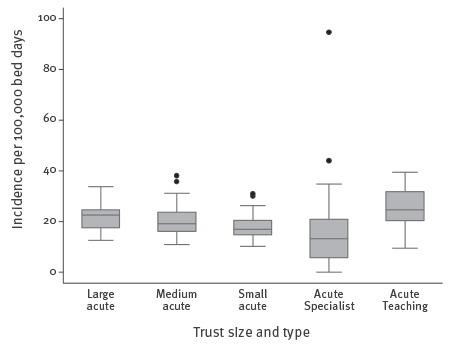
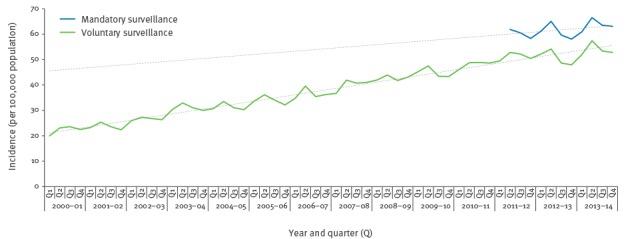
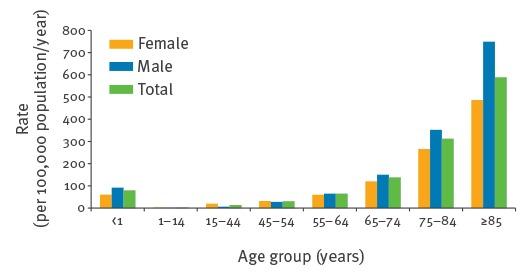
We determined the incidence, risk factors and antimicrobial susceptibility associated with Escherichia coli bacteraemia in England over a 24 month period. Case data were obtained from the national mandatory surveillance database, with susceptibility data linked from LabBase2, a voluntary national microbiology database. Between April 2012 and March 2014, 66,512 E. coli bacteraemia cases were reported. Disease incidence increased by 6% from 60.4 per 100,000 population in 2012-13 to 63.5 per 100,000 population in 2013-14 (p < 0.0001). Rates of E. coli bacteraemia varied with patient age and sex, with 70.5% (46,883/66,512) of cases seen in patients aged ≥ 65 years and 52.4% (33,969/64,846) of cases in females. The most common underlying cause of bacteraemia was infection of the genital/urinary tract (41.1%; 27,328/66,512), of which 98.4% (26,891/27,328) were urinary tract infections (UTIs). The majority of cases (76.1%; 50,617/66,512) had positive blood cultures before or within two days of admission and were classified as community onset cases, however 15.7% (10,468/66,512) occurred in patients who had been hospitalised for over a week. Non-susceptibility to ciprofloxacin, third-generation cephalosporins, piperacillin-tazobactam, gentamicin and carbapenems were 18.4% (8,439/45,829), 10.4% (4,256/40,734), 10.2% (4,694/46,186), 9.7% (4,770/49,114) and 0.2% (91/42,986), respectively. Antibiotic non-susceptibility was higher in hospital-onset cases than for those presenting from the community (e.g. ciprofloxacin non-susceptibility was 22.1% (2,234/10,105) for hospital-onset vs 17.4% (5,920/34,069) for community-onset cases). Interventions to reduce the incidence of E. coli bacteraemia will have to target the community setting and UTIs if substantial reductions are to be realised.
我们确定了英格兰地区24个月内与大肠杆菌败血症相关的发病率、风险因素及抗菌药物敏感性。病例数据来自国家强制性监测数据库,药敏数据则来自自愿性全国微生物数据库LabBase2。2012年4月至2014年3月期间,共报告了66512例大肠杆菌败血症病例。发病率从2012 - 2013年每10万人60.4例增加了6%,至2013 - 2014年每10万人63.5例(p < 0.0001)。大肠杆菌败血症发病率因患者年龄和性别而异,65岁及以上患者中70.5%(46883/66512)的病例被确诊,女性患者中52.4%(33969/64846)的病例被确诊。败血症最常见的潜在病因是生殖/泌尿系统感染(41.1%;27328/66512),其中98.4%(26891/27328)为尿路感染(UTIs)。大多数病例(76.1%;50617/66512)在入院前或入院两天内血培养呈阳性,被归类为社区发病病例,然而15.7%(10468/66512)的病例发生在住院超过一周的患者中。对环丙沙星、第三代头孢菌素、哌拉西林 - 他唑巴坦、庆大霉素和碳青霉烯类药物的不敏感性分别为18.4%(8439/45829)、10.4%(4256/40734)、10.2%(4694/46186)、9.7%(4770/49114)和0.2%(91/42986)。医院发病病例的抗生素不敏感性高于社区发病病例(例如,环丙沙星不敏感性在医院发病病例中为22.1%(2234/10105),而在社区发病病例中为17.4%(5920/34069))。如果要大幅降低大肠杆菌败血症的发病率,减少其发病率的干预措施必须针对社区环境和尿路感染。

 Zotero 插件