
神经母细胞瘤中的碘-间位碘代苄胍闪烁显像:国际专家组开发的一项欧洲小儿肿瘤学会协作组半定量报告方法
I-mIBG scintigraphy in neuroblastoma: development of a SIOPEN semi-quantitative reporting ,method by an international panel.
作者信息
Lewington V, Lambert B, Poetschger U, Sever Z Bar, Giammarile F, McEwan A J B, Castellani Rita, Lynch T, Shulkin B, Drobics M, Staudenherz A, Ladenstein R
机构信息
King's College, London, UK.
Radiology and Nuclear Medicine, Ghent University, Ghent, Belgium.
出版信息
Eur J Nucl Med Mol Imaging. 2017 Feb;44(2):234-241. doi: 10.1007/s00259-016-3516-0. Epub 2016 Sep 24.
PURPOSE
A robust method is required to standardise objective reporting of diagnostic I-mIBG images in neuroblastoma. Prerequisites for an appropriate system are low inter- and intra-observer error and reproducibility across a broad disease spectrum. We present a new reporting method, developed and tested for SIOPEN by an international expert panel.
METHOD
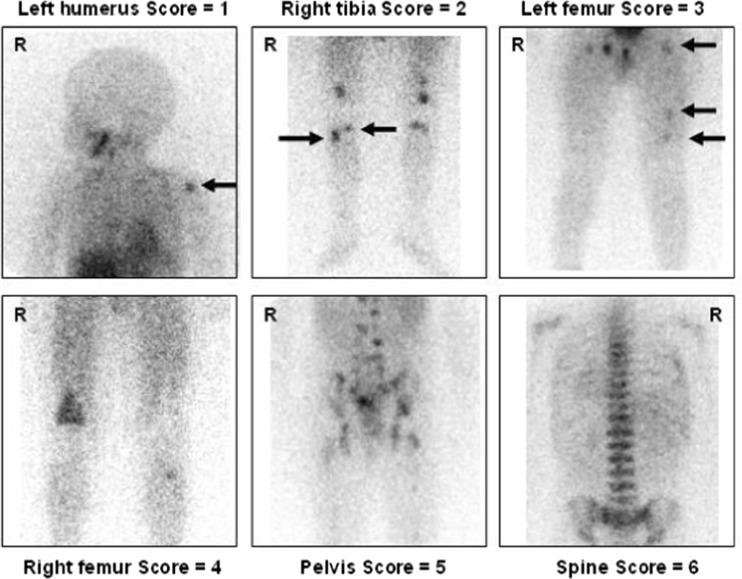
Patterns of abnormal skeletal I-mIBG uptake were defined and assigned numerical scores [0-6] based on disease extent within 12 body segments. Uptake intensity was excluded from the analysis. Data sets from 82 patients were scored independently by six experienced specialists as unblinded pairs (pre- and post-induction chemotherapy) and in random order as a blinded study. Response was defined as ≥50 % reduction in post induction score compared with baseline.
RESULTS
In total, 1968 image sets were reviewed individually. Response rates of 88 % and 82 % were recorded for patients with baseline skeletal scores ≤23 and 24-48 respectively, compared with 44 % response in patients with skeletal scores >48 (p = 0.02). Reducing the number of segments or extension scale had a small but statistically negative impact upon the number of responses detected. Intraclass correlation coefficients [ICCs] calculated for the unblinded and blinded study were 0.95 at diagnosis and 0.98 and 0.99 post-induction chemotherapy, respectively.
CONCLUSIONS
The SIOPEN mIBG score method is reproducible across the full spectrum of disease in high risk neuroblastoma. Numerical assessment of skeletal disease extent avoids subjective evaluation of uptake intensity. This robust approach provides a reliable means with which to examine the role of 123I mIBG scintigraphy as a prognostic indicator in neuroblastoma.
目的
需要一种可靠的方法来规范神经母细胞瘤诊断性I-间碘苄胍(I-mIBG)图像的客观报告。一个合适系统的先决条件是观察者间和观察者内误差低,并且在广泛的疾病谱中具有可重复性。我们提出了一种新的报告方法,由一个国际专家小组为国际小儿肿瘤学会欧洲神经母细胞瘤研究组(SIOPEN)开发并进行了测试。
方法
根据12个身体节段内的疾病范围,定义异常骨骼I-mIBG摄取模式并赋予数值评分[0 - 6]。摄取强度被排除在分析之外。82例患者的数据集由6位经验丰富的专家作为非盲对(诱导化疗前后)独立评分,并作为盲法研究按随机顺序评分。反应定义为诱导后评分与基线相比降低≥50%。
结果
总共对1968套图像进行了单独审查。基线骨骼评分≤23和24 - 48的患者的反应率分别记录为88%和82%,而骨骼评分>48的患者的反应率为44%(p = 0.02)。减少节段数量或扩展尺度对检测到的反应数量有微小但统计学上的负面影响。非盲和盲法研究计算的组内相关系数(ICC)在诊断时为0.95,诱导化疗后分别为0.98和0.99。
结论
SIOPEN mIBG评分方法在高危神经母细胞瘤的全疾病谱中具有可重复性。骨骼疾病范围的数值评估避免了对摄取强度的主观评估。这种可靠的方法提供了一种可靠的手段,用以研究1碘-123间碘苄胍闪烁显像作为神经母细胞瘤预后指标 的作用。


 Zotero 插件