
根管感染的真菌组与细菌组相关。
The mycobiome of root canal infections is correlated to the bacteriome.
机构信息
Department of Preventive Dentistry, Academic Centre for Dentistry Amsterdam (ACTA), University of Amsterdam and Vrije Universiteit Amsterdam, Gustav Mahlerlaan 3004, 1081, LA, Amsterdam, The Netherlands.
Department of Endodontology, Academic Centre for Dentistry Amsterdam (ACTA), University of Amsterdam and Vrije Universiteit Amsterdam, Gustav Mahlerlaan 3004, 1081, LA, Amsterdam, The Netherlands.
出版信息
Clin Oral Investig. 2017 Jun;21(5):1871-1881. doi: 10.1007/s00784-016-1980-3. Epub 2016 Oct 22.
OBJECTIVES
Bacterial infection of the root canal system causes apical periodontitis. Less is known about the role of fungi in these infections. This study aimed to assess the fungal prevalence, abundance, and diversity of root canal infections, as well as the relation between fungi and bacteria present in different parts of the root canal.
MATERIALS AND METHODS
Twenty-six teeth with primary apical periodontitis were extracted, split in apical and coronal root segments, and cryo-pulverized. Bacteriome profiles of 23 teeth were analyzed based on the V3-V4 hypervariable region of the 16S ribosomal RNA gene. Mycobiome profiles of six teeth were analyzed based on the internal transcribed spacer (ITS) 1 or ITS2 region. Samples were sequenced on the Illumina MiSeq platform.
RESULTS
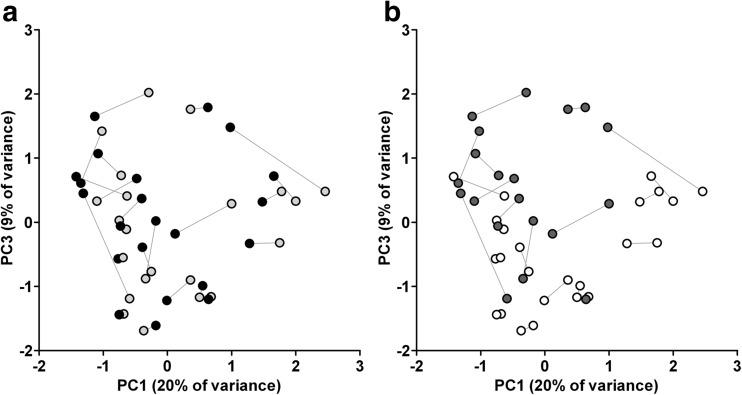
A total of 338 bacterial operational taxonomic units (OTUs), 28 ITS1 OTUs, and 24 ITS2 OTUs were identified. Candida and Malassezia were the most frequently identified fungi. No differences could be found between the bacteriome and mycobiome profiles of the apical and coronal root segments. The bacteriome of fungi-positive root segments contained more Actinomyces, Bifidobacterium, four different Lactobacillus OTUs, Propionibacterium, and Streptococcus. A Spearman correlation matrix between bacteriomes and mycobiomes identified no correlations, but separate clusters could be observed.
CONCLUSIONS
A considerable proportion of the root canal infections contain fungi, although fungal diversity is limited. However, when fungi are present, the composition of the bacteriome is clearly different.
CLINICAL RELEVANCE
Interaction between bacteria and fungi in root canal infections may complicate the infection and require alternative treatment strategies.
目的
根管系统的细菌感染会导致根尖周炎。关于真菌在这些感染中的作用知之甚少。本研究旨在评估根管感染的真菌患病率、丰度和多样性,以及根管不同部位存在的真菌与细菌之间的关系。
材料和方法
从 26 例患有原发性根尖周炎的牙齿中提取并分为根尖和冠根段,然后进行冷冻粉碎。根据 16S 核糖体 RNA 基因的 V3-V4 高变区分析了 23 颗牙齿的细菌组谱。根据内部转录间隔区(ITS)1 或 ITS2 区分析了 6 颗牙齿的真菌组谱。样品在 Illumina MiSeq 平台上进行测序。
结果
共鉴定出 338 个细菌操作分类单元(OTU)、28 个 ITS1 OTU 和 24 个 ITS2 OTU。最常鉴定到的真菌是假丝酵母属和马拉色菌属。根尖和冠根段的细菌组谱和真菌组谱之间没有差异。真菌阳性根段的细菌组谱中含有更多的放线菌、双歧杆菌、四个不同的乳酸杆菌 OTU、丙酸杆菌和链球菌。细菌组谱和真菌组谱之间的 Spearman 相关矩阵未发现相关性,但可以观察到单独的聚类。
结论
尽管真菌多样性有限,但相当一部分根管感染含有真菌。然而,当真菌存在时,细菌组谱的组成明显不同。
临床意义
根管感染中细菌和真菌的相互作用可能使感染复杂化,需要采用替代治疗策略。



 Zotero 插件