
产超广谱β-内酰胺酶革兰阴性菌所致尿路感染的特征:在爱尔兰都柏林南部将匹美西林作为一种治疗选择
Characteristics of gram-negative urinary tract infections caused by extended spectrum beta lactamases: pivmecillinam as a treatment option within South Dublin, Ireland.
作者信息
O'Kelly Fardod, Kavanagh Siobhan, Manecksha Rustom, Thornhill John, Fennell Jérôme P
机构信息
Department of Urological Surgery, AMNCH, Tallaght Hospital, Dublin 24, Ireland.
Department of Clinical Microbiology, AMNCH, Tallaght Hospital, Dublin 24, Ireland.
出版信息
BMC Infect Dis. 2016 Nov 3;16(1):620. doi: 10.1186/s12879-016-1797-3.
BACKGROUND
The prevalence of urinary tract infections (UTIs) caused by extended-spectrum β-lactamase (ESBL)-producing Enterobacteriaceae is increasing and the therapeutic options are limited, especially in primary care. Recent indications have suggested pivmecillinam to be a suitable option. This pilot study aimed to assess the viability of pivmecillinam as a therapeutic option in a Dublin cohort of mixed community and healthcare origin.
METHODS
A prospective measurement of mean and fractional inhibitory concentrations of antibiotic use in 95 patients diagnosed with UTI caused by ESBL-producing Enterobacteriaceae was carried out. 36 % patients were from general practice, 40 % were admitted to hospital within south Dublin, and 25 % samples arose from nursing homes. EUCAST breakpoints were used to determine if an isolate was sensitive or resistant to antibiotic agents.
RESULTS
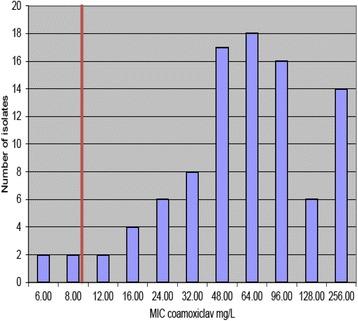
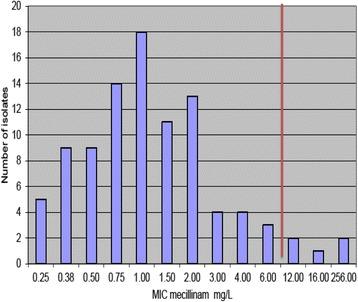
Sixty-nine percent of patients (N = 66) with urinary ESBL isolates were female. The mean age of females was 66 years compared with a mean age of 74 years for males. Thirty-six percent of isolates originated from primary care, hospital inpatients (26 %), and nursing homes (24 %). The vast majority of ESBL isolates were E. coli (80 %). The E tests for mecillinam and co-amoxiclav had concentration ranges from 0.16 mg/L up to 256 mg/L. The mean inhibitory concentration (MIC) of mecillinam ranged from 0.25 to 256 mg/L, while co-amoxiclav MICs ranged from 6 to 256 mg/L. The percentage of isolates resistant to mecillinam and co-amoxiclav was found to be 5.26 and 94.74 % respectively.
CONCLUSIONS
This is the first study exploring the use of pivmecillinam in an Irish cohort and has demonstrated that its use in conjunction with or without co-amoxiclav is an appropriate and useful treatment for urinary tract infections caused by ESBL-producing organisms.
背景
由产超广谱β-内酰胺酶(ESBL)的肠杆菌科细菌引起的尿路感染(UTI)患病率正在上升,治疗选择有限,尤其是在初级保健中。最近的迹象表明匹美西林是一种合适的选择。这项初步研究旨在评估匹美西林作为都柏林一组混合社区和医疗保健来源人群的治疗选择的可行性。
方法
对95例诊断为由产ESBL的肠杆菌科细菌引起的UTI患者使用抗生素的平均抑制浓度和分数抑制浓度进行前瞻性测量。36%的患者来自全科医疗,40%在都柏林南部住院,25%的样本来自疗养院。采用欧洲抗菌药物敏感性试验委员会(EUCAST)的断点来确定分离株对抗生素的敏感或耐药情况。
结果
尿ESBL分离株患者中有69%(N = 66)为女性。女性的平均年龄为66岁,男性为74岁。36%的分离株来自初级保健机构,26%来自住院患者,24%来自疗养院。绝大多数ESBL分离株为大肠杆菌(80%)。美西林和阿莫西林克拉维酸的E试验浓度范围为0.16 mg/L至256 mg/L。美西林的平均抑制浓度(MIC)范围为0.25至256 mg/L,而阿莫西林克拉维酸的MIC范围为6至256 mg/L。发现对美西林和阿莫西林克拉维酸耐药的分离株百分比分别为5.26%和94.74%。
结论
这是第一项探索在爱尔兰人群中使用匹美西林的研究,结果表明,无论是否联合使用阿莫西林克拉维酸,匹美西林都是治疗由产ESBL细菌引起的尿路感染的一种合适且有效的治疗方法。
 Zotero 插件