
阿奇霉素-氯喹固定剂量复方在无症状恶性疟原虫血症孕妇中的寄生虫清除率和药物浓度:撒哈拉以南非洲的一项开放标签、非对照研究
Parasitological Clearance Rates and Drug Concentrations of a Fixed Dose Combination of Azithromycin-Chloroquine in Asymptomatic Pregnant Women with Plasmodium Falciparum Parasitemia: An Open-Label, Non-Comparative Study in Sub-Saharan Africa.
作者信息
Phiri Kamija, Kimani Joshua, Mtove George A, Zhao Qinying, Rojo Ricardo, Robbins Jeffery, Duparc Stephan, Ayoub Ayman, Vandenbroucke Pol
机构信息
College of Medicine, University of Malawi, Blantyre, Malawi.
College of Health Sciences, University of Nairobi, Nairobi, Kenya.
出版信息
PLoS One. 2016 Nov 18;11(11):e0165692. doi: 10.1371/journal.pone.0165692. eCollection 2016.
BACKGROUND
Malaria remains one of the most important causes of morbidity and mortality in pregnant women and their newborn babies in sub-Saharan Africa. Intermittent preventive treatment in pregnancy (IPTp) is recommended by the World Health Organization (WHO) to reduce the burden of disease and improve maternal and neonatal survival and general health. Due to the growing resistance to sulfadoxine-pyrimethamine (SP), the current WHO-recommended drug for IPTp, identification of new and effective drugs is an urgent priority.
METHODS AND FINDINGS
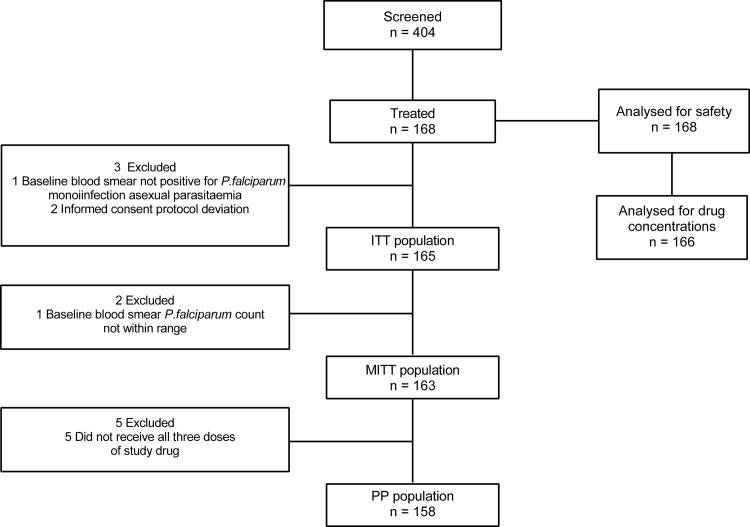
This was an open-label, non-comparative study (NCT01103713) in 5 countries in East and sub-Saharan Africa (Benin, Kenya, Malawi, Tanzania, and Uganda) to assess parasitological response and drug concentrations of a single, 3-day course of four tablets of a fixed-dose combination of azithromycin-chloroquine (AZCQ) 250/155 mg given during the second or third trimester to women with asymptomatic Plasmodium falciparum parasitemia in their first or second pregnancy. Parasitemia was determined by microscopy and molecular genotyping was performed to characterize parasites relative to the baseline infection. Weekly follow-up visits took place until day 42 after first dose and additional follow-up occurred after delivery. Systemic concentrations of azithromycin (AZ), chloroquine (CQ), and the CQ metabolite, desethyl CQ (DECQ) were evaluated at Day 0 (pre-dose), at Day 2 (pre-dose, 2 and 8 hours) and randomly at Days 7 and 14. Systemic concentrations of CQ and DECQ were also measured randomly at Day 21 and Day 28. In total, 404 women were screened for eligibility and 168 were treated, 155 of whom completed the study. PCR-adjusted parasitological response in the modified intent-to-treat population at day 28 (the primary efficacy endpoint) was estimated by the Kaplan-Meier method as 99.35% (95% confidence interval [CI]: 97.76, 100.00). PCR-adjusted parasitological response remained high at day 42 (95.19%; 95% CI: 91.35, 99.03). In general, the mean concentrations of serum AZ, plasma CQ, and plasma DECQ showed large CV% values (ranges of 33-156%, 42-228%, and 57-109%, respectively). There were 157 live births, three stillbirths, and eight pregnancies of unknown outcome: 7 due to withdrawal of participant consent and 1 lost to follow-up. The most frequent treatment-emergent adverse events were vomiting (20.8%) and dizziness (19.6%).
CONCLUSIONS
These results suggest that a 3-day course of AZCQ can lead to an adequate 28-day parasitological response.
背景
在撒哈拉以南非洲地区,疟疾仍然是孕妇及其新生儿发病和死亡的最重要原因之一。世界卫生组织(WHO)建议采用孕期间歇性预防治疗(IPTp)来减轻疾病负担,提高孕产妇和新生儿的存活率以及整体健康水平。由于对目前WHO推荐用于IPTp的磺胺多辛-乙胺嘧啶(SP)的耐药性不断增加,鉴定新的有效药物成为当务之急。
方法与结果
这是一项在东非和撒哈拉以南非洲5个国家(贝宁、肯尼亚、马拉维、坦桑尼亚和乌干达)开展的开放标签、非对照研究(NCT01103713),旨在评估单剂量、为期3天、服用4片250/155mg阿奇霉素-氯喹(AZCQ)固定剂量组合药物的寄生虫学反应和药物浓度,该药物在孕中期或晚期给予首次或第二次怀孕且无症状恶性疟原虫血症的妇女。通过显微镜检查确定疟原虫血症,并进行分子基因分型以根据基线感染情况对寄生虫进行特征描述。在首次给药后直至第42天每周进行随访,分娩后进行额外随访。在第0天(给药前)、第2天(给药前、2小时和8小时)以及在第7天和第14天随机评估阿奇霉素(AZ)、氯喹(CQ)及其代谢产物去乙基氯喹(DECQ)的全身浓度。在第21天和第28天也随机测量CQ和DECQ的全身浓度。总共筛选了404名妇女以确定其是否符合条件,168名妇女接受了治疗,其中155名完成了研究。采用Kaplan-Meier方法估计,在改良意向性治疗人群中,第28天(主要疗效终点)经PCR调整的寄生虫学反应为99.35%(95%置信区间[CI]:97.76,100.00)。在第42天,经PCR调整的寄生虫学反应仍然很高(95.19%;95%CI:91.35,99.03)。总体而言,血清AZ、血浆CQ和血浆DECQ的平均浓度显示出较大的CV%值(分别为33 - 156%、42 - 228%和57 - 109%)。有157例活产、3例死产和8例妊娠结局不明:7例是由于参与者撤回同意,1例失访。最常见的治疗中出现的不良事件是呕吐(20.8%)和头晕(19.6%)。
结论
这些结果表明,为期3天的AZCQ疗程可导致充分的28天寄生虫学反应。
 Zotero 插件